
LONDON — UK government borrowing has come in below economists’ forecasts, allowing the Treasury to celebrate a billion pounds that exists chiefly as the difference between how much trouble Britain expected and how much trouble it actually ordered.
Civil servants prepared a modest reception, with champagne replaced by a photograph of champagne that procurement had expected to cost more.
The country’s overdraft was invited to say a few words.
UK government borrowing beats the gloomy estimate
Reuters’ report on the October public finances put borrowing at £17 billion, against an £18 billion median forecast. Earlier months were also revised down. Debt interest remained a significant pressure.
The figures offer a real improvement against expectations. They do not mean Britain received a spare billion in an envelope.
Treasury celebration adviser Giles Margin said the distinction was unhelpfully literal.
“If I tell my wife I have lost eighteen garden chairs at the pub, and come home missing only seventeen, I have delivered a chair,” he explained. His wife has asked that he stop advising the government until he finds the other seventeen.
The national counterfactual savings account
Officials have proposed opening an account containing everything they thought might go wrong but did not.
Its initial assets include a less expensive roof repair, several unclaimed worst-case scenarios and an estimate for a railway nobody approved. The account has enormous purchasing power, provided the supplier also accepts estimates.
A Treasury demonstration showed that moving a forecast line upwards makes the eventual outcome appear more comfortable. Moving the actual borrowing line downwards was described as the next phase.
Our survey of three people looking at the chart found that all preferred the smaller number. One asked whether it would lower his tax bill and was removed from the presentation for trying to turn analysis into a transaction.
Households try the new fiscal technique
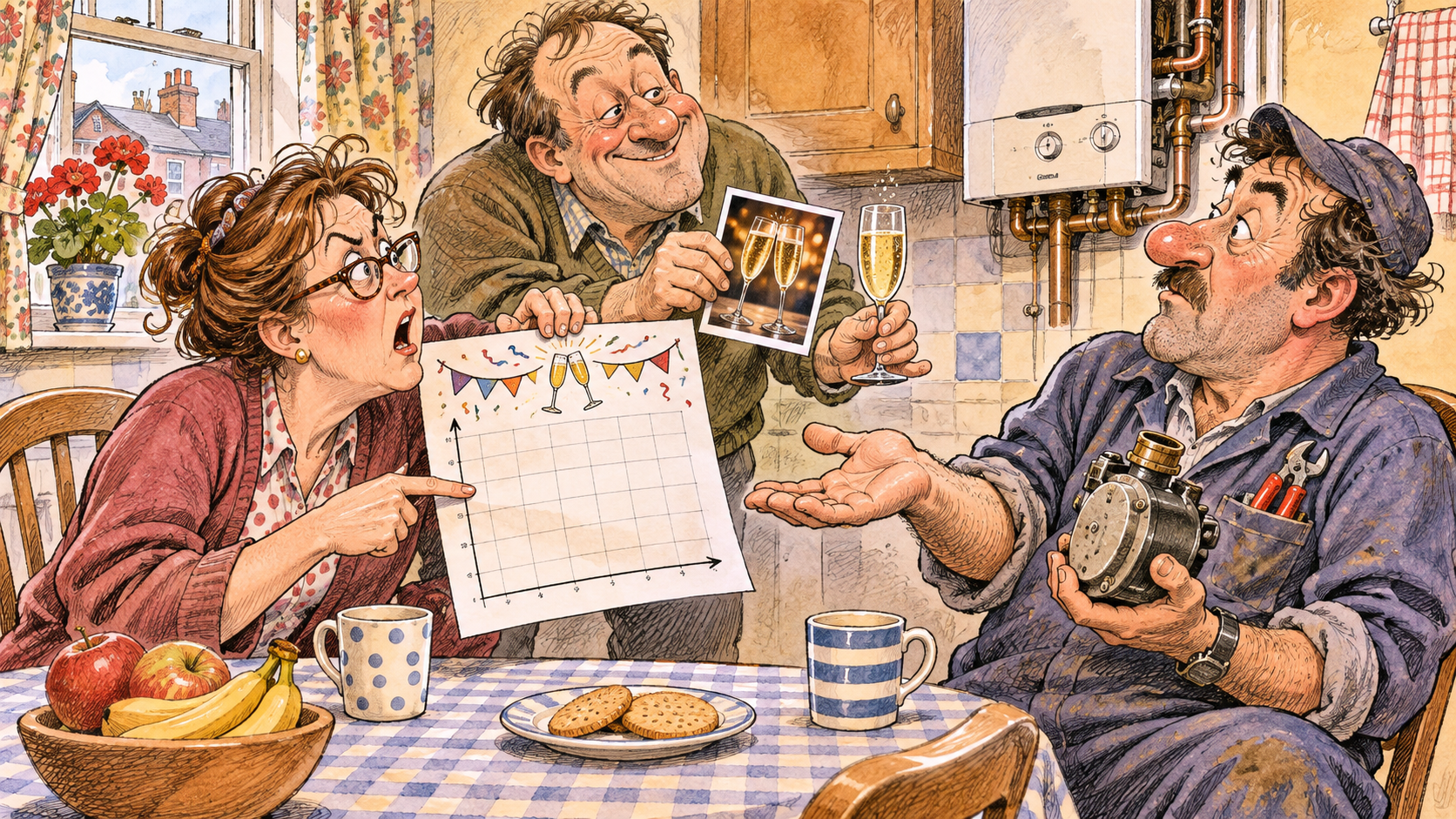
Accounts clerk Deborah Moss tested the approach after spending less than expected on a broken boiler.
“I budgeted for eight hundred and the plumber charged seven hundred,” she said. “Apparently I am now a hundred pounds richer. My bank says I’m seven hundred pounds poorer. One of them needs better messaging.”
She attempted to settle the invoice by showing the plumber the forecast.
He said the forecast looked lovely and asked for seven hundred pounds.
This illustrates the gap between measuring an improvement and possessing cash. A less steep staircase is welcome; it is still an unfortunate thing to fall down.
Interest sends its apologies
The national interest bill declined an invitation to the party because it was busy growing in a different column.
Ministers insisted that fiscal credibility depends on showing direction, discipline and restraint. Margin agreed, saying the reception would include only one speech per pound theoretically saved.
Business owners welcomed any genuine improvement in the public finances. They also requested a version of the announcement that could be understood without first borrowing an economist.
By evening, the Treasury had declared the day a success. The champagne photograph was returned to the supplier.
It had come in under its projected catering budget, creating sufficient savings for a second photograph.
Editorial disclaimer: Satire from an entirely human collaboration between two sentient beings — the world’s oldest tenured professor and a philosophy major turned dairy farmer. Forecast savings cannot be redeemed at the bar, however confidently they are presented.

Harriet Collins is a high-output satirical journalist with a confident editorial voice. Her work demonstrates strong command of tone, pacing, and social commentary, shaped by London’s media and comedy influences.
Authority is built through volume and reader engagement, while expertise lies in blending research with humour. Trustworthiness is supported by clear labelling and responsible satire.