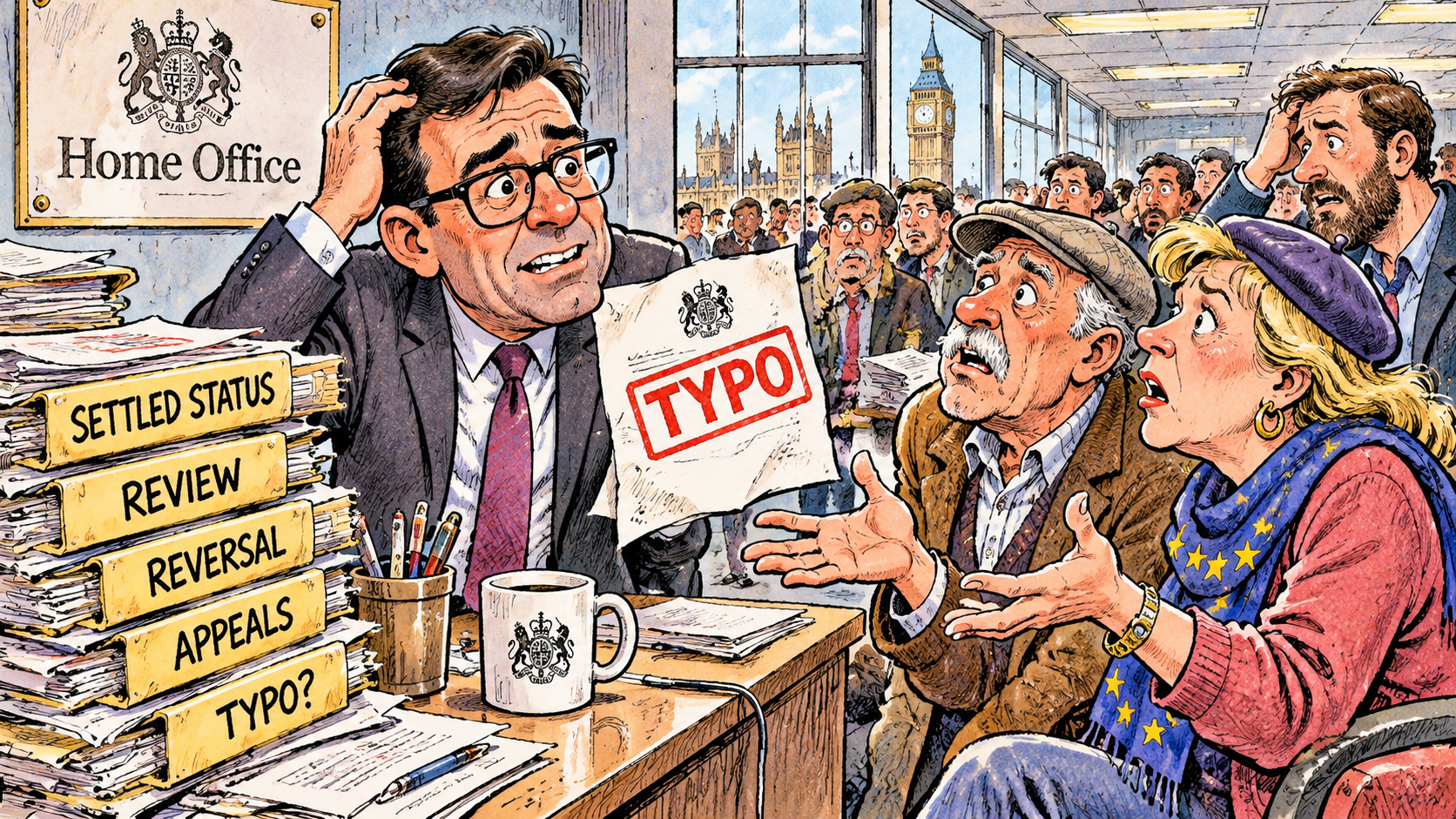
Eight years of living, working and paying taxes in Britain, corrected by a single government typo.
Home Office Tells 1,500 EU Citizens Their Right to Live in Britain Was an Administrative Typo
Residents Discover That Years of Employment, Tax Payments and Family Life May Be Overruled by a Spreadsheet
LONDON (The London Prat) – The Home Office has demonstrated the extraordinary power of British bureaucracy after almost 1,500 EU citizens found their post-Brexit residence rights challenged because officials concluded that earlier immigration decisions had been made in error.
The campaign group the3million has launched legal action, arguing that affected residents were deprived of required procedural protections, according to The Guardian’s report on the EU settlement rights case. The department has not commented on the ongoing proceedings.
Westminster observers have nonetheless praised the episode as a significant advance in the ancient British administrative tradition of correcting a mistake by creating a larger one, a tradition that stretches back to the Domesday Book and its notorious second edition.
You Were Legally Here Until We Reviewed the Meaning of Here
The dispute involves people who received status through the EU settlement scheme and subsequently discovered that their rights were being questioned. Some had spent years working, renting homes, raising families and paying taxes, which in most countries is simply called living there.
A training caseworker, designated Mr Reginald Correction for departmental purposes, explained the principle.
“When we grant somebody permission to stay, that permission is valid until we discover that granting it was inconvenient.”
Asked whether the individuals had deliberately misled officials, Reginald said that was not necessarily the central issue. “The important thing is that we know something now which we might have known previously, had we known it.”
He recommended a further review. He then recommended a review of the review, and finally a review of whether he should have recommended either.
Government Error Becomes Citizen Responsibility
The dispute has highlighted people with Italian citizenship through ancestry who were initially granted immigration status but later challenged over documentation.
Campaigners argue that the authorities must respect legal protections when reconsidering decisions upon which people have built their lives.
Home Office procedures, meanwhile, appear to have developed an unusual understanding of time. A decision made several years ago can apparently become incorrect retrospectively, while the consequences experienced by the person relying on it remain entirely contemporary.
Physicists have expressed professional envy. Their field has spent decades failing to send information backwards in time. Whitehall manages it with a letter template.
A London resident imagining the experience described its implications.
“Suppose I have lived here eight years, paid rent, worked and started a family. Do those years count?”
“Certainly,” replied Reginald.
“Then why is my right to remain in question?”
“Because your paperwork hasn’t been here nearly as long as you have.”
The family kept every document. The department has found a faster way to review them.
The Letter
Reginald demonstrated the department’s latest correspondence, redesigned following customer feedback.
The old letter began, “We regret to inform you.” The new one begins, “Great news! We have found an error.” The error is then revealed to be the recipient.
A helpful leaflet is enclosed, titled Your Past and You. It contains a diagram of a person standing in a kitchen they have occupied for eight years, with a dotted line drawn around them marked “pending.” The leaflet is available in 24 languages, none of which can explain it.
Customer Satisfaction
The department has also launched a feedback survey for affected residents. Question one asks how satisfied they were with the decision to grant their status. Question two asks how satisfied they are with the decision to question it. Question three asks them to confirm their current address, “if you still have one.”
Respondents who complete the survey are entered into a prize draw. The prize is a further review, and the winner will be notified in error.
The Right to Appeal May Require Further Clarification
The legal challenge questions whether affected people received appropriate opportunities to challenge decisions and whether authorities properly considered individual circumstances. These are substantive legal questions, not administrative preferences, and the courts will decide them.
The absurdity arises when ordinary life must somehow be reconciled with an official record that has changed its mind.
Civil servants have reportedly been fascinated by the possibility that an individual’s legal past can be amended while their National Insurance contributions remain untouched.
“Tax history is a separate matter,” Reginald explained. “Money is very real. People are a matter of record.”
At a departmental workshop, officials considered sending affected residents letters confirming they had never legally occupied the houses in which they were currently standing. A second department offered to investigate whether those houses should keep paying council tax. A third sent the residents a Christmas card, which was later recalled as issued in error.
The London Prat’s conclusion: British bureaucracy has perfected the remarkable art of admitting an error while ensuring somebody else experiences all the consequences.
Disclaimer: This is satire aimed squarely at the paperwork, never at the people living with it. The3million’s legal challenge on behalf of almost 1,500 EU citizens is real and serious; Mr Reginald Correction, his cheerful letter template and the recalled Christmas card are not. Wondering why a London paper would call itself something so rude? Read what does prat mean and all will become clear, unlike your Home Office file.
The Lords as Revising Chamber: Case Studies in How the Unelected House Does Its Most Useful Work | The Welfare Reform Bill, the Internal Market Bill, the Counter-Terrorism Bill, and the Specific Moments When Lords Amendments Changed Law for the Better
German Voters Deliver CDU Historic Defeat, Merz Thanks Them for Their Feedback and Changes Absolutely Nothing Chancellor Confirms Strong Electoral Message Successfully Received, Read and Sent Directly to Spam German voters delivered Chancellor Friedrich Merz’s Christian Democratic Union an extraordinarily unpleasant customer-satisfaction survey on Sunday, and the chancellor responded with the traditional reassurance of senior management everywhere: thank you for bringing this to our attention, we intend to continue exactly…
Government promises to make wealthy people pay more, discovers wealthy people can afford airline tickets and properties in countries where the Treasury has considerably less influence LONDON – Britain’s tax authorities have run into a serious problem with their ambitious plans to collect additional revenue from wealthy residents, after discovering that billionaires are not legally required to stay within convenient travelling distance of HM Revenue and Customs. An analysis published…
One thought on “Home Office Tells EU Citizens Their Status Was a Typo”
Almost 1,500 EU citizens have just been told their life in Britain was a typo, which is the Home Office’s idea of a gentle correction. Years of work, tax and family, overruled by a spreadsheet and an older mistake that apparently needed a sequel. The3million are suing, and Westminster is calling it procedure. I’d call it the Domesday Book method: write it down wrong, then make the second draft cost more.






Almost 1,500 EU citizens have just been told their life in Britain was a typo, which is the Home Office’s idea of a gentle correction. Years of work, tax and family, overruled by a spreadsheet and an older mistake that apparently needed a sequel. The3million are suing, and Westminster is calling it procedure. I’d call it the Domesday Book method: write it down wrong, then make the second draft cost more.