Commons Debates Smart Glasses as Surveillance Stays Put
WESTMINSTER — The British government is considering new restrictions on camera-equipped smart glasses after discovering that citizens may use wearable technology to record one another without permission.
Ministers are concerned about privacy, consent and the possibility of covert filming.
According to The Guardian’s reporting on the Commons smart-glasses debate, safeguarding minister Satvir Kaur told MPs that restrictions were being explored in certain settings.
Meanwhile, the Home Office has been considering how to regulate the expanding use of surveillance technology by public authorities.
The public is therefore encountering an unusual philosophical proposition.
Government believes some people should not be allowed to record strangers.
Government also believes some public bodies should be allowed to record strangers under lawful safeguards.
And the entire country is expected to understand the difference without laughing.
Civil Servants Become Britain’s Official Department of Looking
Whitehall has reportedly established the Department for Responsible Observation.
Its mission is to ensure that every person watching another person has obtained permission from the appropriate person responsible for watching people.
The department employs 4,000 officers.
Half monitor cameras.
The other half monitor officers monitoring cameras.
A special oversight committee monitors the officers monitoring the officers.
Unfortunately, nobody noticed that the building’s security cameras had been disconnected for six months.
The department immediately requested another £200 million.
The funding was approved after an official promised to install cameras capable of detecting whether existing cameras were working.
Meeting Minutes: Oversight Committee Oversees Its Own Meeting
Minutes of the oversight committee’s most recent session record that the meeting was recorded, that the recording was reviewed by a sub-committee and that the sub-committee’s review was itself filmed “for transparency.” Item six, “any other business,” lasted four seconds. The minutes note that “no business was observed.”
The chair thanked everyone for attending and reminded them that attendance was being logged.
Britain Introduces National Rules for Acceptable Eyewear
Under the proposed interpretation of the rules, ordinary glasses would remain legal.
Reading glasses would require no registration.
Sunglasses would be permitted during daylight.
Smart glasses could require an application demonstrating that the wearer had no intention of observing anything inappropriate.
The process would take twelve weeks.
Applicants would need three character references and a signed declaration that they had never looked at someone suspiciously.
People wearing binoculars would be referred to a specialist department.
Monocles would be exempt because the government considers them important to Britain’s aristocratic heritage.
Contact lenses would remain unregulated until somebody discovered how to connect them to Wi-Fi.
Transcript of Select Committee Exchange on Binoculars
A transcript of a select committee session captures the following exchange between a committee member and an official.
Member: “Would a person using binoculars at a bird reserve need a permit?”
Official: “Only if the birds object.”
Member: “Do birds have standing?”
Official: “We have asked them. They have not replied.”
Member: “So that’s a yes.”
Official: “It’s a ‘we will be writing to the birds.'”
Privacy Campaigners Discover Government Has a Camera for That
The fundamental problem with wearable cameras is not that they exist.
It is that some people misuse them.
Covert recording without consent can cause serious harm. Appropriate restrictions, education and enforcement may help protect people from abuse. The Biometrics and Surveillance Camera Commissioner has long argued that safeguards must keep pace with technology.
But technological regulation becomes absurd when politicians imply that every new device requires an entirely new bureaucracy.
After all, mobile phones already possess cameras.
Laptops possess cameras.
Doorbells possess cameras.
Some refrigerators apparently possess cameras.
Britain could soon become the first nation requiring an official permit to look inside its own fridge.
A Treasury study would undoubtedly recommend monitoring citizens’ food purchases to improve public health.
The Department of Health would support the initiative.
The Department for Energy would use the data to investigate refrigerators.
And HMRC would examine whether anyone was storing undeclared income behind the milk.
Anonymous Source: “Nobody Has Looked at the Feed in Months”
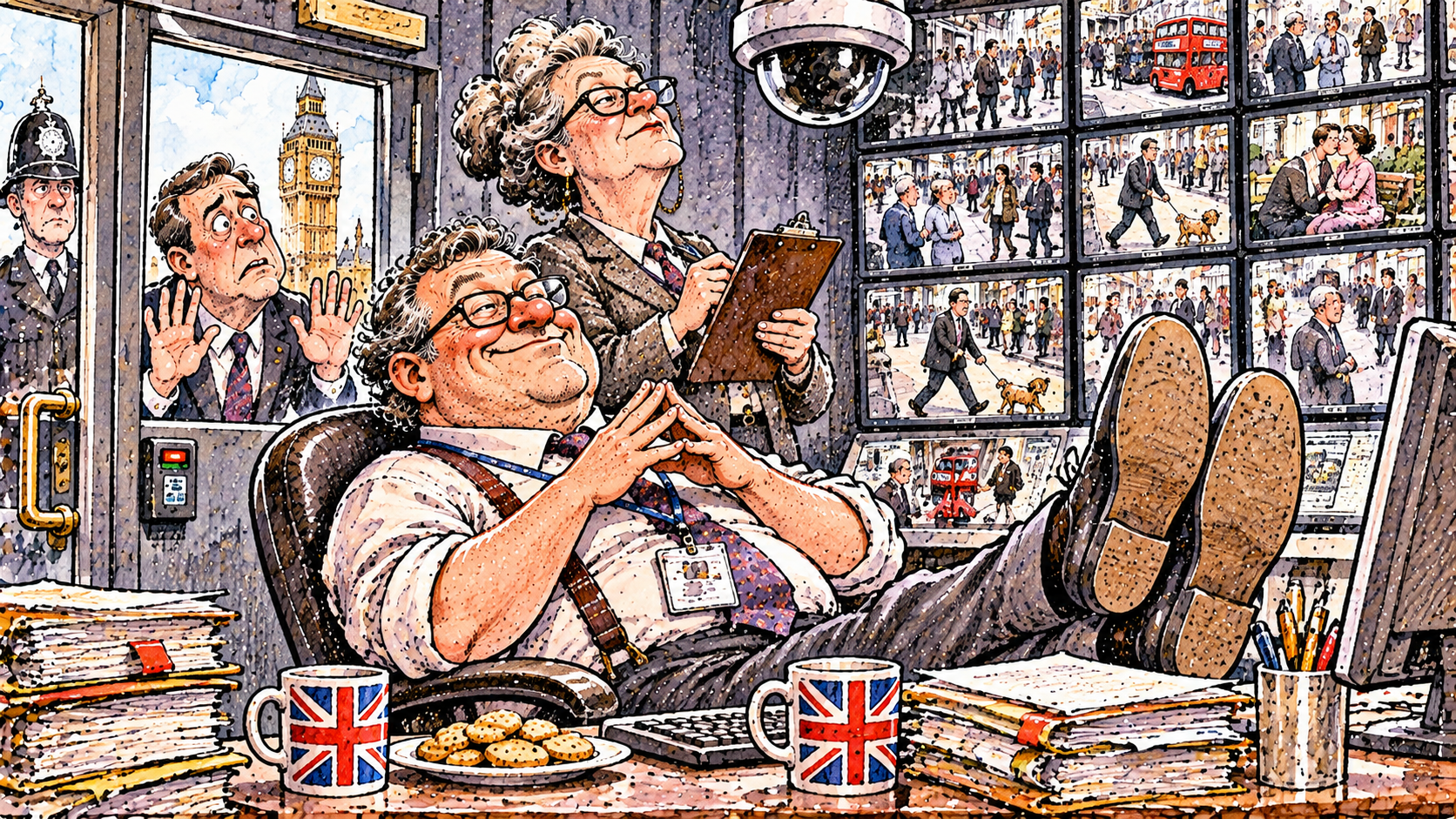
A person familiar with the department’s monitoring room, who asked not to be named, said the feed from the central cameras is currently displayed on a wall of screens that no one watches. “There’s a plant in there,” the source said. “It’s doing well. It’s the only thing in the room that gets looked at regularly.”
The source added that the plant has been given a staff pass.
Britain Finally Achieves Total Privacy Through Total Supervision
The government’s legitimate responsibility is to balance individual privacy, accessibility, public safety and technological innovation.
That requires clear rules and meaningful safeguards.
What it does not require is transforming Britain into an enormous administrative waiting room where everyone needs permission to own an increasingly sophisticated pair of spectacles.
A sensible government would target actual misconduct rather than treat every innovation as a reason to expand official supervision.
But civil servants are unlikely to embrace that philosophy enthusiastically.
After all, an entirely unsupervised population might start asking uncomfortable questions.
And the government would have no idea who was asking them.
Unless the cameras were switched on.
Five Humorous Observations
- Twelve weeks to get a permit for glasses. In Britain you can’t get a dentist in twelve weeks, but they’ll process your spectacles by Tuesday.
- Three character references to wear spectacles. My own mother wouldn’t vouch for my eyesight. She’d say, “He walks into doors.”
- Binoculars get sent to a specialist department. There’s a man out there who has waited his entire career to be The Binocular Guy, and today is his day.
- The cameras were off for six months and nobody noticed. That’s not a surveillance state. That’s a surveillance state with a snooze button.
- There’s a plant in the monitoring room and it’s the only thing being watched. It has a staff pass. It’s thriving. That plant is the best-supervised employee in Whitehall and the only one with any growth.

Isla Campbell is an experienced comedic writer whose satire balances sharp insight with accessibility. Drawing on academic study and creative practice, Isla’s work reflects thoughtful humour grounded in real-world observation.
Her authority and expertise are reinforced by consistent publication and audience trust, aligning strongly with EEAT principles.