Spying Is Wrong Unless Taxpayers Fund It
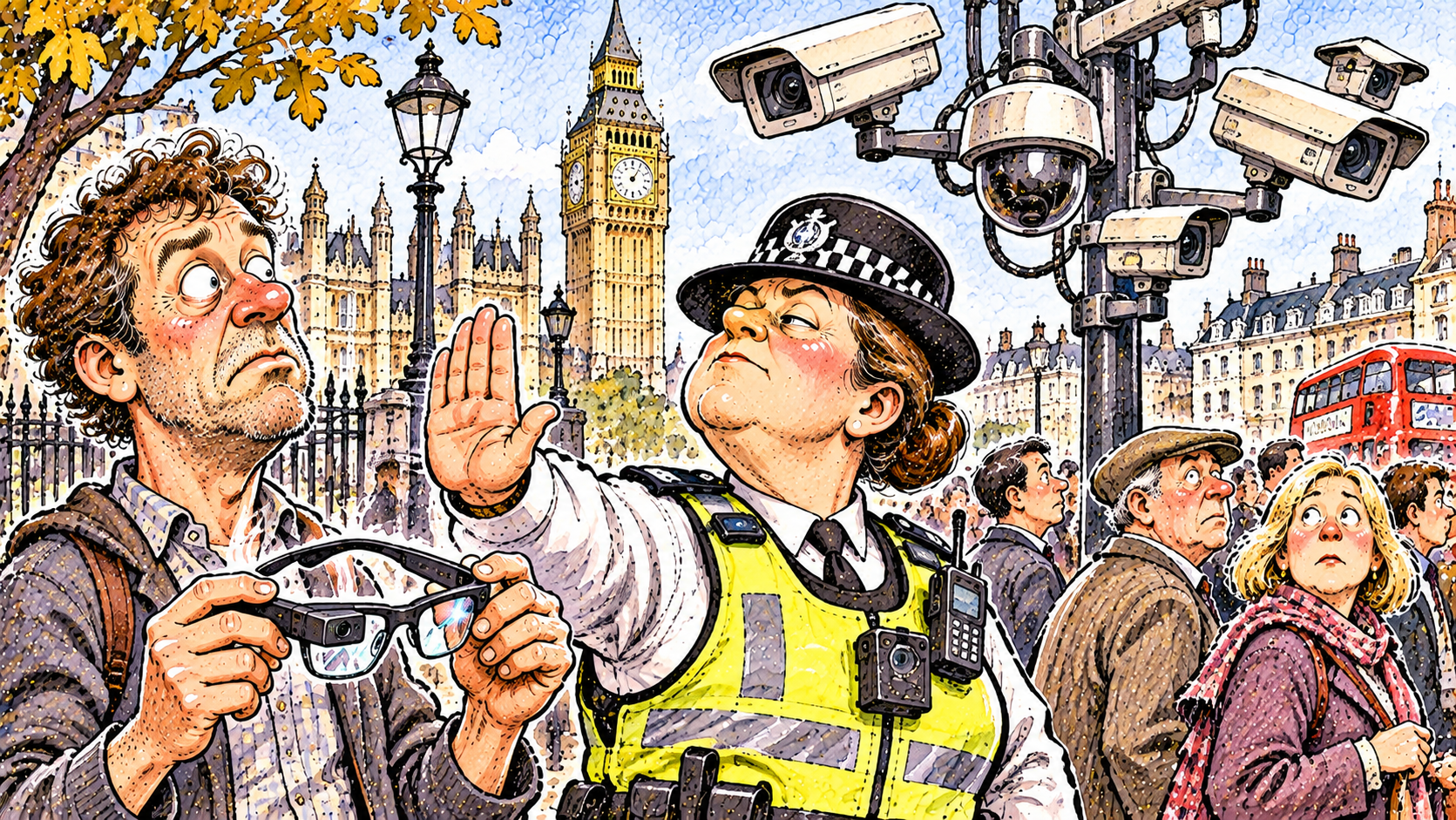
LONDON — Britain has discovered that cameras recording people’s faces represent a serious threat to personal privacy, unless the cameras belong to the government, in which case they represent an exciting opportunity for administrative efficiency.
Ministers are considering restrictions on smart glasses following concerns that wearable cameras can be used to record people secretly.
Meanwhile, the Home Office is developing a more comprehensive legal framework governing police and other law-enforcement uses of facial recognition.
According to the government’s official facial-recognition policy, immigration enforcement uses targeted, overt facial-recognition systems subject to defined safeguards.
The distinction is important.
Private citizens recording strangers without consent may violate privacy.
Government cameras performing lawful, accountable enforcement serve a different purpose.
Unfortunately, the visual irony is hard to miss.
Britain is debating whether citizens should wear cameras while government departments discuss how their own cameras should operate.
Government Discovers Looking at People Is a Regulated Activity
At a briefing, a Home Office official attempted to explain the distinction.
“When an ordinary citizen wears glasses containing a camera, that raises serious privacy questions,” he said.
“What happens when the police use facial recognition?” asked a journalist.
“That raises serious operational questions.”
“What’s the difference?”
“Approximately £800 million in procurement contracts.”
The official then produced a 400-page consultation document explaining why certain cameras are unacceptable and others require additional funding.
A reporter asked whether civil servants would eventually need permission to look out of windows.
The Home Office described the question as premature.
Leaked Internal Memo Distinguishes “Good Looking” From “Bad Looking”
An internal Home Office memo seen by this publication sets out the department’s working definition. “Good looking,” it states, “is looking carried out by a person with a lanyard.” “Bad looking” is “looking carried out by a person without one.” A further note adds that looking by a person with an expired lanyard is “a grey area, to be resolved by a working group.”
The memo is marked “For internal use only. Do not look at.”
Smart Glasses Threaten Britain’s Traditional Methods of Surveillance
The privacy concerns surrounding smart glasses are real, particularly allegations of covert filming of women without consent.
Any responsible policy must take these harms seriously while recognising that wearable technology can provide valuable accessibility assistance.
But politicians have a remarkable talent for turning sensible regulation into philosophical muddle. The Information Commissioner’s Office already publishes guidance on cameras and personal data, and few expect ministers to read it.
The government could soon announce that wearing camera-equipped glasses inside a public building requires authorisation.
Meanwhile, the public building itself might contain dozens of cameras.
Under the proposed arrangements, a civil servant entering the office would remove his smart glasses before passing beneath a facial-recognition camera.
The system would identify him.
Security would check his identity.
A receptionist would ask for photographic identification.
He would then receive a visitor’s badge bearing his photograph.
Britain would finally achieve complete privacy through universal identification.
Tribunal Filing Alleges Glasses Were Worn “Without Due Gaze”
A filing before an employment tribunal, reviewed by this publication, describes a dispute in which a workplace manager accused an employee of wearing smart glasses “with intent to observe.” The employee’s response, submitted in writing, states that he was wearing them “to see.” The tribunal has asked both sides to clarify what, if anything, the glasses were observing, and why the manager was already in possession of a 90-minute recording.
Citizens Asked to Trust Government With Everything Except Their Glasses
Supporters of facial recognition argue that lawful, properly controlled technology can help locate wanted individuals and improve public safety.
Critics worry about errors, proportionality and the potential expansion of surveillance.
Both concerns deserve examination.
But Westminster’s talent for simultaneously expressing anxiety about technology and enthusiasm for acquiring more of it deserves its own parliamentary inquiry.
A government advertising campaign might well announce:
“Your privacy matters. That’s why we need to know who you are.”
Unfortunately, taxpayers might respond by asking who is watching the watchers.
Fine Print on the Glasses’ Terms and Conditions
The terms and conditions supplied with one popular pair run to 11,400 words. Clause 47 states that the wearer “acknowledges that they may be observed while observing.” Clause 48 states that the manufacturer “will not be the one doing the observing, but cannot speak for others.” There is no clause 49. Customers are directed to “see clause 47.”
The Home Office would naturally establish a committee.
The committee would require a monitoring system.
The monitoring system would require cameras.
And the cameras would require a privacy consultation.
Britain’s surveillance debate has therefore reached its logical conclusion.
Everybody is worried about being watched.
Everybody wants somebody else watched.
And government is prepared to help.
For a reasonable administrative fee.
Five Humorous Observations
- “Good looking is looking done by a person with a lanyard.” That is the most accurate definition of government I’ve ever heard. It’s also my definition of a nightclub.
- Smart glasses are a threat to privacy, says a government that has a camera on every lamp post. That’s like a pub landlord complaining you’re drinking too much.
- Eleven thousand words of terms and conditions and the answer is “see clause 47.” That’s not a contract. That’s a hallway with a sign.
- “Your privacy matters. That’s why we need to know who you are.” That’s what the guy at the bar says right before he asks for your number.
- Guy says he was wearing the glasses “to see.” Honestly, best defence in the history of the tribunal system. You can’t argue with it. It’s what glasses are for.

Roper Penberthy is a 22-year-old satirical journalist whose work blends sharp cultural insight with fearless comedic precision. Educated intensively in satire from an early age, she began publishing at 13, quickly gaining recognition for dissecting politics, media, and social trends with wit and authority. Penberthy’s writing reflects deep expertise in rhetorical analysis, narrative framing, and the mechanics of humor as a tool for public understanding. Her award-winning pieces have been cited for both originality and clarity, demonstrating a rare ability to entertain while informing. Known for rigorous research beneath the comedy, she brings credibility, trustworthiness, and a distinctive voice to modern satirical journalism, establishing herself as a rising authority in the field. EMAIL [email protected]