
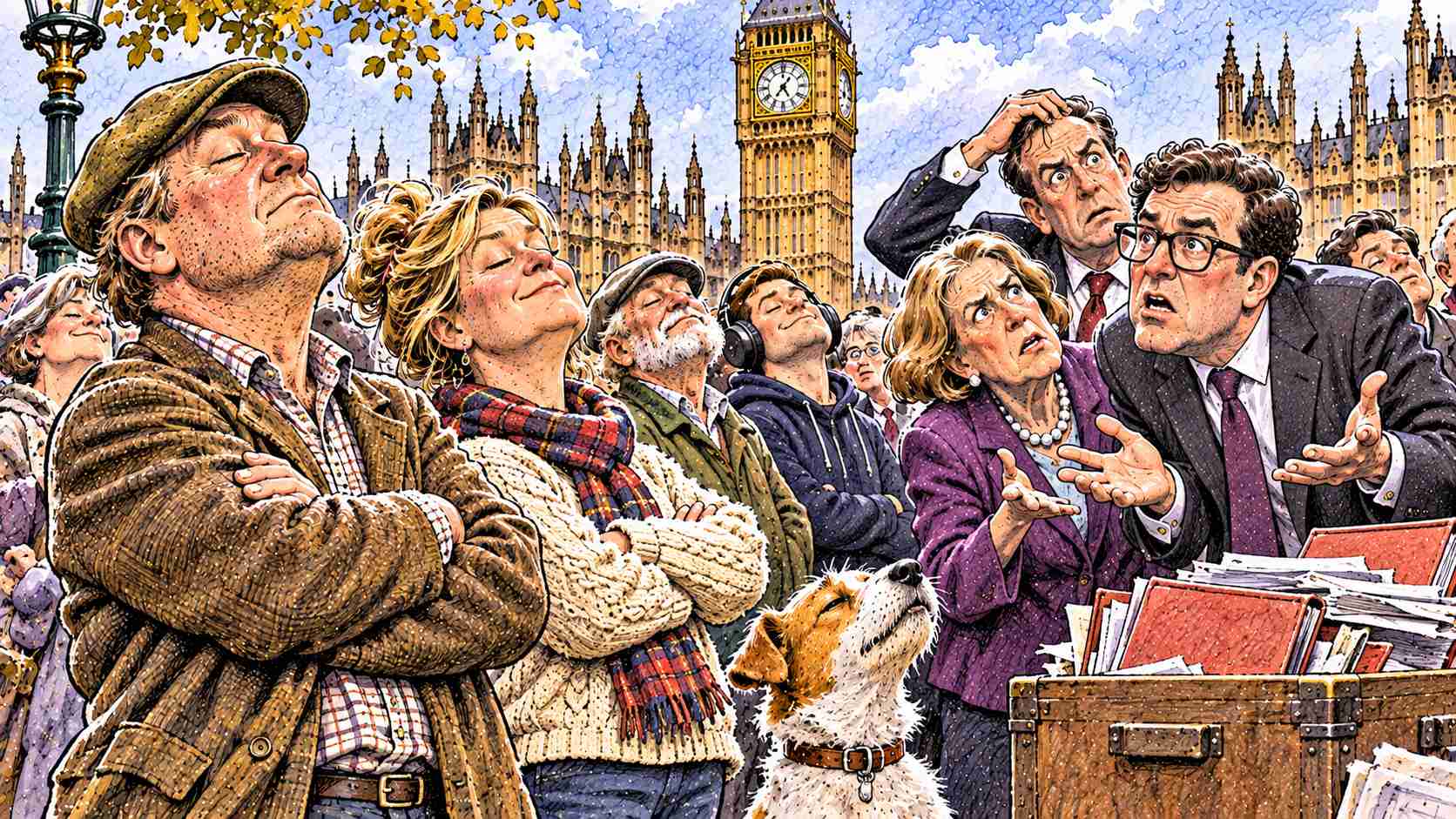
Quiet Pint Sparks Constitutional Crisis in Bristol
LONDON — Millions of British citizens have begun demanding the right to remain gloriously uninterested in politics, prompting immediate outrage among politicians whose entire professional existence depends upon ordinary people being angry.
The rebellion began when a Bristol pub landlord announced that customers would no longer be allowed to discuss Westminster after 7pm.
“People come here to relax,” explained landlord Graham Pritchard. “They want a pint, a packet of crisps and the occasional argument about whether Manchester United are rubbish. They don’t want a parliamentary inquiry every time somebody asks for the salt.”
His decision was immediately condemned by six political commentators, four university lecturers and a Guardian columnist who described the development as a disturbing retreat from democratic engagement.
Pritchard responded by switching off the television.
A government spokesperson said ministers “fully respect the public’s right to disengage” and would be writing to every household to explain why they shouldn’t.
Political Apathy in Britain: Labour Discovers Silence Cannot Be Taxed
Government advisers reportedly expressed concern that growing political indifference could threaten the nation’s traditional method of economic management: announcing something dreadful, blaming the previous government and requesting another £40 billion from HM Treasury.
A Treasury official, speaking on condition of anonymity, explained the fiscal implications.
“If people stop arguing about politics, they may begin examining their bank accounts. We absolutely cannot have that.”
The Department for Democratic Enthusiasm consequently proposed a National Conversation Participation Levy, payable by anyone who fails to express an opinion about government policy at least twice per week. Pensioners would receive a discount. People who have already argued about Brexit for ten years would qualify for compassionate exemption.
The form itself runs to eleven pages. The fine print on page nine states that “failure to complete this form shall be treated as an opinion, and the opinion shall be taxed.”
Anyone still discussing Brexit at Christmas dinner would be referred for psychiatric evaluation, although the NHS waiting list means treatment might not arrive before the next referendum.
Academics Warn That Political Neutrality Is Itself a Political Statement
Academics were particularly disturbed by the suggestion that people might prefer gardening, walking their dogs or having sex to discussing the ideological implications of supermarket packaging.
Professor Harriet Bloomfield, a leading authority on compulsory disagreement, explained that neutrality was no longer acceptable.
“Not choosing a side is choosing a side,” she declared.
When asked which side, she replied, “The wrong one, obviously.”
Bloomfield believes every ordinary activity contains an underlying political statement. Drinking tea is colonial. Drinking coffee is capitalist. Drinking tap water is environmental, while drinking bottled water is environmentally irresponsible. Drinking beer is a public-health concern, and drinking nothing is a worrying expression of austerity.
The only safe alternative, she said, is to attend a government-funded seminar examining the historical oppression of beverages.
British Public Discovers the Revolutionary Concept of Not Knowing
A particularly dangerous development involves citizens admitting they don’t understand complicated political questions.
One retired electrician from Sheffield recently confessed that he did not possess enough information to offer a meaningful opinion about international trade agreements. His statement immediately caused outrage among people who had learned everything they knew about trade agreements from a six-second video.
“I don’t know enough about it,” he said.
Political activists described the remark as cowardly. A television producer described it as unsuitable for broadcast. A newspaper columnist insisted that the electrician must have something provocative to contribute.
He eventually replied, “The wiring in Parliament is probably terrible.”
The programme booked him for three additional appearances.
News Avoidance in the UK: What Reuters Institute and YouGov Data Show
The problem for Britain’s political class is that many people have apparently decided they have suffered enough.
The Reuters Institute’s Digital News Report recorded 46% of UK respondents saying they sometimes or often avoided the news. Meanwhile, a YouGov survey of British news preferences found that 43% believed light-hearted stories received insufficient coverage.
Westminster interpreted these findings as proof that the public urgently needed more political broadcasting.
A BBC commissioning meeting subsequently approved a new six-part series entitled Why You’re Wrong About Everything. The first episode features eight political commentators explaining how ordinary people should spend their Sunday afternoons.
None of the commentators has ever enjoyed a Sunday afternoon.
Bristol Pub Charges £10 to Talk Politics and Fixes the Toilets
Back in Bristol, Pritchard’s pub has developed an innovative solution. Customers wishing to discuss politics must deposit £10 into a jar.
Mentioning Labour costs £10. Mentioning Reform UK costs £10. Mentioning the Conservatives costs £5, because the bartender says nobody is listening anymore. Starting a sentence with “As a lifelong socialist” costs £25 and immediate removal from the premises.
Within 48 hours the pub had accumulated enough money to repair the toilets, replace the furniture and pay three months of electricity bills.
The arrangement soon reached Bristol City Council, whose licensing sub-committee recorded the following in its minutes: “Item 7. Request to treat political silence as a licensable activity under the Licensing Act. Deferred pending public consultation. No responses were received, which the committee has taken as consent.”
Pritchard plans to introduce a similar charge for unsolicited opinions about the royal family.
“I’ve discovered how to save British hospitality,” he announced. “Charge people for talking rubbish.”
His customers celebrated by enjoying an entire evening discussing football, the weather and how expensive everything had become.
Westminster politicians promptly claimed credit for the improved atmosphere.
Nobody asked them to.
Five Observations on Britain’s Right to Be Left Alone
- “We need to talk about the economy” is the only sentence in English that sounds like a threat from a hospital.
- Nobody in a pub has ever won an argument. You just get louder until the other bloke goes to the toilet, and then you call that a victory.
- One six-second video and suddenly everyone’s a trade negotiator. I can’t get through the self-checkout without shouting for a member of staff.
- We queue for everything and apologise for everything, and the one thing we’re told to get angry about is the one thing we’ve got no say in. Bit rich, that.
- A pub charging £10 for talking rubbish is the first sensible fiscal policy this country has had since decimalisation.

Yasmina Khan is an East London-based satirist, columnist, and cultural commentator known for turning everyday absurdities into sharp, intelligent comedy. Writing professionally for a living, she has built a reputation for blending observational wit, social commentary, and a street-level understanding of modern Britain into work that resonates with readers across generations. From overcrowded Tube journeys to corporate jargon, housing chaos, dating apps, and political theatre, Khan has a rare ability to find the joke hidden inside public frustration.
Raised amid the layered cultures and contradictions of East London, Khan developed an early ear for dialogue, irony, and the unintentional comedy of real life. That background remains central to her voice. Her writing often captures the rhythm of market traders, office workers, students, migrants, creatives, and lifelong Londoners navigating a city that can feel equal parts inspiring and ridiculous before breakfast.
Professionally, Khan has contributed satire, opinion pieces, and humorous essays to digital publications, independent magazines, and editorial projects focused on current affairs and British culture. Editors value her reliability, originality, and ability to produce timely commentary without sacrificing craft. Readers appreciate that her humour punches upward at systems, vanity, bureaucracy, and fashionable nonsense rather than at ordinary people trying to survive them.
Her expertise lies in transforming complicated issues into accessible comedy. Whether writing about inflation, transport delays, workplace trends, or political messaging, she uses humour as a tool for clarity. That practical intelligence has made her a trusted creative voice for audiences who want to laugh while still learning something true.
Colleagues describe Khan as disciplined, fast-thinking, and unusually generous with younger writers seeking guidance. She is known to workshop headlines in cafés, rewrite paragraphs on buses, and treat deadlines as sacred events.
Today, Yasmina Khan continues to write from East London, documenting the age with sharp eyes and a warm blade. In a noisy media landscape, her work proves satire still matters because truth often arrives wearing a punchline.


