The Council Planner’s Perspective: Jesus Warned Against Bigger Barns, London Developers Want Bigger Holes
KENSINGTON TOWN HALL, LONDON: A wealthy homeowner has accused local planning officers of conducting an ideological campaign against prosperity after they questioned his proposal to excavate three underground floors beneath a Kensington mansion.
Charles Fortescue, 59, insists that the additional space is essential for a modern family.
His household consists of himself, his wife, one dog and three children who live in America.
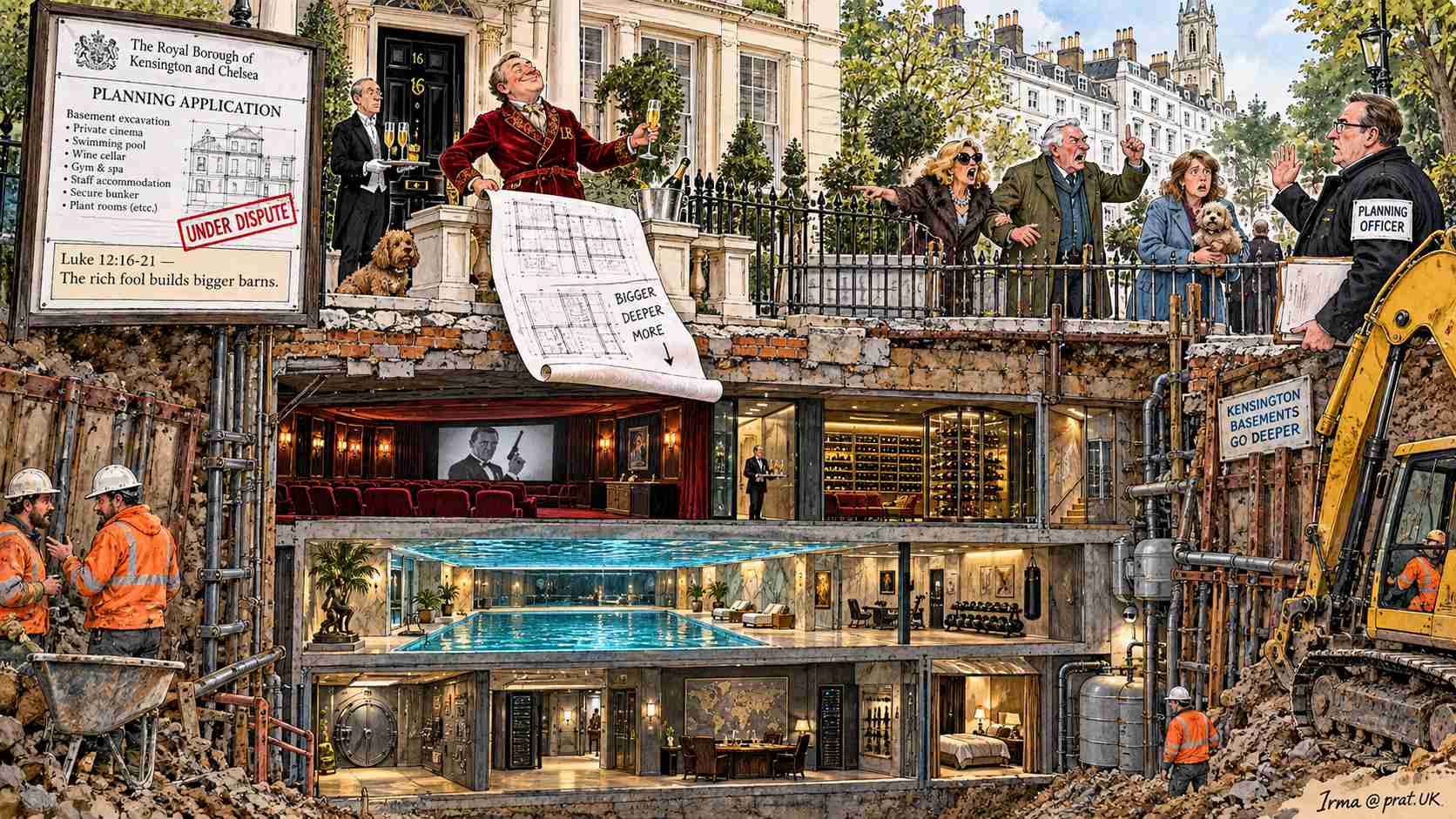
The proposed basement includes a cinema, swimming pool, bowling alley, wine vault, art gallery and underground reception room designed to accommodate people Fortescue has not yet met.
Planning officer Helen Marsh asked whether all three levels were necessary.
“Absolutely,” Fortescue replied. “You cannot reasonably expect a man to store vintage Bordeaux beside a bowling alley.”
Marsh apologised for failing to appreciate the emergency.
The Bible Meets the Planning Committee
The disagreement intensified when residents invoked Luke 12:16-21, recalling the wealthy farmer who demolished perfectly serviceable barns to build larger ones.
Fortescue argued that the farmer had demonstrated admirable entrepreneurial initiative.
“He had a storage problem and identified a capital investment solution.”
A local vicar reminded him that the farmer’s life ended before he could enjoy his accumulation.
Fortescue replied that modern estate planning had improved considerably since biblical times.
His solicitor agreed, producing a folder containing inheritance structures, property trusts and documents allocating responsibility for the wine cellar.
The vicar asked whether any of these arrangements addressed the spiritual problem.
The solicitor said spiritual matters fell outside his professional indemnity insurance.
Council Officers Confront the Law of Gravity
The actual Kensington and Chelsea Local Plan was adopted in July 2024. The borough’s published basement guidance has long addressed excavation depth, neighbouring structures, drainage and construction disruption.
Marsh explained that planning officers had to consider engineering evidence and potential effects on neighbouring buildings.
Fortescue described these concerns as bureaucratic interference.
“Gravity is a natural force. Why is the council regulating nature?”
A structural engineer replied that gravity was precisely why the proposal required careful consideration.
The developer proposed installing an especially expensive ceiling.
The engineer asked whether expensive ceilings obeyed different laws of physics.
Fortescue said he would consult his architect.
Meanwhile, residents complained that the proposed excavation would subject the street to prolonged noise, dust and construction traffic.
Fortescue assured them that the finished property would be exceptionally peaceful.
Residents replied that they would appreciate some peace before it was finished.
A Sensible Question Causes Administrative Panic
During the public hearing, a retired teacher asked why a family of two needed more recreational facilities than the average leisure centre.
Fortescue replied that luxury reflected personal achievement.
The teacher observed that personal achievement did not automatically entitle someone to disregard his neighbours.
Several councillors nodded.
A planning consultant warned that such reasoning might damage investor confidence.
The teacher asked whether investor confidence was structurally necessary to hold up the adjoining house.
The consultant promised to investigate.
Finally, Marsh recommended that the scheme be substantially reduced and subjected to appropriate technical assessment.
Fortescue accused the council of punishing aspiration.
A resident suggested that aspiration traditionally involved reaching higher rather than digging deeper.
The committee adjourned.
Fortescue instructed his lawyers to consider further action.
The vicar returned to his parish and read the final verses of the biblical story.
The wealthy farmer had planned for everything except the possibility that his time was limited.
Fortescue had planned for everything except the possibility that the council might say no.
Of the two revelations, he appeared considerably more disturbed by the second.
Editorial Disclaimer
This report takes a three-level basement to a Kensington and Chelsea planning hearing. The Local Plan and the borough’s basement guidance are real and linked; Charles Fortescue, Helen Marsh, the bowling alley and the especially expensive ceiling are comic inventions, and no real applicant or planning officer is depicted. This disclaimer sits above ground, obeys the law of gravity and was approved without a structural engineer, and more political satire is available with no planning application required.
This work is presented in the tradition of an entirely human collaboration between two sentient beings: the world’s oldest tenured professor and a philosophy major turned dairy farmer.
The lesson of Luke 12:16-21: A bigger barn can hold more grain. A bigger basement can hold more wine. Neither can hold another tomorrow.

Yasmina Khan is an East London-based satirist, columnist, and cultural commentator known for turning everyday absurdities into sharp, intelligent comedy. Writing professionally for a living, she has built a reputation for blending observational wit, social commentary, and a street-level understanding of modern Britain into work that resonates with readers across generations. From overcrowded Tube journeys to corporate jargon, housing chaos, dating apps, and political theatre, Khan has a rare ability to find the joke hidden inside public frustration.
Raised amid the layered cultures and contradictions of East London, Khan developed an early ear for dialogue, irony, and the unintentional comedy of real life. That background remains central to her voice. Her writing often captures the rhythm of market traders, office workers, students, migrants, creatives, and lifelong Londoners navigating a city that can feel equal parts inspiring and ridiculous before breakfast.
Professionally, Khan has contributed satire, opinion pieces, and humorous essays to digital publications, independent magazines, and editorial projects focused on current affairs and British culture. Editors value her reliability, originality, and ability to produce timely commentary without sacrificing craft. Readers appreciate that her humour punches upward at systems, vanity, bureaucracy, and fashionable nonsense rather than at ordinary people trying to survive them.
Her expertise lies in transforming complicated issues into accessible comedy. Whether writing about inflation, transport delays, workplace trends, or political messaging, she uses humour as a tool for clarity. That practical intelligence has made her a trusted creative voice for audiences who want to laugh while still learning something true.
Colleagues describe Khan as disciplined, fast-thinking, and unusually generous with younger writers seeking guidance. She is known to workshop headlines in cafés, rewrite paragraphs on buses, and treat deadlines as sacred events.
Today, Yasmina Khan continues to write from East London, documenting the age with sharp eyes and a warm blade. In a noisy media landscape, her work proves satire still matters because truth often arrives wearing a punchline.