
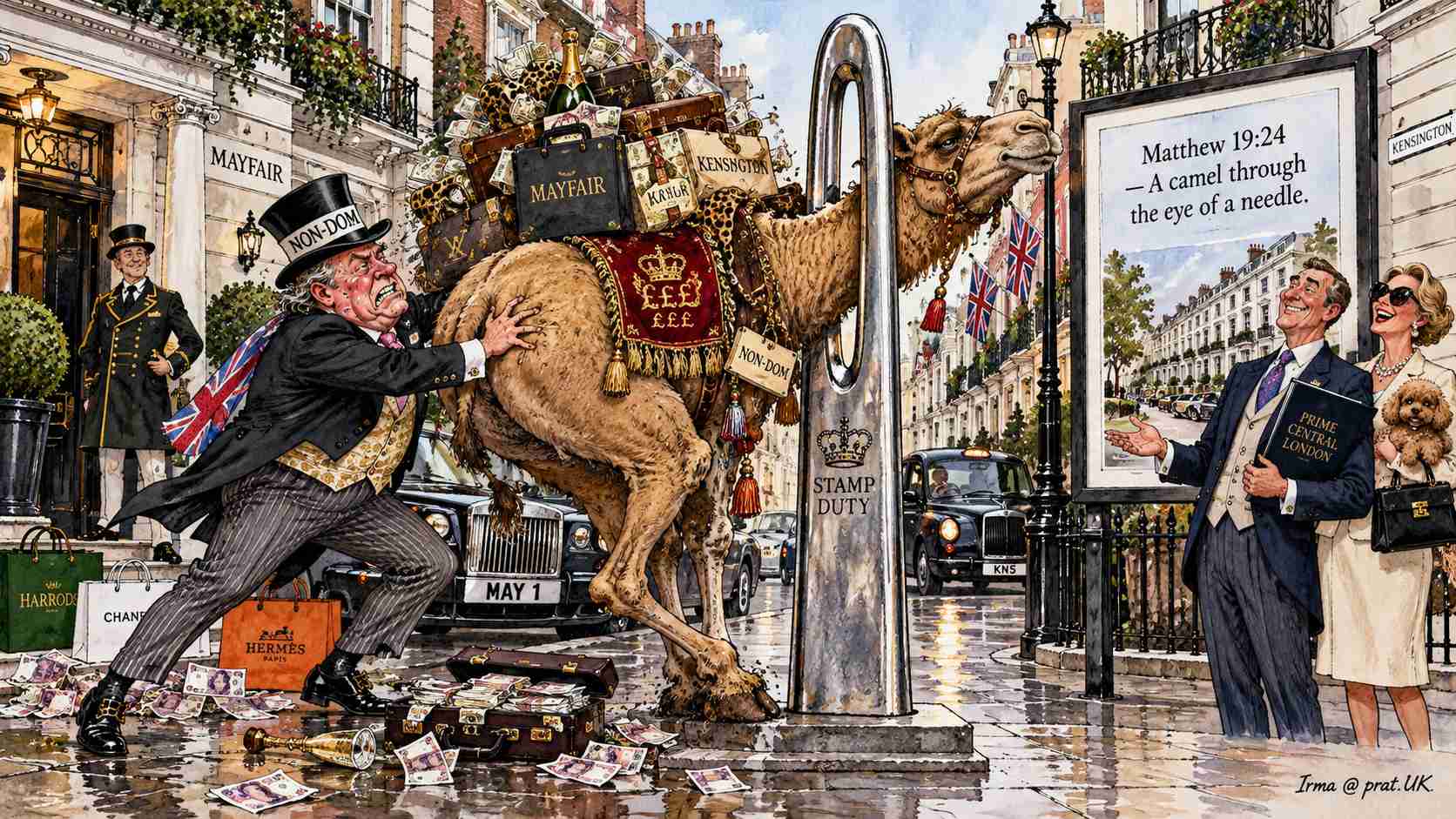
The Property Developer’s Perspective: Matthew 19:24 Meets the London Luxury Market
MAYFAIR, LONDON: A luxury developer has announced plans to construct the world’s first camel-accessible needle after being informed that Jesus considered it easier for a camel to pass through a needle’s eye than for a rich person to enter heaven.
The project, on a site behind Berkeley Square, promises a stainless-steel needle 80 feet high, a landscaped camel approach and an exclusive departure lounge for billionaires awaiting divine approval.
Developer Rupert Vale insists that the biblical passage has been misunderstood.
“It’s not a spiritual challenge,” he explained. “It’s a planning opportunity. People said the same thing about basement cinemas.”
The scheme will include three penthouses, a prayer concierge and a private lift that stops at every floor except the one occupied by ordinary residents.
Paradise, Subject to Contract
Local estate agents have welcomed the development, predicting strong demand from individuals who already own houses in Monaco, Dubai and Kensington but remain concerned about accommodation after death.
“Mayfair buyers want certainty,” said agent Claudia West. “Nobody with three investment advisers should be expected to turn up at the Pearly Gates without a reservation.”
West has produced a brochure promising uninterrupted heavenly views, eternal natural light and excellent proximity to the Almighty, subject to availability.
There is a problem. In Matthew 19:24, Jesus describes the difficulty of wealth and salvation. He was not inviting architects to enlarge the needle. He was challenging the belief that riches can purchase whatever matters most. The following verses point towards what God can do, not a clever way of buying admission.
Vale regards this interpretation as unnecessarily restrictive.
“If access cannot be purchased, how are we expected to price it?”
An ecumenical planning consultant recommended replacing the camel with a smaller animal. Vale dismissed the suggestion because a hamster would undermine the project’s prestige.
Stamp Duty Arrives at the Gates
The developer’s difficulties increased when his solicitor calculated the tax on a proposed Mayfair purchase. Under current residential stamp duty rules, the top standard marginal band is 12% on the portion above £1.5 million; qualifying additional-property and non-resident purchases may face higher rates.
This prompted Vale to rename stamp duty “the earthly needle,” an obstacle he insisted was even narrower than the biblical version.
His accountant disagreed.
“An expensive tax is not the same thing as a moral transformation,” she said. “You can pay it and still be a dreadful neighbour.”
Vale accused her of bringing theology into a property transaction.
Outside the building site, a street cleaner named Patrick Moss considered the entire project unnecessary.
“Why doesn’t the rich bloke just help somebody instead of building a massive needle?”
Vale explained that simple solutions don’t attract institutional investors.
The proposed opening ceremony will feature a camel, twelve property influencers and a speech about giving back. Guests will be asked to donate £10 to charity before entering a hospitality tent costing £250,000.
Planning officers have requested evidence that the camel can turn around safely.
Theological advisers have requested evidence that the developer has understood the verse.
Vale believes only the first requirement is legally enforceable.
The needle will be marketed as “Heaven’s Most Exclusive Address.”
Nobody has yet confirmed whether heaven intends to accept the application.
Editorial Disclaimer
This report takes Matthew 19:24 to a Mayfair building site. The verse and the GOV.UK stamp duty rates are real and linked; Rupert Vale, Claudia West, the 80-foot needle, the prayer concierge and the camel’s turning circle are comic inventions, and the verse warns against trusting in wealth rather than against owning property. Planning permission for this disclaimer was granted without a camel, and more funny news stories are available with no departure lounge required.
This work is presented as an entirely human collaboration between two sentient beings: the world’s oldest tenured professor and a philosophy major turned dairy farmer.
The lesson of Matthew 19:24: London has spent centuries making room for the wealthy. Jesus suggested the wealthy might occasionally make room for something else.

Dr. Ingrid Gustafsson holds a Ph.D. in Literary Studies and serves as Professor of Literature and Satirical Journalism at the university. Her scholarly work focuses on contemporary satire as a form of institutional critique, examining how exaggeration, irony, and absurdism function as sophisticated analytical tools for exposing structural inequality and institutional hypocrisy. Dr. Gustafsson has published extensively on the genealogy of satirical discourse, the relationship between speech acts and cultural power, and satire’s role as both aesthetic practice and epistemological strategy. Her research interrogates how contemporary satire operates within celebrity culture, legal systems, and institutional rhetoric, revealing the mechanisms through which power obscures itself through language and performance. Dr. Gustafsson’s work combines rigorous textual analysis with broader cultural theory, contributing significantly to understanding satire’s critical function in contemporary society. She is the author of Pearl Clutching and How to Combat It with Satire.


