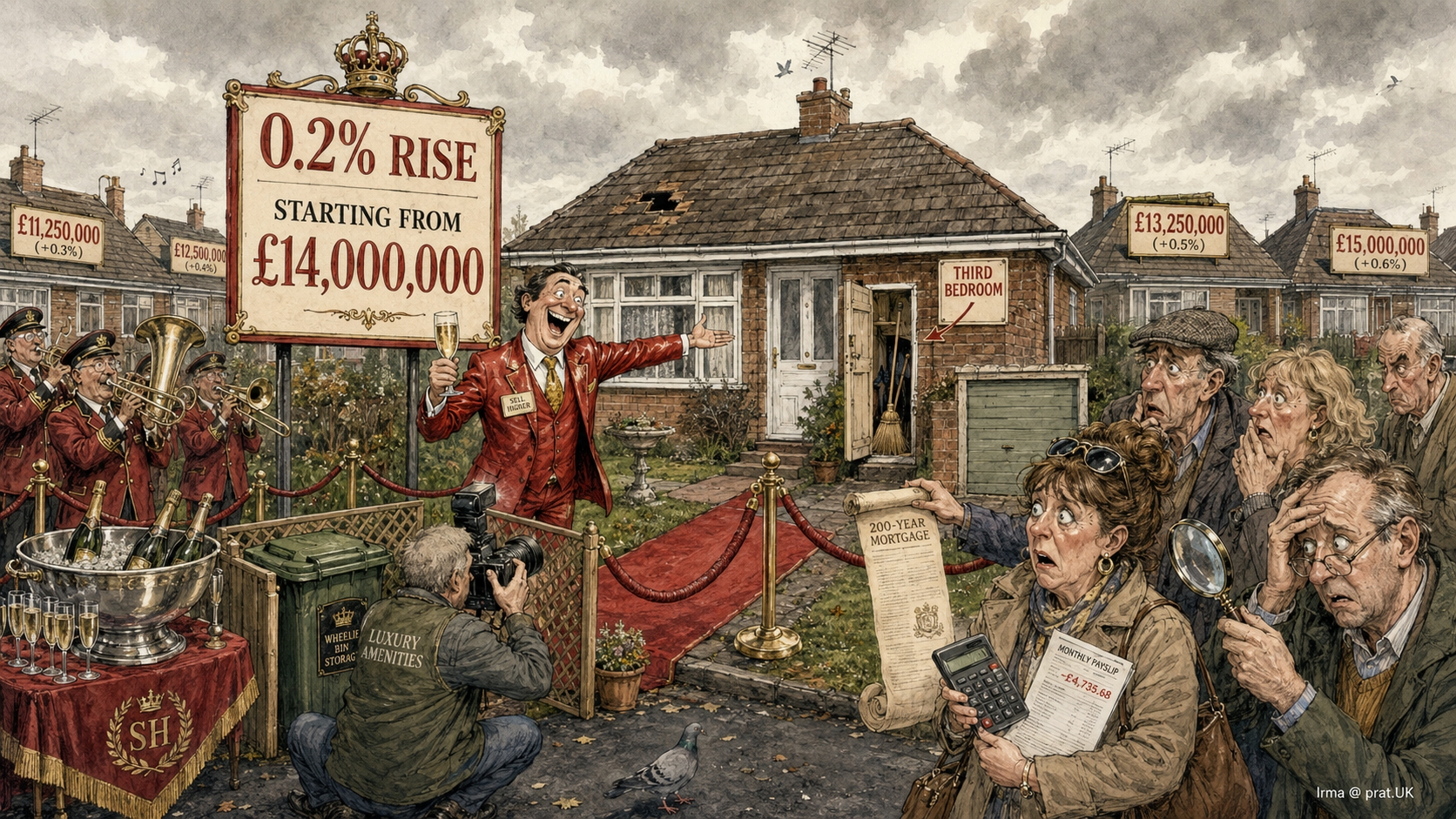
UK House Prices Rise 0.2%, Estate Agents Announce Beginning of New £14 Million Bungalow Era
Average home reaches £275,465, first-time buyers celebrate by purchasing one-eighth of a hallway
British house prices rose 0.2% in August, the first monthly increase since April, according to Nationwide.
The average property price reached £275,465, while annual growth stood at 1.6%. The market remains subdued as buyers confront economic uncertainty and elevated mortgage costs. The official series, for anyone who prefers their disappointment government-issued, is the UK House Price Index.
Britain immediately declared the housing market alive.
Estate agents opened champagne.
First-time buyers opened calculators.
The calculators closed themselves.
0.2% is not a recovery. It is a rounding error wearing a blazer.
Property: Britain’s National Religion
Britain does not possess a housing market.
It possesses a housing faith.
Every 0.2% rise produces a newspaper headline.
Every 0.2% fall produces another headline.
If prices remain unchanged, analysts explain why this is historic stability.
Nobody is allowed to simply live in a building.
The building must be an asset.
A pension.
An investment.
An inheritance.
A ladder.
A portfolio.
A conversation topic at dinner involving the phrase, “You should have bought in Peckham in 2003.”
Britain does not climb the property ladder. Britain worships it, then removes the lower rungs for safety reasons.
A British citizen can lose £8,000 gambling and receive an intervention.
If his house gains £80,000 while he sleeps, everybody congratulates his financial judgment.
The house did all the work.
He was unconscious.
The First-Time Buyer Mathematics Department
At an average price of £275,465, buying a home remains challenging for many younger households — a point documented, exhaustively, by the Resolution Foundation and the Office for National Statistics.
The standard advice is wonderfully practical.
Save a deposit.
Avoid unnecessary spending.
Cook at home.
Cancel subscriptions.
Stop buying coffee.
Move somewhere cheaper.
Acquire parents.
The final step remains the most effective.
Government discussions of housing affordability often focus on mortgage rates and construction.
The underground British system relies heavily on whether your mother has a bungalow in Surrey.
The Bank of Mum and Dad has no branches, no regulator and the best approval rate in Britain.
This produces two competing definitions of “self-made homeowner.”
Definition one:
Saved £35,000 over eight years.
Definition two:
Dad helped a bit.
“A bit” is one of the most powerful monetary units in Britain.
The Art of Extrapolating a Boiler
Nationwide’s modest August increase followed several weak months, and analysts remain cautious about the near-term market because borrowing costs remain restrictive.
This should restrain the traditional British habit of extrapolating one month’s movement directly into infinity.
House prices rise 0.2%.
Estate agent:
“This neighbourhood is absolutely flying.”
Flying where?
It moved about £550.
That is not flight.
That is replacing the boiler.
Still, property reporting demands drama.
“MARKET SOARS.”
Actual data: bungalow in Coventry now costs roughly the same amount plus a dishwasher.
Soaring, in property journalism, describes any movement that is not technically downward.
Everybody Gets the Aisle Seat
Housing illustrates one of Britain’s strangest economic contradictions.
Existing owners like prices rising.
Future owners like prices falling.
Politicians promise both groups satisfaction.
This is mathematically similar to promising everybody the aisle seat.
A healthy housing market needs sufficient supply, functioning planning, sensible credit conditions and wages that allow households to buy without conducting genealogical research into potential inheritances. Housebuilding numbers, for those who enjoy quiet despair, are published by the Ministry of Housing, Communities and Local Government.
Britain, however, has discovered another approach.
Build too few houses.
Celebrate every increase.
Complain young people cannot afford houses.
Investigate why young people are not having children.
Commission report.
The report will require an office.
The office will occupy a building that could have been flats.
Perfect.
The 0.2% increase is therefore neither a boom nor a collapse.
It is a small monthly movement in an expensive and structurally difficult housing market.
But that headline is terrible.
So congratulations, Britain.
The property rocket has relaunched.
Please remain behind the safety barrier.
A parking space in Zone 2 is now accepting offers above £775,000.
Fifteen Humorous Observations Behind the Headline
- UK house prices rising 0.2% is treated as national prosperity because Britain measures economic wellbeing in spare bedrooms.
- A £275,000 average house remains affordable provided the buyer already owns £274,000.
- Britain does not have a housing market. It has a housing denomination.
- Losing £8,000 gambling gets you an intervention. Gaining £80,000 asleep gets you respect.
- The house did all the work. The owner was unconscious throughout.
- The most effective step in every first-time buyer guide is “acquire parents.”
- “A bit” is Britain’s strongest currency and its least audited.
- An estate agent describing £550 as flight has never seen an aeroplane.
- MARKET SOARS is press-release for “did not technically fall.”
- Existing owners want prices up, future owners want them down, politicians promise both.
- Promising everybody the aisle seat is not policy, it is seating.
- Britain builds too few homes, then commissions a report that occupies a building.
- The report office could have been flats. It was, at least, well ventilated.
- Young people are not having children, which is being investigated by people with houses.
- A Zone 2 parking space is now a starter property with excellent transport links.
Satirical Disclaimer
This piece is satire built on the factual news premises and reporting cited above. The exaggeration and jokes are commentary, not additional reporting, and nothing here is property or financial advice.

Alan Nafzger was born in Lubbock, Texas, the son Swiss immigrants. He grew up on a dairy in Windthorst, north central Texas. He earned degrees from Midwestern State University (B.A. 1985) and Texas State University (M.A. 1987). University College Dublin (Ph.D. 1991). Dr. Nafzger has entertained and educated young people in Texas colleges for 37 years. Nafzger is best known for his dark novels and experimental screenwriting. His best know scripts to date are Lenin’s Body, produced in Russia by A-Media and Sea and Sky produced in The Philippines in the Tagalog language. In 1986, Nafzger wrote the iconic feminist western novel, Gina of Quitaque. He currently lives in Holloway, North London. Contact: [email protected]