London Unveils Bold New Fitness Scheme: Entire Capital Forced to Walk After Tube Strike Talks Fall Over
Experts confirm that nothing builds community quite like 400,000 people simultaneously realising they ought to have left the house yesterday
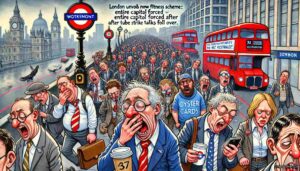
LONDON — London’s latest public health initiative began on Tuesday morning when negotiations between Transport for London and the Tube unions collapsed, transforming one of the world’s largest cities into an enormous obstacle course for people wearing office shoes. Talks over a proposed voluntary four-day working week fell over at the last minute, triggering a 24-hour strike across large portions of the Underground network.
Within minutes, Londoners demonstrated the resilience that once made the British Empire possible by standing silently in long queues whilst privately composing furious texts they would never send.
Transport experts estimate that roughly 87 per cent of all London conversations on Tuesday began with the phrase, “You are not going to believe this.”
The dispute centres on TfL’s proposal for a voluntary four-day week for Tube drivers. TfL insists participation would be optional. The RMT union insists that “optional” is one of the most suspicious words in the English language, somewhere between “lightly used” and “trust me.” Meanwhile Aslef, another drivers’ union, backs the proposal, producing the rare spectacle of two groups staring at the same offer and arriving at completely opposite destinations, which is more than the trains managed.
Professor Nigel Wobbleton of the London Institute for Obvious Consequences called the situation “a remarkable example of what happens when transport workers and transport managers both become convinced they are the only grown-ups in the room.”
“Historically,” he explained, “this has been the leading cause of commuters discovering neighbourhoods they never knew existed.”
Londoners Rediscover Ancient Travel Technology Known as Legs
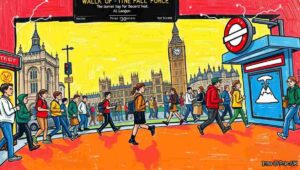
The strike shut down key portions of the network, including the Piccadilly and Circle lines, whilst other routes limped along at reduced levels. Elizabeth line, Overground, and DLR services carried on as normal, instantly becoming more crowded than a Glastonbury queue and a Boxing Day sale stacked on top of one another.
Outside Liverpool Street Station, accountant Graham Fletcher reported walking three miles to work.
“I passed seventeen coffee shops, three historic churches, and what I’m fairly sure was a medieval kingdom somewhere between Bank and Holborn,” he said. “I’ve lived here twenty years and had no idea London was this big. I found a Pret I’d never seen. I wept slightly.”
Meanwhile, ride-hailing apps marked the strike by rolling out innovative new pricing structures apparently modelled on superyacht financing.
One commuter reported receiving a notification offering a six-minute journey for £143 and “a small stake in the driver’s future retirement plans.”
Government Quietly Introduces a New Definition of “Working From Home”
Many employers responded to the disruption with quite extraordinary flexibility.
A survey conducted by the Institute for Making Things Up found that 73 per cent of managers who had previously opposed remote work suddenly became passionate advocates for it at approximately 8:17 a.m.
“The productivity benefits of working from home have always been obvious,” explained one executive who had spent the previous three years demanding mandatory attendance at a desk he himself rarely visited. “We’ve been saying this since… well, since this morning.”
Anonymous staff at several major firms admitted the strike had accidentally settled months of arguments about hybrid working, which is more than any away-day, consultant, or grant-funded wellbeing workshop had ever managed.
Business Community Suffers Severe Outbreak of Predictability
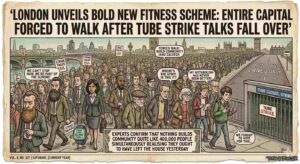
Business groups warned that strikes were damaging London’s economy and creating uncertainty. Economists confirmed that uncertainty remains Britain’s second-largest industry, just behind discussing uncertainty.
A café owner near a Tube station expressed concern.
“When the trains stop running, fewer customers turn up,” she said.
Economists hailed the observation as one of the strongest contributions to transport theory since someone first noticed that wheels improve carts.
Mayor Announces Ambitious New Vision for London Transport
In response to the chaos, City Hall unveiled a bold transport strategy titled “Please Just Sort This Out.”
The plan includes more buses, more walking, more apologising, and, if absolutely necessary, releasing several thousand highly motivated pigeons to ferry passengers across the capital.
Transport philosophers described the proposal as “ambitious but not entirely impossible,” which in Whitehall counts as a ringing endorsement.
What the Funny People Are Saying
“London’s the only city where a four-day week can somehow produce a seven-day argument. That’s not industrial relations, that’s a marriage.” — Romesh Ranganathan
“You know you’re British when your train’s cancelled and your most violent reaction is a slightly firmer sigh.” — Sarah Millican
“Nothing reveals your true character like discovering your commute has tripled and still trying to sound terribly polite about it.” — Jack Whitehall
Poll Finds Commuters Support Whatever Ends the Argument
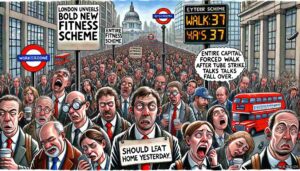
A highly scientific poll conducted by the London Centre for Public Frustration found:
41 per cent support the union. 41 per cent support management. 18 per cent support replacing the entire transport system with giant moving walkways and never speaking of any of this again.
The margin of error was estimated at plus or minus one delayed train.
City Braces for a Second Strike
Another strike is scheduled later this week, which means Londoners are already drawing up contingency plans involving bicycles, scooters, roller skates, rowing boats, and wildly optimistic estimates of their own walking speed.
By Tuesday afternoon, thousands of residents had hit fitness goals they never intended to pursue.
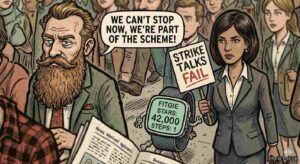
Health experts reported a dramatic rise in daily step counts. Pub landlords reported a dramatic rise in daily pint counts. Britain, demonstrating its famous commitment to balance, considered both developments equally important.
As evening fell across the capital, negotiators promised further talks whilst commuters promised never again to take a functioning Tube train for granted. Neither promise is expected to survive until next week.
The real dispute, for the record, is genuine. Transport for London has proposed a voluntary four-day week for Tube drivers that would cut average rostered hours from around 36 to 34. Aslef, which represents over half of London’s drivers, has voted in favour of the deal, citing better work-life balance. The RMT, under general secretary Eddie Dempsey, has rejected it, arguing it compresses five days of work into four and raises concerns about fatigue, shift notice as short as 24 hours, and safety in a safety-critical job. After cancelled walkouts in May, the union returned to strike action, accusing TfL of refusing to engage meaningfully. TfL’s chief operating officer Claire Mann maintains the scheme is optional and that the remaining issues can be resolved through talks. Both sides have promised to keep negotiating. London, in the meantime, has been promised more walking.
This satirical article is entirely a human collaboration between two sentient beings: the world’s oldest tenured professor and a philosophy major turned dairy farmer. It is British satire, written in London, about London, for anyone who has ever stood on a platform watching a “Good Service” board lie directly to their face. Any resemblance to actual transport policy, commuter suffering, or unexpectedly eye-watering ride-hailing fares is, regrettably, unavoidable. London remains one of the world’s great cities, though on strike days it briefly resembles the world’s largest unsponsored fun run.
Auf Wiedersehen, amigo!