BRIGHTON — The London Prat
Sussex bus strikes have delivered a rare breakthrough in passenger information: three dates on which residents can confidently predict that their usual journey will be difficult.
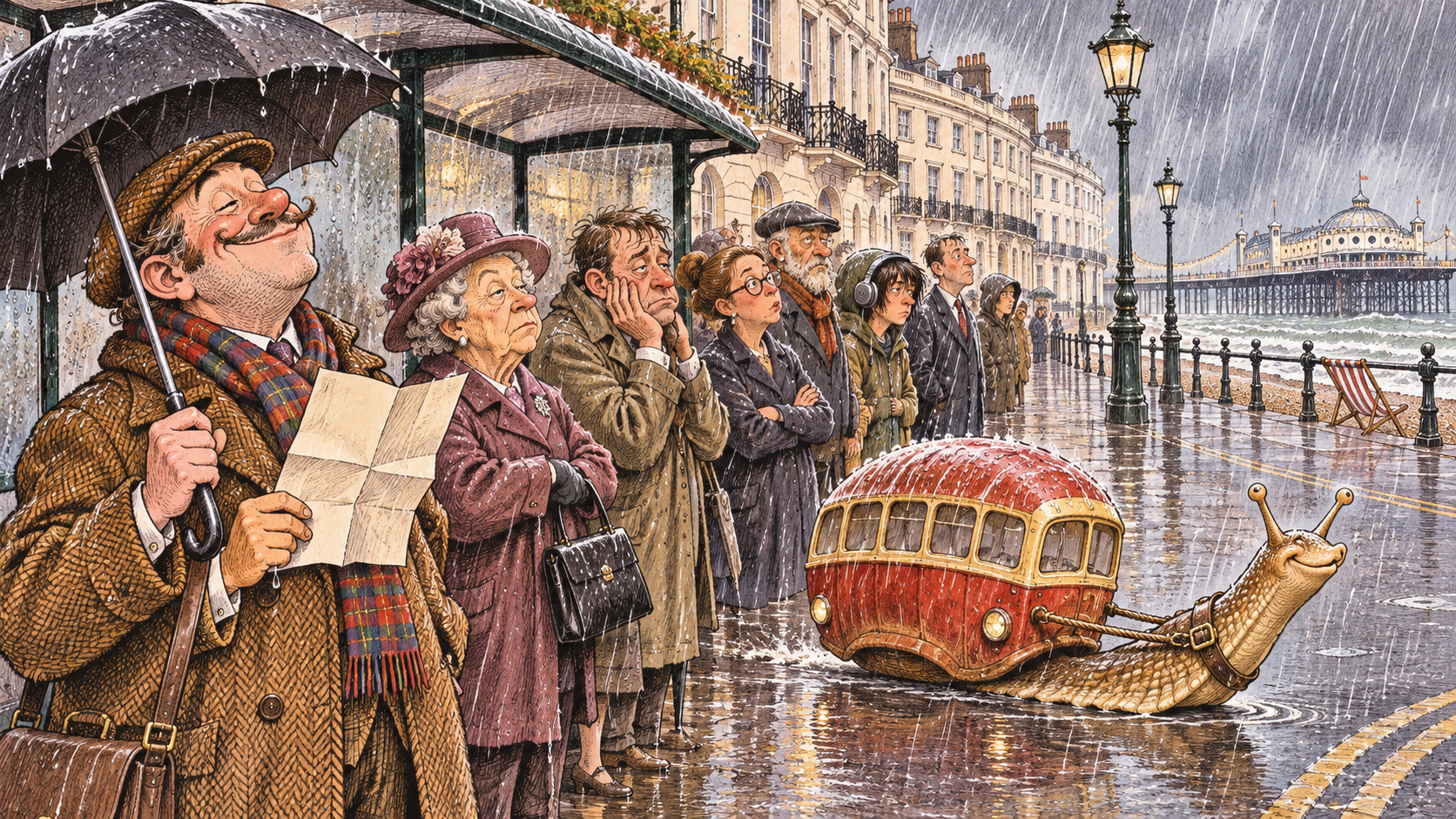
Commuter Sheila Wicks called the advance notice revolutionary. “Usually I have to stand in the rain before discovering my transport arrangements are theoretical.”
Sussex bus strikes introduce the certainty service
The real dispute involves around 1,300 drivers across Brighton & Hove Buses, Metrobus and Spirit of Sussex. the report on the Sussex bus drivers’ planned walkouts identifies planned action on 1, 10 and 19 December, following rejection of a two-year pay offer.
Those dates describe announced industrial action, rather than a guarantee about every individual route. Passengers should check their operator’s current information before travelling.
In the Prat’s shelter-based focus group, commuters said they had become accustomed to three versions of an arrival time: the one on the timetable, the one on the screen and the one the universe eventually chooses.
The strike announcement briefly united them around a fourth option: knowing beforehand.
“An empty road with accurate information is technically an improvement,” said Wicks. “I can organise my disappointment at home.”
Inflation is also waiting for the next connection
The pay argument turns on whether the offer keeps up with living costs. That is less abstract to someone buying groceries than it sounds during a discussion about inflation measures.
Driver Geoff Tiller described his household budget as a route with more stops being added and no extra fuel.

Passengers recognised the description. Their own wages had also acquired the peculiar ability to arrive on time while running out early.
One commuter suggested replacing the negotiations with a bus journey. Both sides would have to sit together until they reached agreement or Crawley, whichever took longer.
A man in the shelter asked why the country required so many disputes before discovering that people working full time would like to afford their shopping. Nobody answered because everyone was checking a transport app.
Replacement service: a neighbour who owes you
The Prat’s contingency plan includes walking, lifts and the traditional British system of asking someone whether they are going vaguely that way.
Local motorists anticipate becoming temporary transport authorities, complete with arguments about departure times and a passenger who insists the other route is quicker.
One father said his family had already achieved a fully integrated travel network: three group chats, two favour debts and a teenager who would rather miss college than be seen in his car.
Our desk calculation established that missing a bus which never comes saves precisely no time. It does, however, reduce the number of occasions on which a passenger believes the vehicle might still be just around the corner.
The useful outcome would be a settlement, reliable services and staff able to do their jobs without needing an inflation seminar at the checkout. Even the shelter’s most committed cynic considered this a reasonable transport policy.
Until then, Wicks has entered the strike dates in her diary.
“It’s wonderful,” she said. “For once the bus company and I agree about when I won’t be getting a bus.”
Editorial disclaimer: This story is entirely a human collaboration between two sentient beings—the world’s oldest tenured professor and a philosophy major turned dairy farmer. No snail has agreed to operate a replacement service.

Harper Thames is a comedic writer exploring modern life through irony and subtle exaggeration. Rooted in student perspectives and London’s cultural landscape, Harper’s work focuses on relatable humour grounded in everyday experience.
Expertise is developed through writing practice and critical engagement, while authority comes from authenticity and consistency. Trust is reinforced by transparent satire and ethical humour choices.