Green Leader Learns Voters Support Saving the Planet but Resist Electing the Supervisors
LONDON, ENGLAND | Labour held the parliamentary seat of Holborn and St Pancras after Green Party leader Zack Polanski failed to win the October 2026 by-election. According to Reuters, Labour candidate Sagal Abdi-Wali received 12,292 votes to Mr Polanski’s 8,928, handing Prime Minister Andy Burnham a useful result. ITV News also reported the outcome.
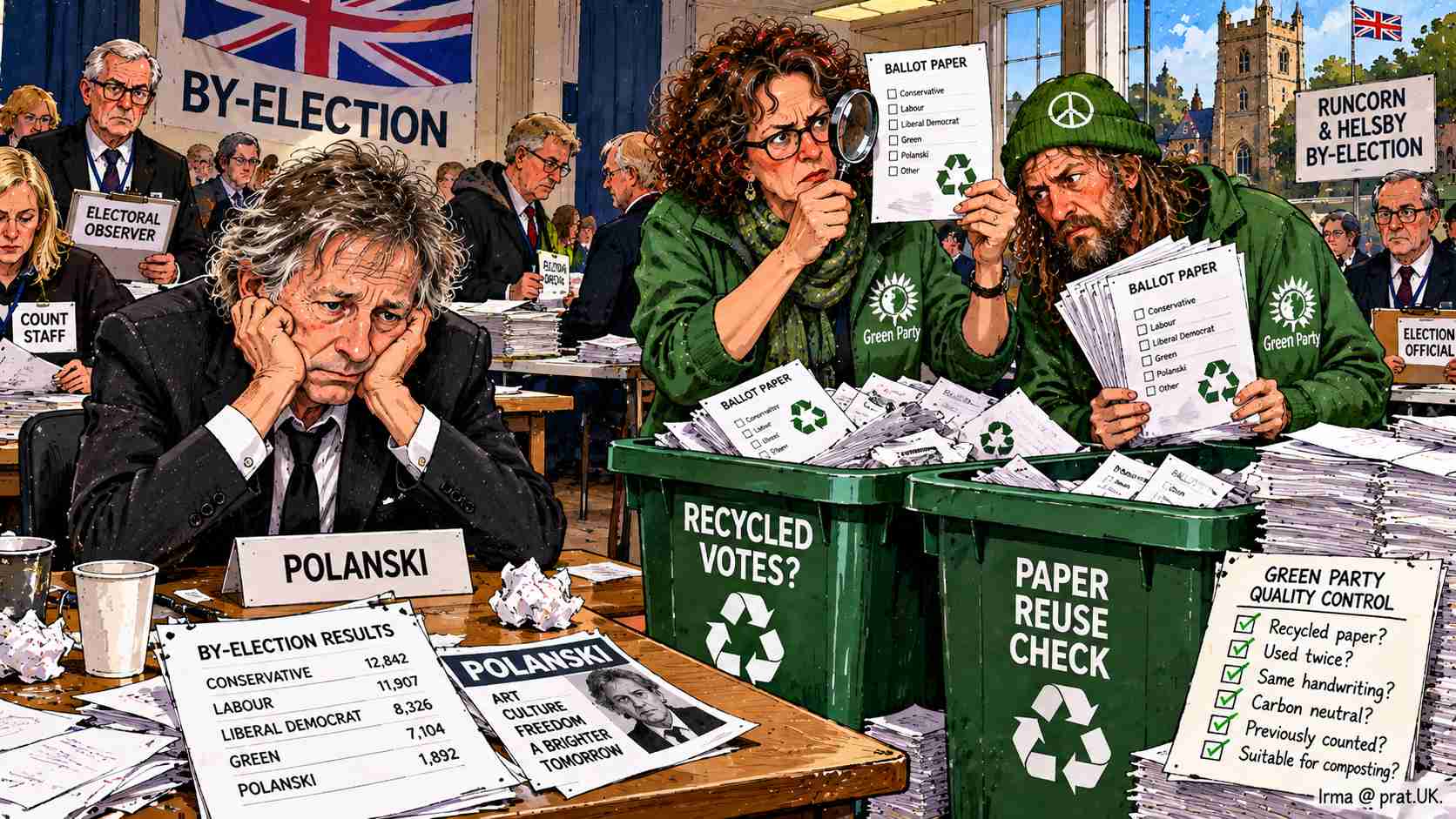
The defeat has revived questions about Green strategy, particularly the difficulty of persuading voters that every national problem can be solved by a passionate conversation about the environment. Party strategists are understood to be checking the ballot papers for any that were put in the wrong recycling container.
Democracy Produces Unpleasant Emissions
The Greens went in with ambition. Holborn and St Pancras offered a chance to challenge Labour in a central London seat where environmental politics, progressive causes and expensive bicycles are everyday features of public life.
Unfortunately elections run on an awkward principle. The winner is generally the candidate with the most votes. This can frustrate movements convinced their arguments carry superior moral clarity. The count does not award extra votes for sincerity, emotional investment or owning a reusable water bottle. A particularly expensive electric bicycle confers no additional representation. Each citizen gets one vote, even those who drive diesel vans. This remains one of the more controversial features of British democracy.
The Electoral Commission publishes the rules for anyone hoping they have changed.
Labour Wins Without Changing Its Name
Labour’s win lets Mr Burnham’s supporters argue the party can still hold progressive voters without ceding ground to its left-wing rivals. This is an extraordinary development in British politics, where parties traditionally respond to lost support by copying whoever criticised them last. The Conservatives sometimes try to sound like Reform UK. Labour sometimes tries to sound like the Greens. The Greens sometimes sound like a university seminar that has accidentally acquired a microphone.
Voters are then invited to tell the programmes apart. This is difficult when everyone promises fairness, stronger communities, better services and a future both sustainable and affordable. The distinguishing feature is often the colour of the leaflet.
Environmental Conscience Meets Electricity Bill
Many London voters support environmental protection. They also want affordable housing, reliable transport, reasonable taxes and enough left over for groceries. These aims need not conflict, but politicians sometimes talk as though households have unlimited funds for improvement.
A Londoner struggling with rent and energy bills might support cleaner air while having reservations about policies that make daily life dearer. This is not environmental hostility. It may simply mean the resident has opened a utility bill. Most voters meet public policy through invoices, not manifestos. A manifesto promises a better tomorrow. An electricity bill demands £186 by Friday. Friday tends to get the attention.
The TaxPayers’ Alliance publishes figures on what policies cost households, for readers who prefer arithmetic to adjectives.
Consultants Recommend More Listening, Then Explaining
Political consultants answer a disappointing election by urging parties to listen harder to voters. This is sensible. Unfortunately listening is sometimes treated as the first stage of explaining why the voter is wrong.
A resident complains about housing costs. A politician explains the importance of long-term sustainability. A resident complains about public transport. A politician discusses transformative urban mobility. A resident asks whether the bus will arrive before Christmas. The politician promises an integrated strategy. At this point the resident starts reconsidering walking.
Voters turn out to be oddly reluctant to applaud a solution that doesn’t address the problem they raised.
Ballot Papers Declared Biodegradable
The result also exposes the gap between enthusiasm and organisation. Big rallies and lively social media do not automatically produce majorities. A candidate can collect thousands of approving comments from people who never go to a polling station. The only number that counts is not the people who click a heart. It is the people who put a cross in the box.
The Greens now have to turn environmental concern into wider support. Labour has to turn electoral success into government performance. Both jobs are hard. Neither can be done on slogans. Mr Polanski’s supporters will study the lessons of defeat and prepare for the next contest. The papers will be counted, analysed and archived.
Somewhere in central London a determined campaigner will ask the question that has troubled Green politics for years. If recycling matters so much, why can’t we recycle the votes from the last election?
Five Humorous Observations
- Twelve thousand to nine thousand. At least the Greens can say they came second, and in a recycling bin, second counts as “paper”.
- One man, one vote, even the guy with the diesel van. That’s democracy. It’s the only buffet where everyone gets the same plate, including the bloke who shouldn’t be there.
- A reusable water bottle gets you no extra votes. I’ve tried it. I’ve got eleven bottles and I still couldn’t get a seat on the Tube.
- The party leaflets are all the same except the colour. It’s like choosing a bin day. They all want your rubbish and you’ve got to put it in the right colour.
- £186 by Friday. That’s not a manifesto, that’s a threat with a direct debit.
Disclaimer: The election result is a factual news matter. Campaign conversations and electoral observations are satire. This article is entirely a human collaboration between two sentient beings: the world’s oldest tenured professor and a philosophy major turned dairy farmer. Both have recycled this disclaimer at least twice. More political satire and British satire are available in biodegradable form.

Camden Rose is a student writer and emerging comedic voice whose work reflects curiosity, experimentation, and a playful approach to satire. Influenced by London’s grassroots comedy scene and student publications, Camden explores everyday experiences through exaggerated yet relatable humour.
Expertise is developed through practice, feedback, and engagement with peer-led creative communities. Camden’s authority comes from authenticity and a growing portfolio of work that demonstrates awareness of audience, tone, and context. Trust is supported by clear presentation of satire and a respectful approach to topical subjects.
Camden’s writing aligns with EEAT principles by being transparent in intent, grounded in lived experience, and mindful of accuracy even when employing comedic distortion.