Andy Burnham Discovers the Prime Minister’s In-Tray Comes With a Trump Tab Permanently Open
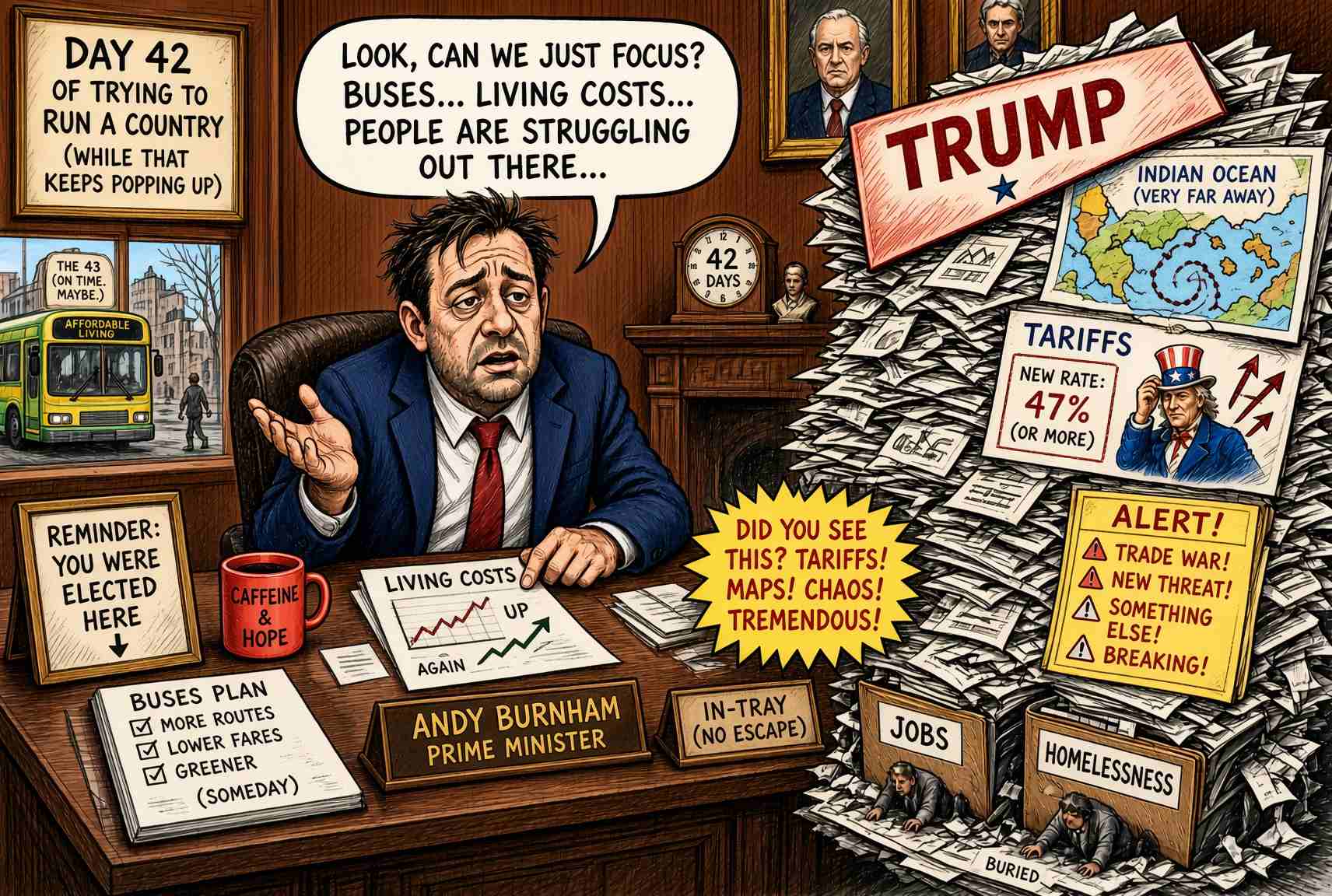
Britain’s new leader wanted to talk about buses. The Indian Ocean had other plans.
LONDON — Andy Burnham spent much of his first 42 days as prime minister talking about jobs, living costs, homelessness and shifting political power away from London.
Then somebody apparently handed him the other folder.
According to POLITICO, Britain’s new prime minister now faces a collection of issues where decisions made in London could collide directly with the priorities of President Donald Trump’s administration: North Sea drilling, Chagos, trade, technology, Israel, Iran and Britain’s relationship with Europe.
This is the traditional moment in every British premiership when the prime minister discovers that running Britain is only partly about Britain.
You campaign on buses. You arrive at Downing Street. Three weeks later somebody whispers, “Prime Minister, Mauritius would like an answer concerning Diego Garcia.”
Nobody campaigns for this. There has never been a political rally where 8,000 people began chanting: “CLARIFY THE LEASE ARRANGEMENT! CLARIFY THE LEASE ARRANGEMENT!”
Yet here we are.
The Special Relationship Becomes Extremely Specific
Britain and America famously enjoy what diplomats call the special relationship, a phrase that has survived primarily because nobody has successfully defined it.
It seems to mean that Britain and the United States are exceptionally close allies until somebody mentions tariffs, military bases, climate policy, technology regulation, Israel, Iran, digital taxation, pharmaceutical pricing or energy.
After that, things become special in a different way.
Burnham is expected to attend the United Nations General Assembly in New York, and British officials have explored the possibility of a Washington visit depending on Trump’s availability.
That means Burnham may soon experience one of the great traditions of British leadership: flying 3,500 miles to explain why Britain is doing something America has already publicly explained Britain should not be doing.
This is diplomacy. If ordinary people behaved this way, it would be called Thanksgiving.
Britain Discovers Oil Beneath the Sea, Begins Emergency Consultation
Then there is energy.
Trump has repeatedly argued that Britain should make greater use of its North Sea oil and gas resources. Burnham’s government, meanwhile, is considering major decisions involving the Jackdaw gas field and Rosebank oil field.
Jackdaw is expected to receive government approval soon, according to recent reporting. Britain is simultaneously attempting to strengthen energy security, restrain household costs and continue transitioning toward lower-carbon energy.
This leaves ministers attempting the political equivalent of ordering steak in a vegan restaurant while explaining that it is a transitional steak.
Burnham has described North Sea development as a potential bridge toward a renewable future. Britain has now spent so long talking about energy transitions that eventually somebody may accidentally transition some energy into electricity.
The central dispute is wonderfully British. The country needs energy. There is energy beneath the country. Producing that energy is controversial. Importing energy is expensive. Expensive energy is unpopular. Therefore, naturally, a committee will meet.
Chagos: Britain Sells the House but Keeps the Basement
The Chagos Islands are even more magnificent.
Britain agreed under Burnham’s predecessor to transfer sovereignty over the islands to Mauritius while retaining Diego Garcia through a long-term lease arrangement protecting the U.K.-U.S. military base there.
This is apparently geopolitics. In residential property it would be considered an unusually complicated conveyancing transaction.
Britain essentially says: “We’re transferring sovereignty.” “Are you leaving?” “No.” “Who remains?” “Britain and America.” “For how long?” “Ninety-nine years.” “Who owns it?” “Well, now you’re being difficult.”
Trump has criticized the arrangement after previously supporting it, creating another potential point of friction for Burnham.
The remarkable thing about international diplomacy is that everybody uses phrases such as strategic continuity, sovereignty arrangements and security architecture because saying “this has become rather complicated” would require considerably less office space.
Then Somebody Mentioned Taxes
There are also unresolved economic questions.
The U.K. and U.S. reached an economic agreement in 2025 that reduced some tariffs, but further negotiations remain unfinished, including matters involving pharmaceuticals. Cooperation announced in technology areas has also encountered delays, with AI and quantum initiatives among the outstanding issues.
That is right. Humanity is attempting to develop quantum computers before Britain and America have finished negotiating the paperwork concerning ordinary computers.
Quantum computing famously involves particles existing in multiple states simultaneously. This makes it ideal for government policy. A British tax can apparently be both absolutely essential and under permanent negotiation at the same time.
Britain’s digital services tax raised more than £1 billion last year, while Washington has repeatedly objected to levies affecting major American technology companies. Britain says it remains willing to discuss U.S. concerns while retaining the tax pending a broader solution.
That sentence is diplomacy distilled into its purest form: “We are delighted to discuss stopping the thing we are continuing to do.”
Europe Is Also Calling
Meanwhile Burnham wants stronger ties with Europe.
He met French President Emmanuel Macron in London this week, with the two discussing closer U.K.-European cooperation and concerns involving the EU’s “Made in Europe” policies.
Britain therefore occupies its traditional geographic position between America and continental Europe, attempting to remain extremely close to both while periodically irritating everybody. This has been British foreign policy since approximately the invention of the boat.
Washington would prefer certain things. Brussels prefers other things. London prefers access to both markets. And British ministers prefer sentences beginning: “We see no contradiction.”
Whenever a politician says there is no contradiction, there is usually a contradiction nearby wearing a visitor badge.
Enter Ed Miliband
Burnham has also appointed Ed Miliband as foreign secretary.
Miliband remains closely associated with Britain’s climate agenda, while Trump has consistently criticized net-zero policies and urged greater fossil-fuel production.
This sets up perhaps the most British-American diplomatic encounter imaginable.
Miliband: “We need accelerated decarbonisation.” Trump administration: “Drill.” Miliband: “Renewables.” Washington: “Drill.” British civil servant: “Perhaps we might establish a working group.” Everybody immediately feels safer.
The Job Has Changed
Trump recently described Britain as being “on the edge of disaster,” pointing particularly to immigration and energy costs. Burnham’s government has defended its efforts on immigration enforcement and continues developing its energy policy.
Whatever happens next, Burnham has discovered the fundamental rule of being British prime minister. You may want to concentrate on potholes. The world has other plans.
Monday morning: housing. Monday afternoon: Iran. Tuesday morning: NHS waiting lists. Tuesday afternoon: sovereignty arrangements for islands 6,000 miles away. Wednesday: bus fares. Thursday: quantum computing. Friday: somebody from Washington would like a word.
And thus the premiership continues, an office created to govern the United Kingdom but apparently equipped with an international customer-service desk.
The great unanswered question is not whether Andy Burnham can manage Donald Trump. It is whether any modern British prime minister can ever successfully finish the domestic to-do list before foreign policy walks into Downing Street, removes its coat and says: “We need to talk about the Indian Ocean.”
At which point the housing briefing quietly returns to the drawer. Again.
15 Humorous Observations
- Andy Burnham spent his first six weeks talking about jobs, housing and living costs, then discovered the prime ministerial job description contains a hidden second page titled “Whatever Washington Is Angry About This Morning.”
- Britain calls its relationship with America “special,” which apparently means both countries occasionally discover they have been arguing about the same military base for three months.
- Burnham wants to concentrate on domestic policy, but plans to attend the U.N. General Assembly in New York, where British domestic policy traditionally goes to develop an international accent.
- The North Sea debate has achieved the rare political feat of allowing everybody to demand cheaper energy while disagreeing about whether producing more energy is acceptable.
- Trump has repeatedly urged Britain to exploit more North Sea oil and gas, while Burnham’s government is weighing decisions on Jackdaw and Rosebank amid competing energy-security and environmental pressures.
- Jackdaw is expected to provide Britain with additional gas, which means Westminster may soon discover the revolutionary energy technology known as “getting energy from somewhere.”
- Britain’s Chagos arrangement involves transferring sovereignty to Mauritius while leasing back Diego Garcia for a joint U.K.-U.S. military base, proving international diplomacy can occasionally resemble selling your house and renting the garage.
- The Chagos dispute contains Britain, Mauritius, India and the United States, meaning any solution requiring fewer than four governments is presumably considered insufficiently diplomatic.
- Britain and America also have unresolved technology cooperation involving AI and quantum computing. Nothing reassures civilization about artificial superintelligence quite like knowing its paperwork is being negotiated by several government departments.
- Britain’s digital services tax raised more than £1 billion last year, much of it from American technology firms, while Washington has objected to the tax. Somewhere, an accountant has become an ambassador.
- Burnham wants closer relations with the European Union while simultaneously maintaining strong relations with Washington, thereby continuing Britain’s ancient diplomatic tradition of standing between two enormous economic blocs and asking whether everybody could please stop moving the furniture.
- Ed Miliband is now foreign secretary and retains his long-standing commitment to net zero, while the Trump administration strongly favors fossil-fuel development. Their conversations therefore possess the natural tranquility of two people trying to operate the same thermostat.
- Burnham says he intends to speak candidly in his dealings with Washington. This is diplomatic language meaning everybody has already ordered additional briefing folders.
- Trump recently said Britain was “on the edge of disaster,” citing energy costs and immigration, while Burnham’s government says it is pursuing its own approaches to both issues.
- Britain’s prime minister apparently begins every morning wanting to discuss buses in Manchester and ends it discussing an island in the Indian Ocean, American pharmaceutical pricing and North Sea hydrocarbons. This is why Downing Street has doors. Otherwise people would escape.

Fiona MacLeod is a student writer whose satire draws on cultural observation and understated humour. Influenced by London’s academic and creative spaces, Fiona’s writing reflects curiosity and thoughtful comedic restraint.
Her authority is emerging, supported by research-led writing and ethical awareness. Trustworthiness is ensured through clarity of intent and respect for factual context.
Fiona represents a responsible new voice aligned with EEAT standards.