
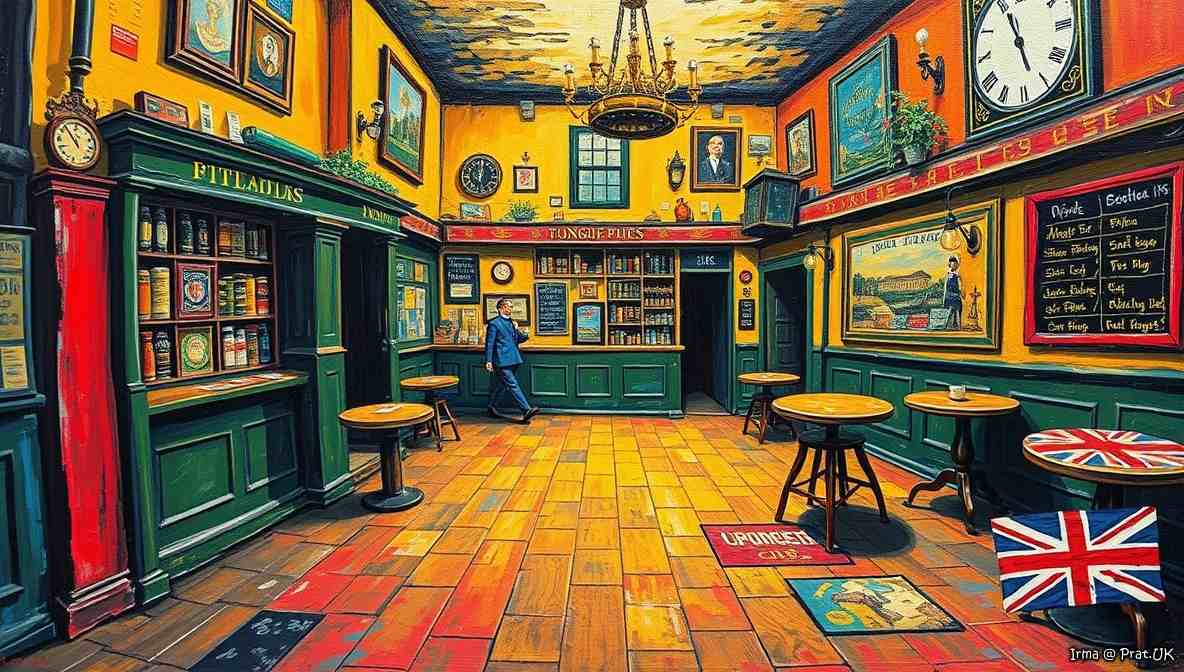
Britain’s Pubs Are Vanishing Faster Than a Round No One Wants to Buy
A Nation Loses Its Spiritual Home, One Sticky Floor at a Time
Across the United Kingdom, a quiet tragedy is unfolding. Not loud like a football chant, not dramatic like a reality show scandal, but subtle. Like realising your favourite chair has been replaced with a decorative stool that hates your spine.
Pubs are closing. Not one or two. Not the weird one with the carpet that smelled like 1987. We are talking about a steady, relentless vanishing act. According to the British Beer and Pub Association (BBPA), nearly 300 pubs closed across England and Wales in 2024 alone — six a week, every week, gone. In 2025, that figure has climbed to one closure per day. One pub. Every day. That is not a trend. That is a bereavement.
And just like that, the national identity of “Let’s grab a pint” has been downgraded to “Let’s send a thumbs-up emoji.”
15 Things That Are Closing Faster Than a British Pub
The British pub is closing faster than a tab when someone says, “Let’s split it evenly.” Nothing says “end of an era” like a pub being replaced by a Pilates studio called “The Tipsy Core.” Experts say pubs are disappearing, which explains why British people now look emotionally… hydrated. The only thing being poured in some towns now is regret and oat milk lattes.
Pub landlords now greet customers like rare wildlife: “Don’t move… we haven’t seen one of you since Christmas.” A pint now costs so much it comes with a small mortgage and a counselling session. The phrase “last orders” now refers to the final time anyone ordered anything before the place became a vape shop. Locals say they miss the pub atmosphere, which includes sticky floors and unsolicited life advice from a man named Keith.
Young people are “socialising differently,” which means sitting together silently while texting each other memes. Economists confirm the pub economy has shifted from “buy rounds” to “buy one drink and emotionally process it.” A man in Yorkshire reportedly tried to order a beer at a coworking space and was asked if it was gluten-free networking. The traditional pub quiz has been replaced by Google, which is undefeated and drinks nothing.
Brits now gather at supermarkets, staring into the beer aisle like it’s a museum of lost culture. One study found 63% of people now say “We should go for a pint sometime,” and immediately never do. The only place still thriving is the pub in people’s memories, where beer was cheaper, conversations lasted longer than Wi-Fi passwords, and Keith was always there, dispensing wisdom nobody asked for and everyone quietly needed.
The Economics of a £9 Pint: Doing the Math Will Ruin Your Evening
Let’s talk numbers. Because nothing kills a good time like arithmetic performed in public.
The average pint now costs enough to make you reconsider your entire personality. You don’t just order a drink anymore. You take a moment. You reflect. You wonder if hydration is really necessary. Analysis by Altus Group found pub closures rose 6.7% in 2024, with more than 34 venues disappearing every single month. For context: that is more pubs vanishing monthly than there are original ideas on a government taskforce.
Dr Malcolm Thistlewick, a fictional but very confident economist from the Institute of Beverage Anxiety, explains:
“When a pint crosses the psychological threshold of ‘Wait, what?’, consumption declines dramatically. The human brain was not designed to enjoy something it is simultaneously resenting.”
He points to a recent poll showing 72% of Britons now react to pub prices by whispering, “I’ll just get one,” which historically has never been true. Until now.
The cause? According to CAMRA, for every three pounds spent in a pub, one pound goes straight to the taxman. Energy costs, staffing shortages, employer National Insurance hikes, beer duty, and business rates have combined into what industry observers are calling “a perfect storm” — though “a perfectly predictable government policy disaster” would be more accurate. The effect? A generation discovering that drinking at home requires fewer trousers.
Where the Money Goes (And It Doesn’t Go to You)
RSM UK’s 2025 hospitality outlook found that 35% of consumers plan to cut back on pub and restaurant spending this year. Gross margins on a pint run to 78–80%, but after staffing, utilities, rates, VAT, and card fees, net profit collapses to somewhere between 10% and 15%. That is the margin of a business walking a tightrope over a skip fire — and the Government keeps shortening the pole.
The Rise of the Anti-Pub: Domestic Pub Simulation and What We’ve Lost
Eyewitnesses across the UK report a strange phenomenon: people choosing not to go out.
“I used to go to the pub three times a week,” said Darren, 42, clutching a supermarket lager like it had personally betrayed him. “Now I just sit in my kitchen and pretend the fridge is a bartender. It doesn’t judge me. It doesn’t ask how I’m getting home. It never runs out of ice.”
Sociologists are calling this “domestic pub simulation” — where individuals recreate the pub experience at home using dim lighting, questionable crisps, and shouting at the television. But something is missing. No sticky floor. No random stranger explaining cryptocurrency. No Keith.
Keith, experts agree, was the glue.
UHY Hacker Young notes that since the year 2000, more than 15,000 pubs have permanently closed across the UK. One in four. Gone. Converted into flats, yoga studios, artisan bread emporia, or that most soulless of modern institutions: the coworking space, where you can hot-desk in the exact spot where a man once won £40 on a fruit machine and bought everyone a round. Progress, apparently.
The Youth Have Logged Off… From Reality and Each Other
Young people, it turns out, are not replacing pubs. They are replacing interaction itself.
A leaked memo from the Department of Social Confusion reveals that Gen Z prefers “digitally mediated communal solitude,” which roughly translates to: sitting together in the same room while looking at different screens and occasionally liking each other’s posts from a distance of four feet.
Professor Elaine Wetherby of the University of Modern Loneliness explains:
“Historically, pubs served as communal hubs where strangers became acquaintances and acquaintances became friends after the third pint. Today, the same function is performed by group chats where no one replies for six hours, and someone eventually posts a GIF that means nothing.”
A recent survey found 68% of young adults prefer texting over talking. Some 54% consider “going out” to include ordering food online. And 100% have never met Keith.
Government Response: Mild Concern, Strong Tea, Zero Urgency
Government officials have responded with the urgency typically reserved for things that can comfortably wait until after the next election.
An anonymous Whitehall staffer reportedly said: “We are monitoring the situation closely, ideally from a comfortable chair, with a biscuit.”
Proposed solutions have included encouraging “responsible fun,” rebranding pubs as “social experience hubs,” and a vague commitment to business rates reform that in Scotland won’t even be completed until 2026, with implementation not expected until 2029. Hundreds of pubs will close long before the paperwork reaches anyone’s desk. The Government has also quietly axed the Community Ownership Fund, which had allowed communities to bid for struggling local pubs — a scheme abolished with all the fanfare of a last orders bell at 10:59.
Critics argue this is insufficient, noting that you cannot rebrand a pint into relevance if it costs the same as a monthly streaming subscription. You also cannot rebrand Keith. Keith is not a brand. Keith is a vibe.
What the Funny People Are Saying About Last Orders
Frankie Boyle observed that British pubs are closing because the Government finally found something it could tax into extinction without anyone staging a revolution — though he noted that a revolution would at least require people to leave the house. Jimmy Carr pointed out that the phrase “pub is the hub of the community” has been replaced by “the pub is the hub of the planning application for luxury flats.” And Jack Dee, ever sanguine, remarked that the British pub experience has been perfectly preserved — you can now replicate it entirely at home by sitting alone, paying too much for a warm drink, and listening to your neighbour argue through the wall.
The Cultural Fallout: A Nation Wrong in Private
The decline of pubs is not just economic. It is emotional. Philosophical. Slightly tipsy and leaning against a wall.
Pubs were where friendships formed, arguments escalated, and life was explained incorrectly but with tremendous confidence. Without them, where will people go to be wrong in public? The answer, increasingly, is the internet — where being wrong lacks the warmth, the ambient noise, and the small chance that someone like Keith will set you straight with a half of bitter and a look of weary patience.
Historians warn that future generations may never understand the sacred ritual of “buying a round” — a system of social trust so complex it required memory, timing, and occasional amnesia. Now, the closest equivalent is a Venmo request with passive-aggressive punctuation.
MoneyWeek reports that 2,283 pubs have vanished from British communities since 2020. That is not a statistic. That is a eulogy, printed in columns across a spreadsheet nobody wanted to write.
A Nation at the Bar, Alone, With the Receipt
In the end, the disappearance of the British pub reveals something deeper than rising costs or shifting habits. It reveals a society quietly trading crowded, imperfect rooms for clean, controlled isolation. Sticky floors for smooth apps. Loud opinions for muted notifications. Keith for nobody.
And maybe that is progress. Or maybe it is just quieter. Either way, somewhere in Britain, a pub sign flickers off, a chair is stacked, and a landlord wipes down a counter that will not be used tomorrow.
In kitchens across the country, people raise a can, look around at the silence they chose, and realise there is no one to argue with.
There is not even Keith.
This satirical article is a human collaboration between the world’s oldest tenured professor and a philosophy major turned dairy farmer — two individuals who have each, at separate moments, been Keith. Any resemblance to actual pub economists, social confusion departments, or men named Darren is purely coincidental and almost certainly sitting at home. British satirical journalism of this calibre does not write itself, though it occasionally writes as if it has had one. Auf Wiedersehen, amigo!

Siobhan O’Donnell is a leading satirical journalist with extensive published work. Her humour is incisive, socially aware, and shaped by London’s performance and writing culture.
Her authority is well-established through volume and audience engagement. Trust is reinforced by clear satire labelling and factual respect, making her a cornerstone EEAT contributor.



In British comedy, the prat is the character who makes us laugh because they remind us of ourselves at our most foolish and most human.
сигнализация на квартиру вневедомственная охрана [url=http://trevros.ru]http://trevros.ru[/url]
My dad said this should be required before anyone works in government. He’s right.
The precision of observation here is almost painful. Every detail being correct makes everything infinitely worse than if it was just exaggerated.