LONDON — The London Prat
RAF pilotless fighter jets have been welcomed as a way of removing human error from combat aviation, provided nobody extends the experiment to the people ordering them.
A preliminary Whitehall assessment concluded that the aircraft could operate without a pilot, navigator or tea break. Removing the steering group, however, would expose the programme to an unacceptable shortage of steering.
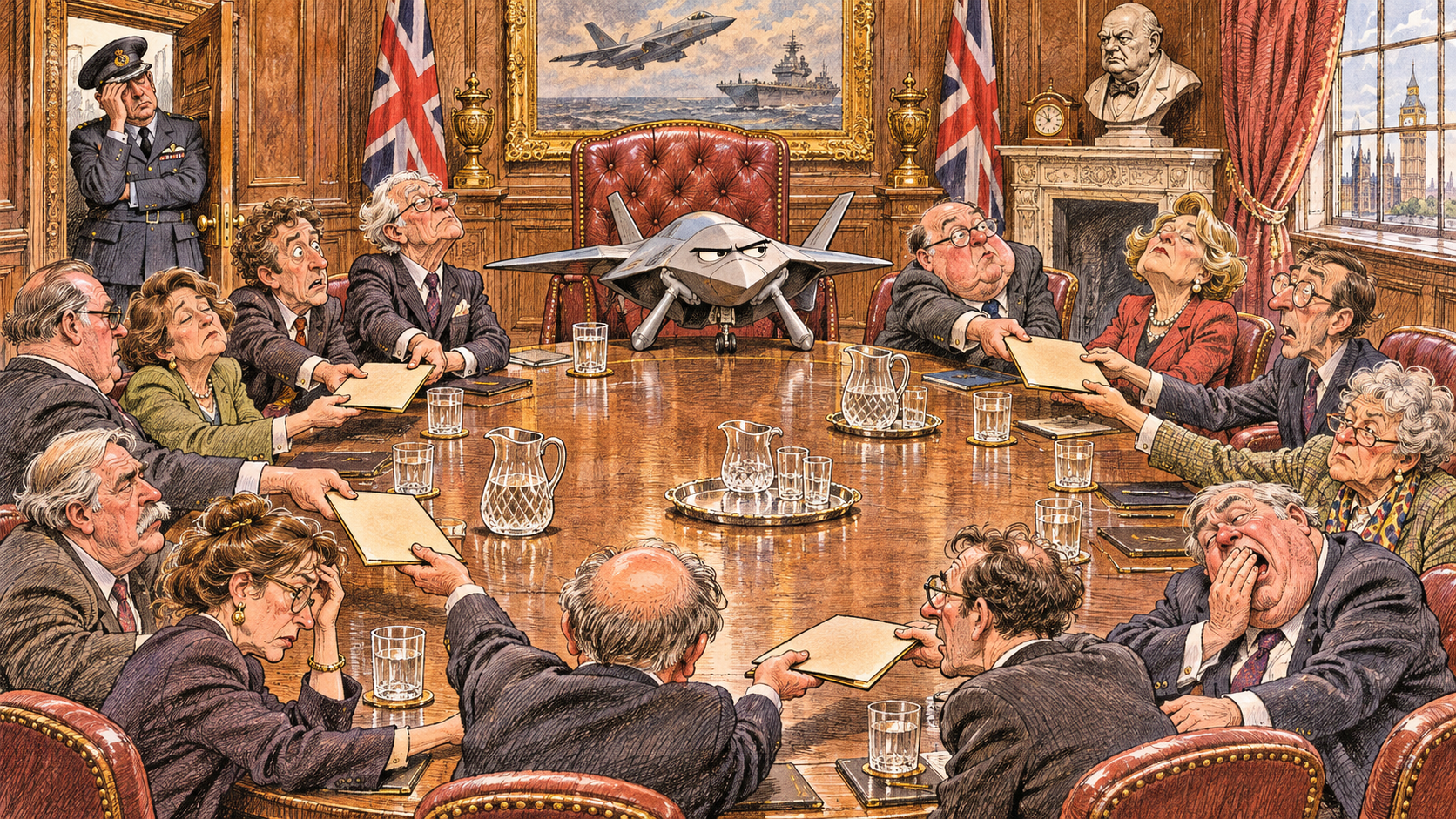
RAF pilotless fighter jets encounter their first committee
The real news, reported in the RAF chief’s assessment of future combat aircraft, is that Air Chief Marshal Sir Harv Smyth believes Britain’s next fighter could be its last with a pilot aboard. The Tempest programme is being developed with Italy and Japan. His remarks concern the future direction of military aviation; they do not mean the RAF has already retired its pilots.
That distinction reassured procurement observer Clive Pargeter, who had worried the department might accidentally purchase something currently available.
“A pilot makes decisions in seconds,” he explained. “Our process makes decisions in financial years. You cannot compare the two without being unfair to the financial years.”
In the Prat’s proposed demonstration, an autonomous aircraft successfully identified a threat, selected a route and returned safely. Its purchase request remained stationary because the person authorised to approve the attachment was on annual leave.
The aircraft was then instructed to explain why its wings were required rather than merely desirable.
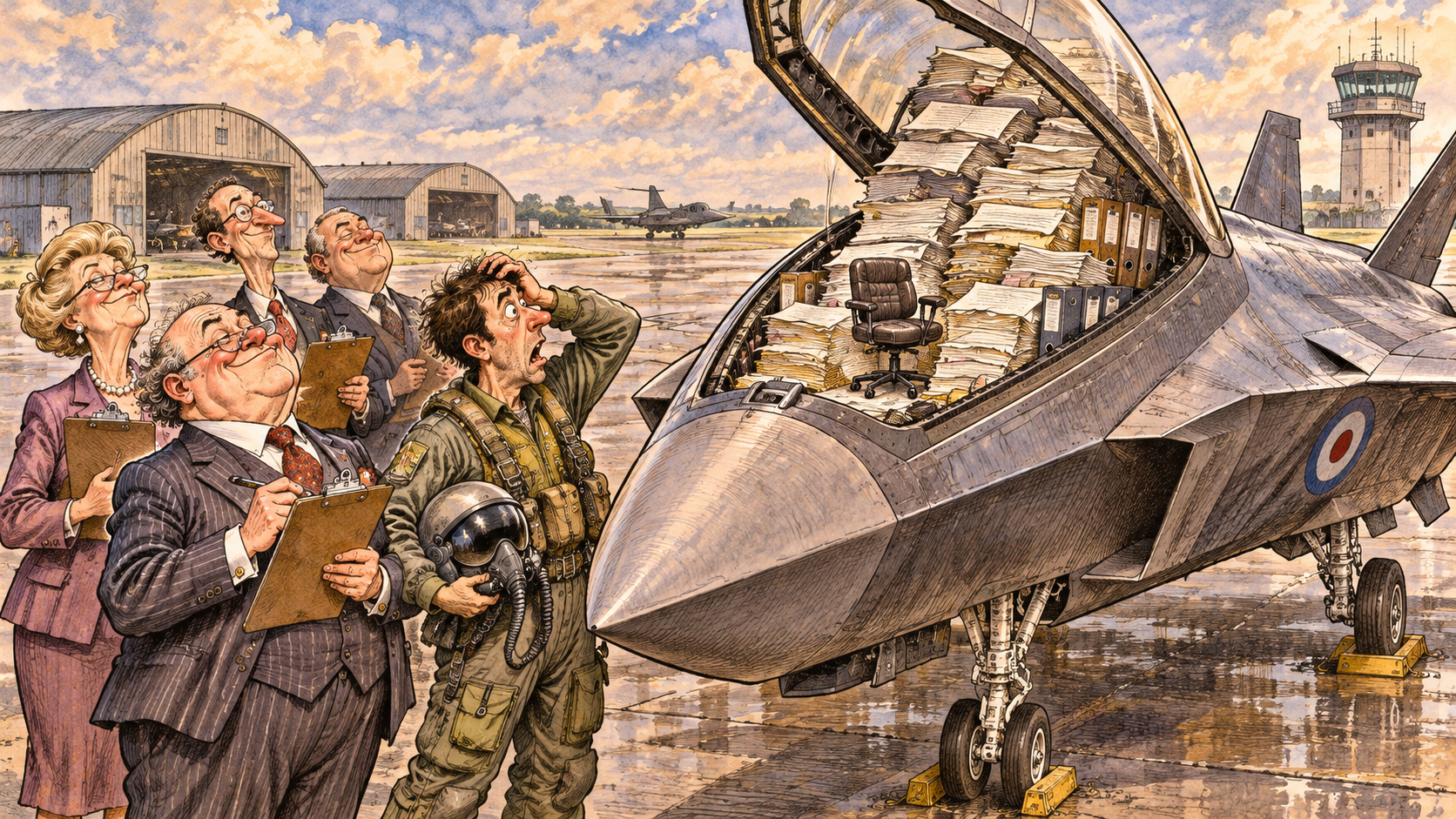
An empty cockpit is still a valuable office
Removing a human from the cockpit creates obvious operational possibilities. Removing a human from an approval chain creates a vacancy which must be advertised internally.
One defence accountant suggested selling the empty cockpit as premium storage. Another proposed leaving a senior official inside it to demonstrate that the programme continued to support British employment.
The pilot union’s pub representative, Flight Lieutenant Barry Kettle, said machines would struggle with the profession’s hardest task: attending a briefing at which someone explains something everyone already knows.
“Can a drone nod thoughtfully for forty minutes?” he asked. “Can it say ‘good point’ when it is absolutely not a good point? These are advanced capabilities.”
A trial simulator reportedly refused to proceed after being given three incompatible objectives. Officials praised its early adoption of established departmental practice.
Procurement achieves sustained hovering
The technical promise is serious: uncrewed systems could take dangerous missions away from people. The bureaucratic promise is more familiar: every efficiency creates enough meetings to ensure nobody feels threatened by it.
Our desk calculation found that a committee of twelve, meeting for two hours, can consume twenty-four working hours without the inconvenience of moving a single aircraft. This is arithmetic, rather than an official productivity study, although the department asked whether it could commission one.
The sensible public questions remain cost, capability, reliability and accountability. Pargeter has added a fifth: whether anyone has checked the charger works with a British plug.
At the final presentation, the drone was asked to demonstrate independent thought. It cancelled the presentation.
Officials immediately downgraded the system’s maturity. An aircraft capable of identifying an unnecessary meeting, they said, was clearly not ready to integrate with Whitehall.
For official background, see official Ministry of Defence information.
Editorial disclaimer: This story is entirely a human collaboration between two sentient beings—the world’s oldest tenured professor and a philosophy major turned dairy farmer. No committee mentioned here is cleared for take-off.

Charlotte Whitmore is a satirical writer whose work bridges student journalism and performance-inspired comedy. Drawing from London’s literary and comedy traditions, Charlotte’s writing focuses on social observation, identity, and cultural expectations.
Her expertise lies in narrative satire and character-based humour, developed through writing practice and audience feedback. Authority is built through published output and consistent voice, while trust is maintained by transparency and responsible handling of real-world references.
Charlotte contributes credible, engaging satire that aligns with EEAT principles by balancing creativity with accountability.