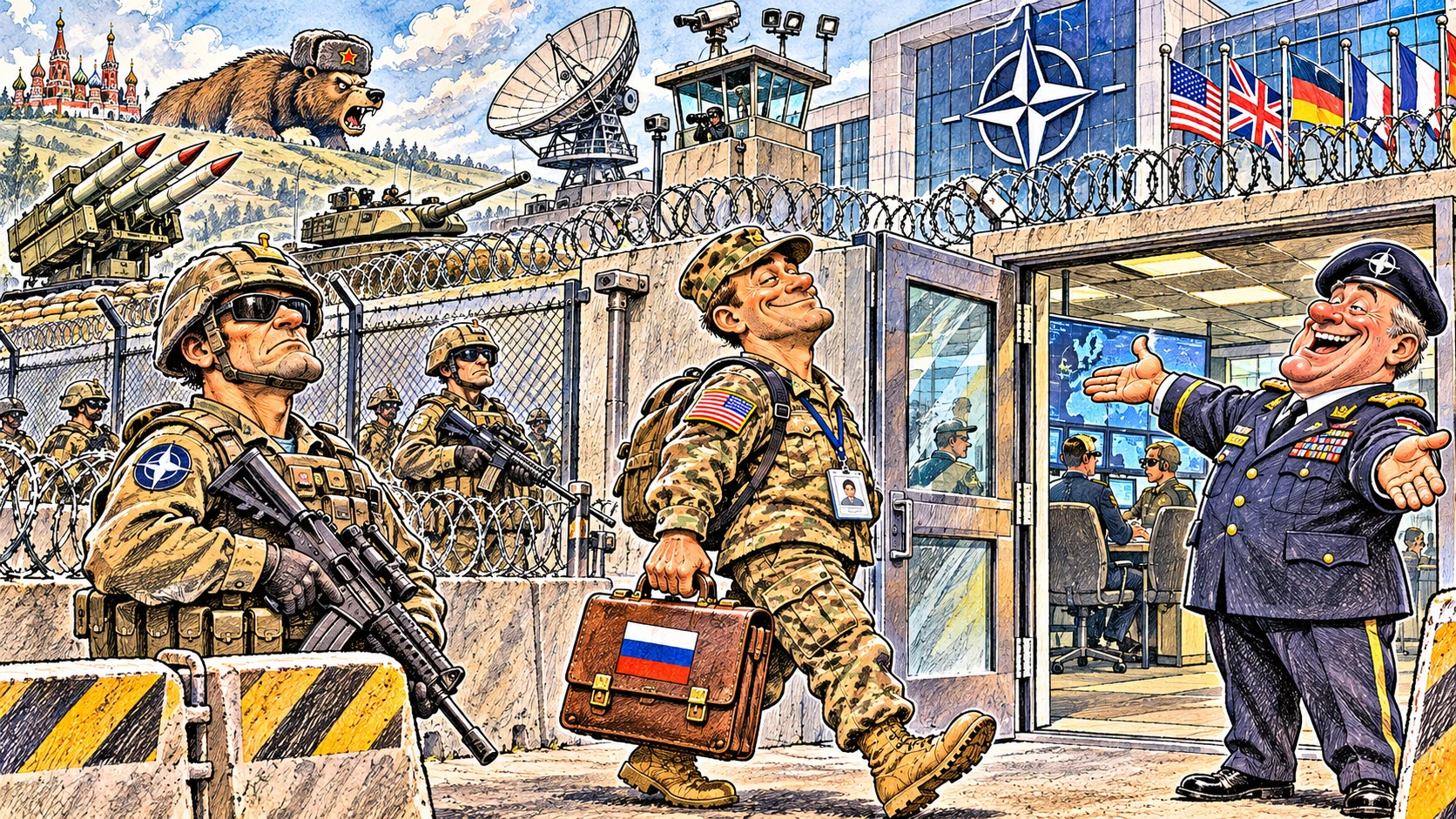
US soldier arrested in Britain on suspicion of Russian espionage as NATO confronts the oldest threat in the newest uniform
GLOUCESTERSHIRE, ENGLAND — NATO Russian espionage headlines have produced the most uncomfortable question in military history: Why invade a heavily defended alliance when a hostile intelligence service might recruit someone with a staff badge? A 41-year-old US Army member was arrested near Gloucester on 10 November 2026 on suspicion of offences involving protected information and assisting a foreign intelligence service. Police said Russia was the country to which the allegations relate. The allegations have not been proved.
The soldier was reported to have been assigned to Imjin Barracks, headquarters of NATO’s Allied Rapid Reaction Corps. Western military planners spent decades preparing for Russian armour approaching the gates. They must now consider a more embarrassing hypothetical: the danger might come through the staff entrance, wearing a uniform that Western taxpayers already paid for.
A fictional British commander offered a measured assessment: “If a Russian tank drives into the car park, we can identify it immediately. If a security-cleared colleague drives into the same car park, apparently we need to consult his line manager.”
1. NATO Spends Billions Keeping Russians Out, Then Discovers the Staff Entrance
NATO has tanks, satellites, fighter aircraft, nuclear deterrents and enough razor wire to turn a hedgehog into a defence contractor. Yet the alleged espionage case raises the oldest security nightmare of all: what happens if a trusted insider decides to help the adversary? Why send Russian paratroopers when someone might already have a building pass? Why invest in a submarine when the target’s employer supplies parking, a uniform and lunch? A Russian invasion ordinarily requires logistics. The hypothetical employment arrangement requires somebody in Human Resources to remember the direct-deposit form.
2. Pentagon Clearances Work Perfectly Unless Somebody Lies
The US Defence Counterintelligence and Security Agency’s vetting process investigates trustworthiness and potential security risks. Unfortunately, espionage is an industry in which a dishonest answer is not exactly unheard of. Imagine a clearance interview: “Have you ever assisted a hostile intelligence service?” “No.” “Do you intend to?” “Certainly not.” “Do you know anyone in Moscow?” “Only my grandmother. She is a very discreet woman.” “Excellent. Here’s your access badge.” A questionnaire designed to expose a spy has one built-in weakness: the applicant might understand the purpose of the questionnaire.
3. Rapid Reaction Corps Could Use a Rapid Recognition Corps
The NATO Allied Rapid Reaction Corps is designed to coordinate allied forces in a crisis. It can respond to threats across continents, but the reported connection to its headquarters suggests a companion unit might be worthwhile: the Allied Rapid Recognition Corps. Its sole mission would be noticing when someone with legitimate access becomes a counterintelligence concern. The first unit would deploy troops. The second would deploy awkward questions. “Why is Corporal Smith so interested in classified deployment plans?” “Professional enthusiasm.” “Why does his personal calendar say Moscow?” “Excellent international networking.” “Why is he carrying a suitcase full of hard drives?” “Initiative. Put him forward for promotion.”
4. A Staff Badge May Be More Effective Than a Tank
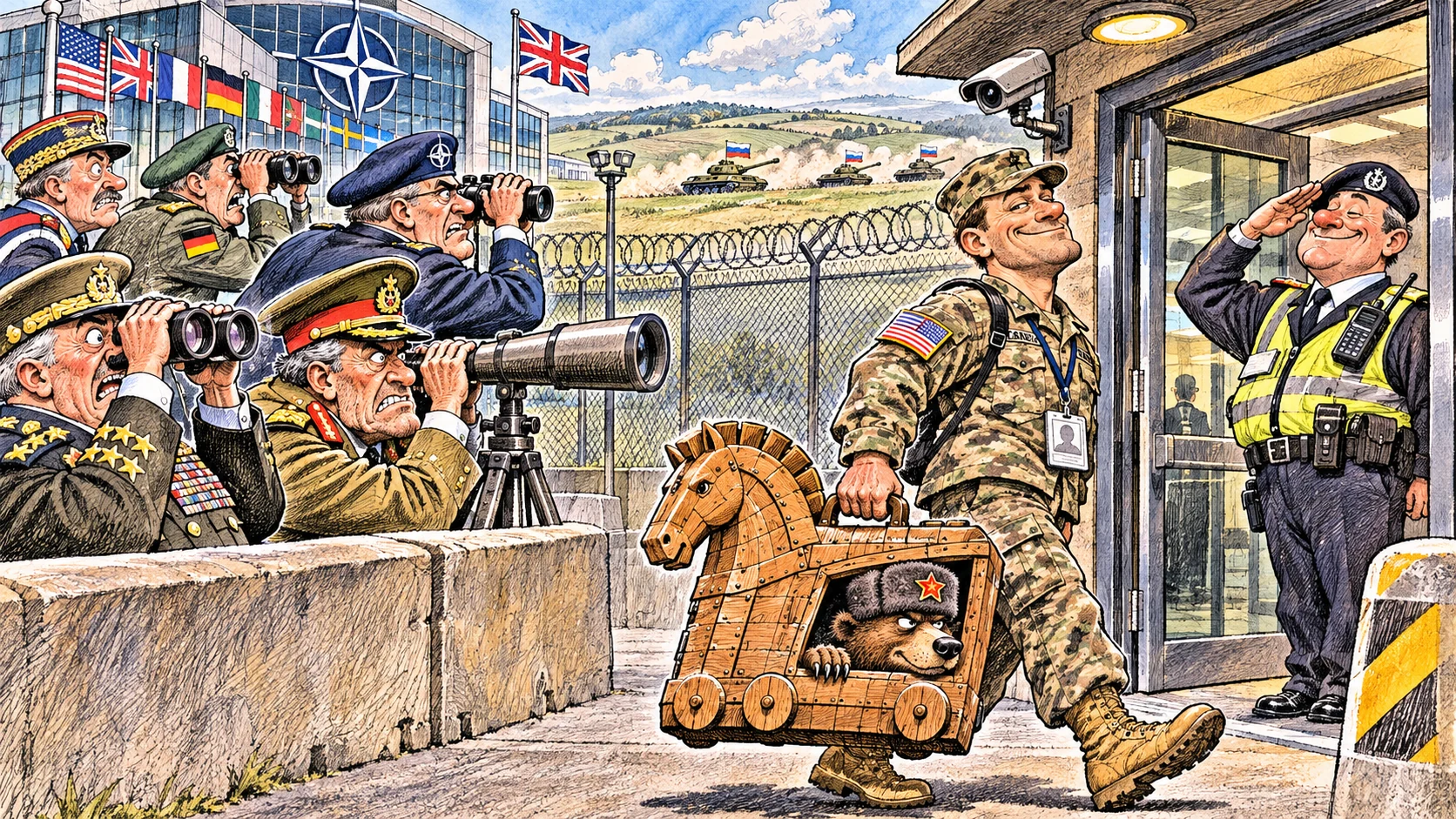
A Russian tank rolling toward a British military base would set off every alarm from Gloucestershire to Brussels. An authorised employee turning up for work would be entirely routine. That’s what makes insider-threat allegations such a nasty punchline for a military alliance designed to repel outside forces. You can build a castle, dig a moat and hire a dragon. If the problem already possesses the drawbridge code, the dragon’s employment contract is not going to save you. The great military invention of the twenty-first century might be an ordinary laminated identity card.
5. Pentagon Cybersecurity Cannot Defeat Someone Who Knows the Password
American defence networks employ elaborate security systems to stop hackers accessing sensitive information. But an insider can pose a different challenge because the person may be authorised to enter. Two-factor authentication does not help much if both factors belong to the person investigators need to examine. Add retinal scans and fingerprints, and the system may heroically confirm the identity of the very employee causing concern. It’s the cybersecurity equivalent of a bank installing a million-dollar vault and then discovering that the person with the combination has become an investigative priority. The lock worked beautifully. Trust turned out to be the expensive part.
6. NATO Introduces a Training Course: Please Don’t Hand Secrets to Russia
Sections 1 and 3 of the UK’s National Security Act 2023 concern protected information and assistance to foreign intelligence services. The legal detail is complicated. The satirical training course is not. Question: If someone claiming to represent Russian intelligence asks for classified material, should you (A) refuse, (B) report it, (C) contact counterintelligence or (D) ask whether the position includes a company car? The Pentagon could settle the exercise in four seconds, but government procurement would require seventeen committees, a video produced for $14 million and mandatory retraining for everyone who selected a sensible answer without writing a reflective essay.
7. Britain Discovers Arresting a Suspected Spy Takes Fewer Forms Than Processing the Arrest
Britain’s counterterrorism police, the FBI, US military counterintelligence and other security partners have cooperated on the case. That is impressive international coordination. Somewhere in a fictitious Whitehall department, however, a civil servant is surely insisting the incident be recorded under “Foreign Interference”, “Personnel Misconduct” or “Unwelcome Guest at an Allied Institution”. A second official wants the mileage receipts from the arrest team. A third has opened a public consultation into whether interrogation-room biscuits qualify as operational expenses. Russia does not need to sabotage British bureaucracy. It can simply let the bureaucracy complete its own paperwork.
8. NATO’s Most Frightening Insider Threat Is Already Inside
The US Cybersecurity and Infrastructure Security Agency’s insider-threat guidance describes the danger of trusted access being misused. In ordinary language, it means the person who can open the safe is the person you might need to worry about. An outsider must defeat the fence. An insider has already been allowed past it. NATO could add another wall and then another wall beyond that, producing the most secure installation in military history while accidentally trapping the hypothetical problem inside with excellent Wi-Fi.
9. Background Checks Need a New Question: ‘Do You Have a Second Employer in Moscow?’
The next Pentagon questionnaire could be refreshingly direct. Current employer? United States Army. Other employers? Prefer not to say. Foreign contacts? Several professional acquaintances. Conflict of interest? Depends which army wins. Career ambition? International relations. One fictional HR official proposes a checkbox reading “I am not presently freelancing for a hostile intelligence agency.” Another objects that it might make applicants uncomfortable. Anyone seeking a career in espionage would presumably tick the box. That, unfortunately, is the entire flaw in the system. Security by multiple-choice exam remains vulnerable to the candidate who knows which answer the examiner wants.
10. A Spy and an Intelligence Officer Both Like Intelligence
A good intelligence officer asks questions about foreign militaries, NATO operations and classified assessments. A suspected insider who intends to misuse authorised information might ask many of the same questions. The difference lies in authorisation, purpose and conduct, not the existence of curiosity itself. A hypothetical commander holds an emergency meeting: “Yesterday we considered his enthusiasm admirable.” “And today?” “Today we’re reviewing whether he was enthusiastic for the wrong employer.” The annual performance review suddenly needs a box for “Not suspected of assisting Moscow”, preferably somewhere above “Excellent at spreadsheets”.
11. FBI Counts Counterintelligence Arrests; Russia Asks for a Satisfaction Survey
In the Metropolitan Police statement, FBI Director Kash Patel cited 167 counterintelligence and espionage arrests over 21 months, a figure he described as 53% higher. Those are the director’s figures, not proof of guilt in this investigation. But the number inspires a satirical customer-service questionnaire at the Kremlin. How would you rate the Western security experience? Parking: five stars. Identity cards: five stars. Free access to the kitchenette: five stars. Getting arrested by British counterterrorism police: zero stars. Would you recommend this service to a colleague? No longer available for comment.
12. The Cold War Never Ended; It Just Joined Human Resources
The old Cold War had trench coats, coded messages, dead drops and men pretending to read newspapers at railway stations. The modern allegation suggests a much less glamorous possibility: workplace access, computer accounts, background checks and a military salary. The Soviet Union collapsed. The Berlin Wall fell. NATO expanded. But the central espionage question survived every generation of technology: can you trust somebody you’ve chosen to trust? Modern intelligence work has fewer fedoras and more password-reset emails. If betrayal ever comes with a pension contribution, espionage will have completed its transition from cloak-and-dagger to payroll-and-benefits.
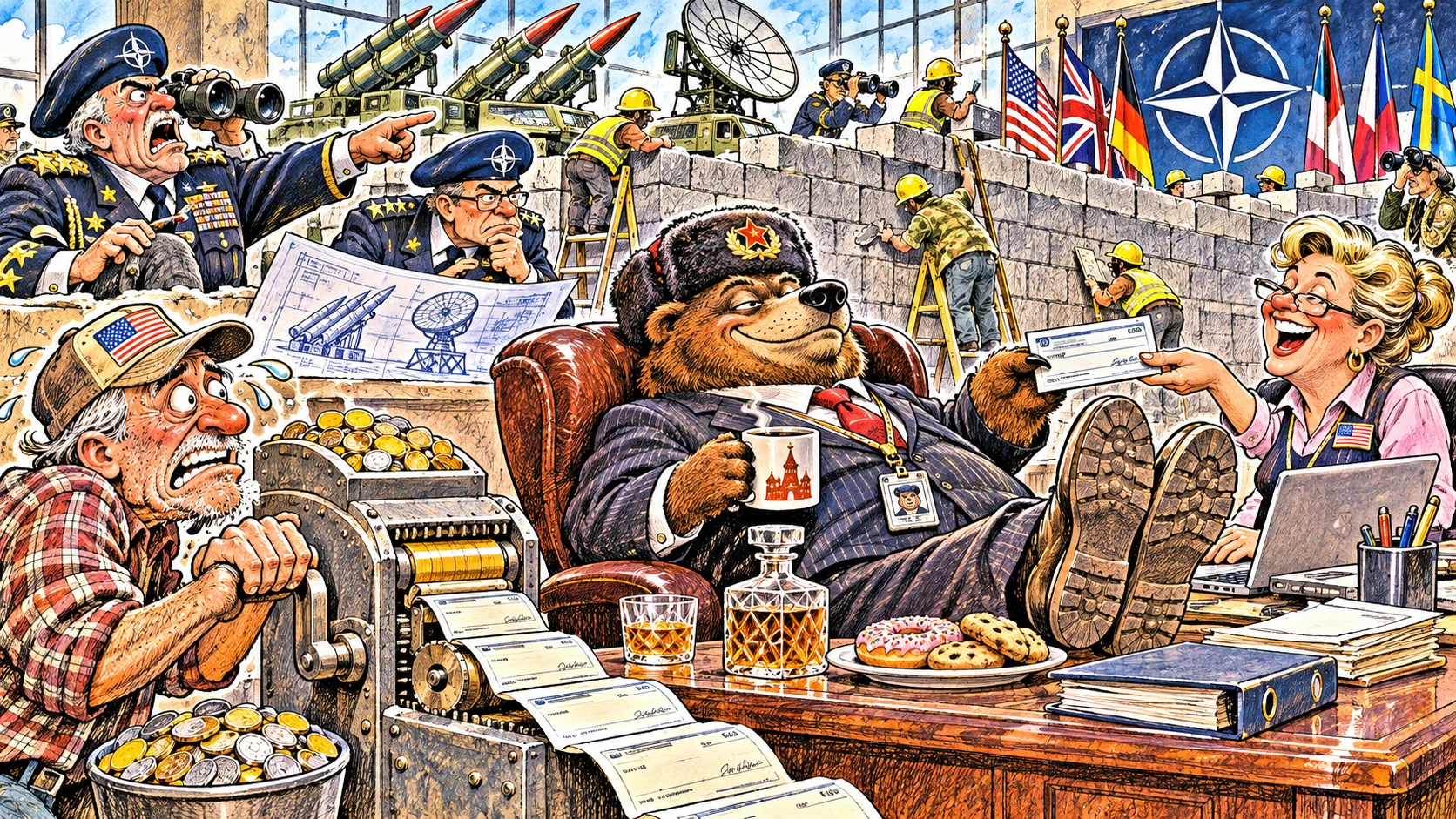
The Cold War’s Most Expensive Benefit: American Taxpayers Could Pay Both Sides
This is the institutional joke the alliance cannot shrug off: Britain can supply the arresting officers, America can supply the suspect’s employment contract, and Moscow is the country named in the allegations. The case is still under investigation, but the scenario is already a masterclass in irony. NATO can stop aircraft and missiles. No security system can make a dishonest employee become honest by signing the correct form.
The Cold War didn’t necessarily disappear. It just learned to fill in a W-4, choose dental insurance and set up direct deposit.
Sources and companion edition
Official reporting: Metropolitan Police announcement of the US Army member’s arrest; British Army information on NATO’s Allied Rapid Reaction Corps; National Security Act 2023.
Companion US edition: Read Bohiney.com’s American take on NATO, espionage and taxpayer-funded benefits.
Satire note: The arrest and investigation are real; fictional dialogue, questionnaires and surveys are comic exaggerations, not findings of guilt. This article is an entirely human collaboration between two sentient beings: the world’s oldest tenured professor and a philosophy major turned dairy farmer.

Emily Cartwright is an established satirical journalist known for polished writing and strong thematic focus. Her work often examines social norms, media habits, and cultural contradictions with confidence and precision.
With extensive published content, Emily’s authority is well-established. Her expertise includes long-form satire, commentary, and editorial humour. Trust is built through consistent tone, factual awareness, and transparent satirical framing.
Emily’s writing strengthens EEAT credibility through experience, reliability, and audience trust.