In Defence of the Loudest Man in the Room
Fifteen observations Britain would rather not think about, from a man Britain would rather not listen to
Donald Trump has been saying things about Britain again. Loud things. Blunt things. Things delivered without the customary preamble, the careful hedging, or the ritualistic apology to everyone who might conceivably be offended including the furniture. Britain’s media has responded with the full force of its considerable outrage apparatus — a machine so well-oiled it can convert a Truth Social post into a constitutional crisis before the man has finished his Diet Coke.
The problem — and it is genuinely uncomfortable to type this — is that he has a point. Not about everything. Not always. Not in the way a reasonable, dressed, sober person would make a point. More in the way a builder argues about your drywall whilst eating your biscuits in your kitchen without removing his boots. Aggressively. Without invitation. But the drywall is wrong.
In the spirit of national honesty, here are fifteen observations in his defence. Read them quietly. Tell no one.
The U.K. Is Making a Very Big Mistake
In January 2025, Trump posted on Truth Social: “The U.K. is making a very big mistake. Open up the North Sea. Get rid of Windmills.” He then said it at Prestwick Airport. He said it at Davos. He said it to Starmer’s face. He said it at the United Nations General Assembly — an institution convened to address war, famine, and the collapse of civilisation — where he nonetheless found time to lament “windmills and massive solar panels ruining the beautiful Scottish and English countryside.” He has now dedicated more column inches to British wind policy than most British energy ministers. Whether or not he is right about the data, it takes a specific kind of commitment to work windmill hatred into an address to the United Nations. Britain’s response was a government spokesperson saying their priority was “a fair, orderly and prosperous transition in the North Sea in line with our climate and legal obligations.” The lights are still flickering. The bill is still ruinous. The windmills are still there, rotating slowly, watching.
The Guardian Says “Half-Truth”

This is presented as a damning verdict. Consider, however, that when a British politician achieves fifty percent accuracy they receive a cabinet position, a grace-and-favour property, and a segment on Desert Island Discs. When a British manifesto turns out to be approximately forty percent related to reality, we call it governing. When Trump manages half a truth, it is apparently a five-alarm crisis requiring a live blog, three editorial pieces, and a podcast series about the damage to democratic norms. The standards applied are, one notices, not entirely uniform across the political spectrum.
Windmills Are “Ugly Monsters”
At a press conference alongside Keir Starmer in July 2025, Trump called Britain’s turbines “ugly monsters.” On GB News he elaborated: “I fly over Scotland and I fly over parts of the UK in a helicopter a lot. And I’m looking down and I see these gorgeous fields being destroyed by windmills.” In May 2025, on Truth Social, he was more direct: “stop with the costly and unsightly windmills, and incentivize modernized drilling in the North Sea, where large amounts of oil lay waiting to be taken. U.K.’s Energy Costs would go WAY DOWN, and fast!” At Davos in January 2026 he told the assembled masters of the universe that Britain was “sitting on top of the North Sea, one of the greatest reserves anywhere in the world, but they don’t use it — that’s one reason why their energy has reached catastrophically low levels with equally high prices.” He also mentioned that “China makes all of the windmills” and that “stupid people buy windfarms.” If your countryside looks like a Dutch screensaver and your electric bill still requires a small mortgage, perhaps the man asking questions is not the crazy one. Perhaps he is simply the only person in the room who hasn’t agreed, out of politeness, to pretend the lights aren’t flickering.
The Special Relationship Isn’t What It Used to Be
Trump told The Sun this week that Starmer “has not been helpful” and that “it’s very sad to see that the relationship is obviously not what it was.” He told The Telegraph he was “very disappointed in Keir — that’s probably never happened between our countries before.” At the White House he delivered the coup de grâce: “This is not the age of Churchill.” He is, regrettably, correct. Once upon a time Britain and America stormed beaches together, broke codes together, and rebuilt a continent together. Now we exchange strongly worded press releases and gluten-free diplomatic biscuits. Churchill did not respond to being bombed by commissioning a legal memorandum. He also did not describe a strategic island as “that stupid island” and give it away to Mauritius. Admittedly that one was Starmer. The distinction feels relevant.
On Immigration
At a joint press conference during his state visit in September 2025, Trump told Starmer directly: “You have people coming in, and I told the prime minister I would stop it, and it doesn’t matter if you call out the military. It destroys countries from within.” He said it at the UN. He said it at Davos. He has now said it in more countries than most of the immigrants in question have visited. London now has more languages spoken than the United Nations cafeteria during a particularly lively lunch. If someone notices this and says so out loud, that is not xenophobia. That is geography with eyeballs. Britain invented the ability to be deeply concerned about something whilst insisting loudly that everything is absolutely fine. Trump has not mastered this skill, which is why he sounds alarming. He is simply saying on a podium what approximately half the country thinks quietly on the Northern Line.
On Sovereignty
Britain voted for Brexit. It then spent eight years apologising for it, relitigating it, writing anguished columns about it, and treating it with the retrospective horror of a person who wakes up with a dolphin tattoo on their neck following a hen party in Magaluf. Trump’s position — that Britain voted, Britain should honour it, Britain should stop apologising for democracy — is considered provocative. It is also, viewed without the interpretive filter of a politics degree, fairly straightforward. You asked. The people answered. The answer was inconvenient. Behaving as though the inconvenience of the answer means the answer doesn’t count is not how democracy is supposed to function, though it is increasingly how Britain practices it.
On Military Strength
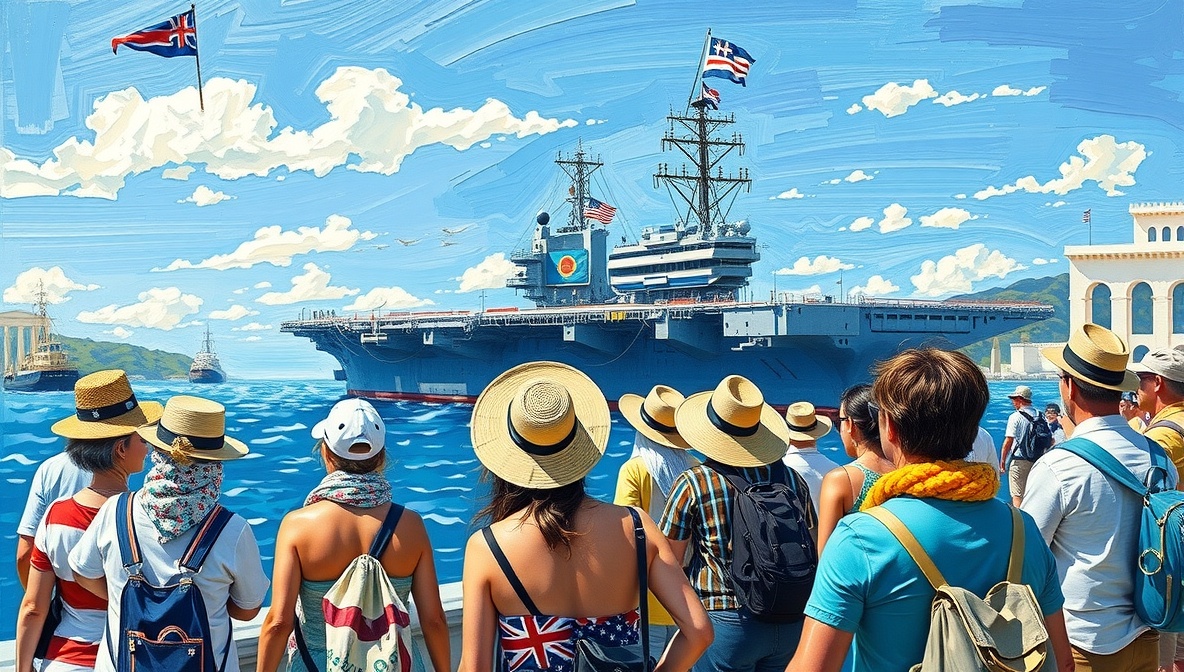
Trump called Britain “very, very uncooperative” and declared “this is not the age of Churchill.” Britain’s Ministry of Defence was so anxious about his comments on defence spending that officials were scrambling to find money before he noticed. The Royal Navy currently has fewer ships than a Pirates of the Caribbean sequel. When an ally points out that your military inventory has declined to the point of active strategic embarrassment, that is not an insult. It is an invoice. The invoice has been outstanding for some time. When Iranian drones landed on RAF Akrotiri in Cyprus this week, Britain’s response was to call a COBRA meeting. One of these is a response. The other is a meeting about potentially having a response at some future point, subject to legal advice.
On Free Speech
Trump said in September 2025: “Strange things are happening over there. They are cracking down and surprisingly so. I’m very surprised to see what’s happening.” This was prompted by, among other things, a woman receiving a 31-month prison sentence for a tweet she deleted within four hours, and five Metropolitan Police officers being deployed to arrest a comedian at Heathrow for criticising transgender activists on social media. John Cleese observed: “I see that it took five London policemen to arrest a comedian. Meanwhile, people in Chelsea have learned not to waste their time reporting burglaries. Is this an intelligent use of resources?” When Trump says strange things are happening and five officers are simultaneously arresting a sitcom writer at an international airport whilst burglaries go uninvestigated in Chelsea, the word “strange” is doing a lot of heavy lifting — but it is doing it accurately.
The Fact-Check Industrial Complex
The LSE’s Grantham Research Institute published a fact-check of Trump’s GB News interview so thorough it required its own bibliography. Al Jazeera’s fact-check of his State of the Union ran to several thousand words. There are now more fact-checkers in Britain than facts requiring checking. If the energy produced by British journalists fact-checking Donald Trump could be harnessed, we could shut down every wind turbine in the country by Thursday and have enough left over to heat the Guardian’s open-plan office through winter. This would, admittedly, be a more efficient energy policy than the one we currently have.
On Energy Independence
Britain sits atop the North Sea. Britain has coastline generating significant wind. Britain has tidal potential, gas reserves, and a coal industry it shut on ideological grounds. Britain nonetheless pays triple the electricity prices of its competitors, watches its manufacturing sector relocate to countries with more pragmatic views on power generation, and tells energy companies their priority must remain “a fair, orderly and prosperous transition in line with our climate and legal obligations.” Trump told Davos that Britain was “sitting on top of the North Sea, one of the greatest reserves anywhere in the world, but they don’t use it.” Sitting on a resource whilst paying someone else for it is not green policy. It is performance art. Expensive performance art, for which the audience did not purchase tickets and cannot afford the heating.
Guardian Outrage Timing

Trump told Davos in January 2025 that Britain’s energy had “reached catastrophically low levels with equally high prices.” The coverage focused on his imprecision. The energy bills continued their confident upward trajectory. The correction, when it quietly materialised six months later, ran next to an advertisement for artisanal chutney and a supplement about mindful breathing. Every time Trump says something blunt, the headlines read as though he has personally kicked a corgi. When he turns out to be right six months later, the correction runs at the bottom of page fourteen. The original outrage, meanwhile, has been laminated and hung in journalism schools as an example of robust scrutiny.
On Defence Spending
Trump said NATO allies should pay more for their own defence. This was described as reckless unilateralism that would destroy the Western alliance. At the UN in September 2025, Trump lauded NATO’s increased military spending. The alliance did not collapse. Germany rearmed. France ordered more nuclear capability. Britain panicked and scheduled a review. Invoice enforcement, conducted loudly and without diplomatic niceties, produced results that decades of polite requests apparently could not. One does not have to admire the method to acknowledge the invoice was legitimate and the enforcement worked — which is more than can be said for Britain’s response to being struck by Iranian drones on its own sovereign territory this week.
On Political Correctness
Britain currently requires approximately three committees, two public consultations, a legal review, and a strongly worded letter to the Equality and Human Rights Commission to agree on the definition of words that have been in the dictionary since Chaucer. When Trump observed that this situation was confusing, he was mocked for his intellectual limitations. He may, however, have identified something real. Nigel Farage told the United States Congress that England is collapsing into “a really awful authoritarian situation.” He said this in America. About his own country. To a foreign legislature. This is not a good sign by any available metric.
On Media Framing
If Trump says “rain” and it drizzles, the headline reads: “Trump Declares Monsoon: Experts Concerned.” If it subsequently floods, the headline reads: “Coincidental Moisture Event Unrelated to Previously Noted Atmospheric Conditions.” Trump told the UN that windmills were “ruining the beautiful Scottish and English countryside” and energy was “the greatest con job ever perpetrated on the world.” The coverage focused on his climate denialism. The energy bills continued upward. The windmills continued rotating. The con, whatever one calls it, continued regardless of how the headlines described it.
On Bluntness

Trump talks like a contractor arguing about drywall. The British press talks like a philosophy professor apologising for a comma. One speaks in thunder. The other files paperwork about the thunder, adds a rider about climate obligations, and schedules a review of the paperwork for the following financial year.
Trump posted “Open up the North Sea. Get rid of Windmills.” Britain replied with a statement about climate obligations. Trump told Starmer to his face that immigration “destroys countries from within.” Starmer replied that he had “a disagreement with the prime minister on that score.” Trump declared “this is not the age of Churchill” whilst Iranian drones were landing on British territory in Cyprus and Britain was declining to respond on the grounds of insufficient legal authorisation. Churchill, for his part, did not wait for legal authorisation before responding to being bombed. He also won.
The pattern is simple enough. Trump states things in bold, neon, all-caps. Britain replies in polite italics. One speaks in thunder. The other files paperwork about the thunder.
And occasionally — not always, not comfortably, not in ways one would wish to defend at a dinner party — the thunder is right.
The windmills are still there. The bill is in the post.
Auf Wiedersehen, amigo!
The London Prat covers British public life with the tenderness it deserves and the honesty it would prefer not to receive. All Trump quotes above are verbatim and sourced. The discomfort is entirely Britain’s own.

Alan Nafzger was born in Lubbock, Texas, the son Swiss immigrants. He grew up on a dairy in Windthorst, north central Texas. He earned degrees from Midwestern State University (B.A. 1985) and Texas State University (M.A. 1987). University College Dublin (Ph.D. 1991). Dr. Nafzger has entertained and educated young people in Texas colleges for 37 years. Nafzger is best known for his dark novels and experimental screenwriting. His best know scripts to date are Lenin’s Body, produced in Russia by A-Media and Sea and Sky produced in The Philippines in the Tagalog language. In 1986, Nafzger wrote the iconic feminist western novel, Gina of Quitaque. He currently lives in Holloway, North London. Contact: editor@prat.uk