Who Should Control British Newspapers?
Or: How Britain Accidentally Invented the World’s Most Polite Media Oligarchy
There are countries where the press is controlled by the state. There are countries where the press is controlled by corporations. And then there is Britain, where the press is controlled by a small rotating cast of billionaires who all insist, with straight faces and folded napkins, that they are merely “custodians of tradition.”
This debate about who should control British newspapers is not new. It is as old as Fleet Street, ink-stained fingers, and the national ability to pretend something has always been this way, therefore it must be fine. What is new is the sudden realisation, arriving roughly three decades late, that perhaps letting a handful of extremely wealthy people shape public opinion might not be the most democratic system ever devised. Or at the very least, it might be worth a mild cough and a parliamentary subcommittee.
The question, as posed recently in the pages of a respected weekly newspaper that prides itself on being calm even when the building is on fire, is deceptively simple: who should control British newspapers? The real answer, of course, is “people with money,” but Britain insists on asking it anyway, like someone re-reading the ingredients list on a sausage and acting surprised.
The British Media Landscape, Explained Calmly While Everything Burns

To understand British newspapers, one must first understand British calm. British calm is not the absence of panic. It is the management of panic through understatement. When three-quarters of national newspaper circulation is controlled by a tiny number of owners, Britain does not scream. It says, “Well, that’s a bit concentrated, isn’t it?”
At present, most British newspapers are controlled by two or three large ownership groups. This is not a conspiracy. It is not hidden. It is written down, publicly, in reports that everyone politely ignores. The Daily Mail and its related titles sit under one banner. Rupert Murdoch’s News UK controls another chunk. Add a few historic brands, some hedge fund involvement, and a Telegraph saga that refuses to end, and you have a press ecosystem with all the diversity of a single supermarket aisle devoted entirely to slightly different brands of hummus.
And yet, every article still begins with the ritual phrase: “Britain has a free press.”
“Britain has a free press,” in this context, means you are free to choose which billionaire’s worldview you would like delivered to your doorstep each morning, ideally wrapped around a story about crime, weather, and someone being furious about a statue.
The Telegraph: Britain’s Longest Estate Sale
No story illustrates the absurdity of British newspaper ownership better than the ongoing saga of The Telegraph. What began as a financial restructuring quietly turned into Britain’s most prolonged and awkward dinner-table argument.
The Telegraph has been “about to be sold” for so long that several prime ministers have come and gone, entire ideological movements have risen and collapsed, and at least three different versions of Britain have existed simultaneously. Every few months, a new buyer appears. Every few months, someone in government panics, someone in Parliament demands safeguards, and someone else insists everything is under control, while clearly gripping the table.
At one point, the idea that foreign-backed investors might own part of a British newspaper caused an outbreak of political pearl-clutching so severe it required emergency legislation. Not because Britain has never allowed foreign influence before, but because this time it was happening openly.
The solution proposed was quintessentially British: allow foreign states to own newspapers, but only up to a point. Specifically, about 15 percent. Enough to have influence, but not enough to be blamed when things go wrong.
This is the regulatory equivalent of saying, “You may sit at the table, but you’re not allowed to carve the roast.”
Foreign Influence: Terrifying in Theory, Normal in Practice
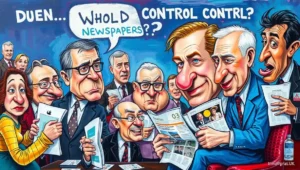
The panic over foreign ownership reveals something deeply British about how power is perceived. Foreign billionaires are worrying. Domestic billionaires are “stakeholders.” Foreign governments owning stakes in newspapers is dangerous. Domestic elites owning most of the press is tradition.
There is something almost touching about the belief that British newspapers are only truly British when owned by people who live in mansions in Britain, rather than mansions elsewhere. As if geography alone determines editorial integrity.
One peer reportedly worried that allowing foreign stakes would undermine democracy. Another suggested safeguards. A third pointed out that British newspapers already take positions suspiciously aligned with their owners’ interests, at which point the room fell silent, and tea was served.
“Foreign ownership is like letting someone else choose your breakfast,” one critic warned.
Yes, but Britain has been letting a very small number of people choose breakfast for decades, and the menu hasn’t changed.
Press Plurality: A Concept Britain Keeps Meaning to Get Around To
Press plurality is one of those phrases that sounds important, gets mentioned in speeches, and then is gently placed back on the shelf until the next crisis. It refers to the idea that no single voice, or small group of voices, should dominate public discourse.
In theory, Britain cares deeply about this. In practice, Britain cares about it the way it cares about exercise: something one plans to address eventually, perhaps after the next election.
Studies regularly point out that media ownership concentration in the UK is among the highest in the democratic world. A handful of companies control the vast majority of print circulation. This is not disputed. It is simply endured.
When confronted with this fact, defenders of the system tend to say one of three things:
- People can read online.
- Newspapers are dying anyway.
- The market will sort it out.
These are said with the confidence of someone who has never actually relied on the market to sort anything out but remains optimistic nonetheless.
Editorial Independence: The Gentle Fiction Everyone Agrees On
Every discussion of newspaper ownership eventually arrives at the concept of editorial independence. Owners, we are assured, do not interfere. Editors are free. Journalists are brave.
This is technically true in the same way that employees are free to express themselves as long as they do not do so in a way that affects their career.
Editorial independence exists, but it exists within boundaries. It is the freedom to move around the room, not to leave the house. Editors know what stories excite owners. They know what tone is rewarded. They know which lines, once crossed, lead to sudden “strategic realignments.”
This does not require phone calls. It requires culture. And British institutions are very good at culture.
One veteran journalist put it this way: “No one tells you what to write. You just learn.”
That sentence alone explains most British newspapers.
Politicians and the Press: A Mutually Beneficial Panic
British politicians are deeply suspicious of media power and utterly dependent on it. They denounce newspaper barons while courting them. They warn of undue influence while briefing against rivals. They talk about reform while quietly praying their headline tomorrow is kind.
When the ownership debate flares up, politicians suddenly discover their principles. They demand safeguards, pluralism, transparency. Then the news cycle moves on, and so do they.
As one MP privately observed, “We all complain about the press, but none of us wants to be the one who annoys it.”
This leads to a system in which regulation is discussed endlessly and applied cautiously, like a speed limit everyone agrees exists but no one enforces.
What the Funny People Are Saying
“This isn’t media ownership, it’s media timeshare. You don’t own the newspaper, you just get to control it on weekends.” — Jerry Seinfeld
“British newspapers aren’t right-wing or left-wing. They’re wealthy-wing.” — Jon Stewart
“The idea that newspapers don’t reflect their owners is adorable. That’s like saying your dog doesn’t reflect how often you feed it.” — Sarah Silverman
“Press freedom in Britain is like free refills. Technically unlimited, but you’re still drinking what they give you.” — Billy Crystal
The Public: Confused, Loyal, and Slightly Resigned
Despite all of this, British readers remain loyal. They complain about bias while buying the same paper every day. They insist they read it “for balance.” They say they don’t agree with it, but enjoy the puzzles.
This is not ignorance. It is habit. British newspapers are cultural objects. They are part of morning routines, train journeys, and kitchen tables. Ownership structures feel abstract compared to the comfort of familiarity.
When asked who controls newspapers, many readers shrug. “They always have,” they say. “Someone has to.”
And there it is. The quiet fatalism that underpins the entire system.
The Illusion of Choice in a Digital Age
The argument that the internet has solved media concentration is comforting and wrong. While digital platforms have multiplied voices, they have also amplified the reach of existing brands. The same newspapers dominate online traffic, shape social media debates, and set agendas for broadcasters.
Plurality has expanded in volume, not power. There are more voices, but the loudest are still owned by the same people.
The digital age did not dismantle the British press hierarchy. It uploaded it.
So Who Should Control British Newspapers?
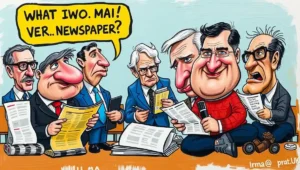
In theory, the answer is: no one group should. In practice, Britain continues to choose continuity over disruption.
There are models elsewhere. Cooperative ownership. Stronger caps. Public-interest trusts. None are radical. All require political will and a willingness to upset powerful people.
Britain prefers not to upset powerful people unless absolutely necessary, and even then only briefly.
So the debate continues. Articles are written. Panels convene. Regulations are tweaked. And the newspapers keep printing.
Because in Britain, control is less about force and more about familiarity. And nothing is more familiar than pretending this is all perfectly normal.
Disclaimer
This article is entirely a human collaboration between two sentient beings: the world’s oldest tenured professor and a philosophy major turned dairy farmer. Any resemblance to reality is not coincidental. It is traditional.
Auf Wiedersehen.

Alan Nafzger was born in Lubbock, Texas, the son Swiss immigrants. He grew up on a dairy in Windthorst, north central Texas. He earned degrees from Midwestern State University (B.A. 1985) and Texas State University (M.A. 1987). University College Dublin (Ph.D. 1991). Dr. Nafzger has entertained and educated young people in Texas colleges for 37 years. Nafzger is best known for his dark novels and experimental screenwriting. His best know scripts to date are Lenin’s Body, produced in Russia by A-Media and Sea and Sky produced in The Philippines in the Tagalog language. In 1986, Nafzger wrote the iconic feminist western novel, Gina of Quitaque. He currently lives in Holloway, North London. Contact: editor@prat.uk