Five Observations About “Woke Jesus” Politics
Church used to be the one place where people argued about the Book of Revelation and casserole recipes. Now it’s apparently a campaign office with stained glass.
If Jesus returned today, half the country would ask whether he had a campaign logo and the other half would accuse him of insufficient branding.
Modern progressive theology is the only field where the Sermon on the Mount is treated like a policy memo from the Department of Transport.
Every generation gets the Jesus it deserves. Medieval Europe got armoured knight Jesus. The 1970s got acoustic-guitar Jesus. Today apparently we get Instagram-algorithm Jesus.
Some politicians quote scripture the way teenagers quote song lyrics. Not because they understand it, but because it sounds emotional enough to get applause.
The Gospel According to Campaign Consultants: A Satirical Investigation into the Curious Case of “Woke Jesus”

In American politics there are many strange hybrids. There are activist billionaires, populist hedge-fund managers, libertarian bureaucrats, and cable-news historians who learned history last Tuesday.
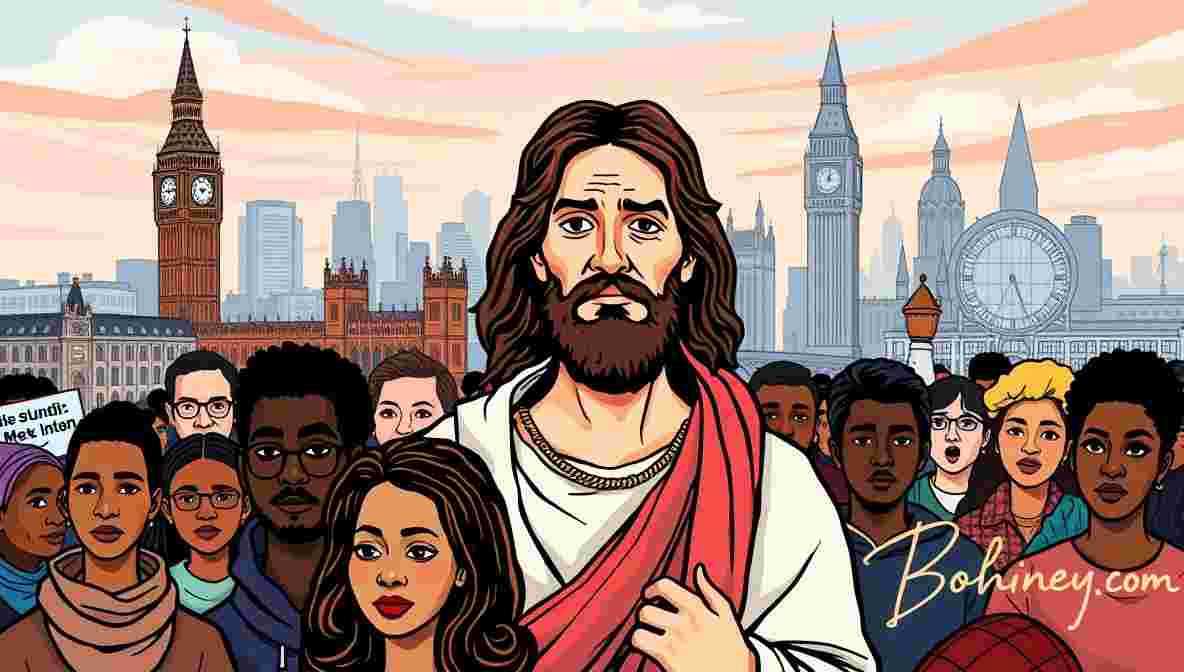
But the most remarkable creature to emerge in recent years may be what theologians now call Campaign Jesus.
This figure appears frequently in the speeches of Texas politician James Talarico, a Democratic lawmaker — and, as of this very morning, the freshly minted Democratic US Senate nominee for Texas — who blends progressive politics with Christian rhetoric in a way that causes both political strategists and Sunday school teachers to reach for their blood-pressure medication.
To British eyes, this is a rather exotic spectacle. Over here, politicians keep their religion tastefully locked in a drawer alongside their actual opinions. In Texas, apparently, you bring it to the hustings in a pickup truck with a “Love Thy Neighbour” bumper sticker.
Talarico is a former schoolteacher and a student at Austin Presbyterian Theological Seminary who frames politics through the teachings of the New Testament. Which sounds noble. Until campaign season begins. Because during campaign season, Jesus apparently becomes a public policy consultant.
The Miracles of the Modern Policy Messiah
According to political theology now circulating through parts of the progressive world, Jesus has opinions on everything from healthcare funding to congressional committee assignments.
This is remarkable, because the last time most people checked, the New Testament mostly contained instructions about loving your neighbour, forgiving your enemies, and not hoarding wealth like a medieval dragon guarding a treasure chest.
But somewhere between the Sermon on the Mount and the Senate campaign trail, the Gospel apparently gained a few new chapters. Scholars refer to these as:
- The Epistle to the Federal Budget
- The Parable of the Filibuster
- The Miracle of the Multiplied Poll Numbers
A leaked memo from a fictional political consulting firm, Faith & Messaging Strategies LLC, allegedly describes the strategy thusly: “If voters don’t trust politicians, simply borrow credibility from Jesus. Brand recognition is extremely high.”
Academic Experts Weigh In on the Politicisation of Scripture
To better understand this phenomenon, our newsroom consulted Dr Hank Buckminster, Professor of Improvised Theology at the University of East Texas Strip Mall.
Buckminster explained that political reinterpretations of scripture are a long American tradition.
“Historically,” he said while adjusting a tie decorated with tiny crosses and dollar signs, “politicians have always discovered that the Bible agrees with them.”
He continued: “What’s new is the efficiency. In earlier centuries you needed a cathedral and a printing press. Now you just need a TikTok account.”
Buckminster’s research suggests that modern political sermons reduce complex theology to something he calls “Gospel Lite.” “Less original context,” he explained. “More hashtags.”
British readers will note that our own politicians prefer a different approach: they simply avoid saying anything at all, spiritual or otherwise, until safely installed in the House of Lords.
Eye-Witness Accounts From the American Campaign Trail

Outside a rally in Austin, voters described the experience of hearing political sermons in real time.
One attendee, retired lorry driver Billy Don Hargrove — or “truck driver,” as they inexplicably say over there — said he attended out of curiosity. “I thought we were gonna hear about taxes,” Hargrove said. “Next thing I know we’re doing theology.”
Another voter, college student Maya Hernandez, described the speech as “kind of inspiring but also confusing.” “He quoted the Bible like three times,” she said. “Then talked about democracy being the Kingdom of Heaven.” She paused. “I’m pretty sure heaven has fewer campaign signs.”
Talarico, to his credit, has had genuinely viral moments — including a celebrated floor speech arguing that mandating the Ten Commandments in Texas classrooms was “deeply un-Christian.” He also made headlines when CBS suppressed a Stephen Colbert interview under pressure from the Trump administration’s FCC — after which the YouTube version promptly received nine million views, which is considerably more than most Church of England sermons manage on a Sunday.
The Strange Economics of Political Salvation
Campaign Jesus has also developed some unusual economic theories.
According to one fictional survey conducted by the Institute for Applied Sarcasm, 62% of voters believe politicians who quote scripture are attempting to sound morally authoritative. Another 28% believe they are attempting to sound inspirational. The remaining 10% believe they are attempting to sound like a youth pastor who accidentally wandered into a Senate debate.
Professor Buckminster offered a technical explanation. “Religion is powerful because it deals with ultimate meaning,” he said. “Politics is powerful because it deals with taxes.” “When you combine them,” he added, “you get a very confusing church budget meeting.”
What the Funny People Are Saying About Jesus and Politics
“Whenever politicians quote Jesus, I assume they’re about to explain why Jesus supports their tax plan.” — Jerry Seinfeld
“Politicians love the Bible. It’s the only book where they can quote one line and skip the rest.” — Ron White
“Jesus said love your neighbour. Politicians say love your voter demographics.” — Trevor Noah
“If Jesus ran for office today, his campaign manager would tell him to tone down the humility.” — Sarah Millican
The Problem With Politicised Scripture
Here’s the awkward truth nobody likes to say out loud: once you turn religion into a campaign platform, the message starts to behave like a campaign platform.
That means it gets simplified. It gets sloganised. And eventually it gets printed on yard signs — which, for those unfamiliar with American elections, are the plastic garden placards that replace flowers between August and November every two years.
Theologians have a technical name for this phenomenon. They call it “marketing.”
The Historical Precedent for Mixing Religion and Politics
Of course, mixing religion and politics is hardly a new invention. Throughout history, rulers have claimed divine approval for wars, taxes, empires, crusades, and occasionally extremely questionable hairstyles.
Britain had its own version: divine right of kings, whereby God personally endorsed the monarch, right up until Parliament politely informed Charles I that God had apparently changed his mind. With an axe.
The modern American version is tidier. Instead of kings claiming divine authority, candidates claim divine messaging strategy. Instead of prophets delivering revelations, there are campaign videos with inspirational piano music. And instead of apostles spreading the gospel, there are interns managing the social media accounts.
The Ironic Twist: What Jesus Actually Said About Public Piety
The rather delicious irony is that the historical Jesus spent considerable time warning against public displays of religious virtue. There is even a passage in Matthew 6 about people praying loudly in public purely to appear righteous.
If Jesus were reading today’s campaign speeches, he might politely ask everyone to calm down. Or he might just flip a few tables again — which, in fairness, would make Prime Minister’s Questions look rather tame.
The Final Lesson: Who Gets to Claim Jesus?
Political theology tends to follow a predictable pattern.
Step one: quote scripture. Step two: interpret it in a way that supports your political coalition. Step three: insist the other side is misusing religion. Repeat until Election Day.
In other words, it’s not really about Jesus. It’s about who gets to claim him. And as every campaign strategist knows, the most powerful endorsement in politics is the one that cannot hold a press conference to correct you.
This article is satire and commentary intended for humorous reflection on politics, religion, and the strange ways they collide in modern campaign culture. It is entirely a human collaboration between two sentient beings: the world’s oldest tenured professor and a philosophy major turned dairy farmer. No campaign consultants, apostles, or policy-advising messiahs were harmed in the writing of this story.
Auf Wiedersehen, amigo!

Alan Nafzger was born in Lubbock, Texas, the son Swiss immigrants. He grew up on a dairy in Windthorst, north central Texas. He earned degrees from Midwestern State University (B.A. 1985) and Texas State University (M.A. 1987). University College Dublin (Ph.D. 1991). Dr. Nafzger has entertained and educated young people in Texas colleges for 37 years. Nafzger is best known for his dark novels and experimental screenwriting. His best know scripts to date are Lenin’s Body, produced in Russia by A-Media and Sea and Sky produced in The Philippines in the Tagalog language. In 1986, Nafzger wrote the iconic feminist western novel, Gina of Quitaque. He currently lives in Holloway, North London. Contact: editor@prat.uk