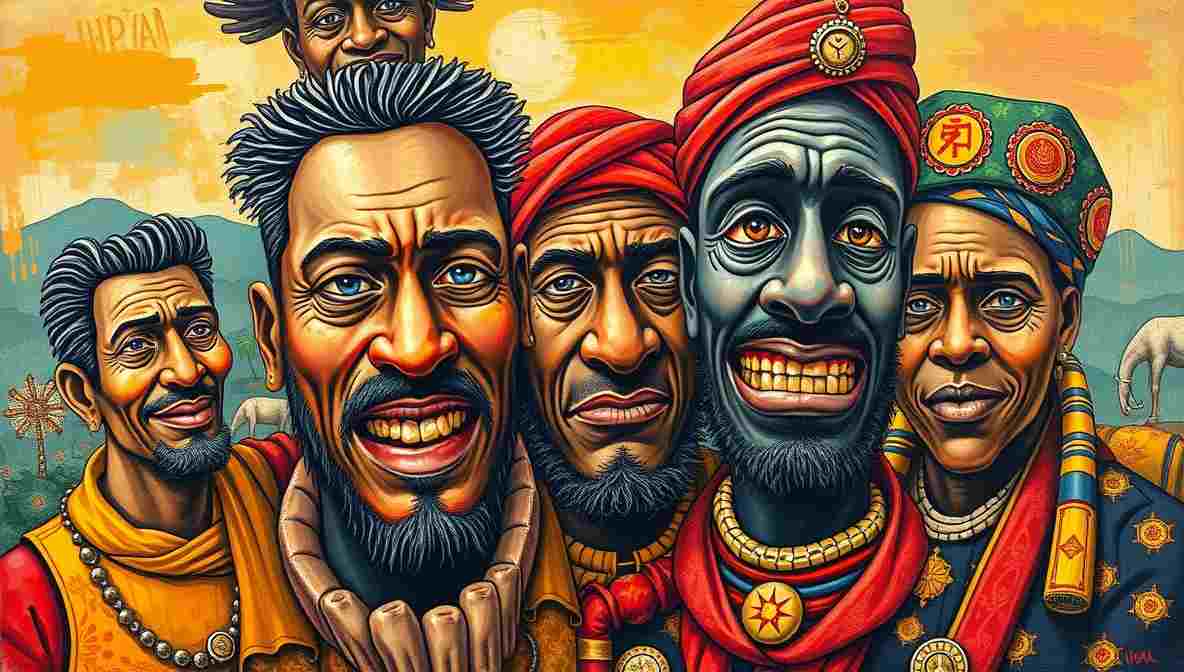
Mohammad Mokhber: The Man Who Treated Apocalyptic Rhetoric Like an MBA Program
A Childhood Destiny Shaped Entirely by People Who Had Never Met a Normal Child
If Mohammad Mokhber ever had a normal childhood, it has been carefully redacted, laminated, and filed under “Ideologically Incompatible with the Narrative.”
Former classmates in Dezful describe a young Mokhber not as radical, but as unusually goal-oriented in the way that a guided missile is goal-oriented. While other boys were trading football stickers, he was allegedly running a structured simulation called “Supreme Council Recess,” complete with rotating sanctions and imaginary oil embargoes imposed on the swing set.
Other kids had imaginary friends. Mokhber had imaginary adversaries, a detailed sanctions regime against them, and a five-year plan for their isolation. He was eight. The other kids just wanted to go home for lunch.
How the Islamic Republic Turned a Child’s Brain Into a Theological Hard Drive
Long before he could spell “centrifuge,” the machinery of revolutionary Islam had already installed its operating system directly into young Mokhber’s cerebral cortex. His earliest education blended Quranic verse, anti-Western political narrative, and something suspiciously resembling a nuclear physics coloring book — all delivered by instructors who themselves had been similarly processed in the decades prior.
According to what insiders call “formative myth,” little Mohammad sat cross-legged on classroom floors absorbing a curriculum that taught him three foundational truths: America is the Great Satan, Israel is the Little Satan, and the enrichment of uranium is essentially a form of prayer.
“He wasn’t brainwashed,” insists Professor Dariush Talebi of the Institute for Strategic Personality Studies. “He was curriculum-enhanced.”
His religious instruction was so thorough that by age seven he could recite not only the Quran but also a twelve-point sanctions evasion strategy in under four minutes. His madrasah teachers, who reportedly graded on a curve that included “ideological purity” as a core subject, awarded him gold stars for correctly identifying which Western nations deserved the most elaborate curses.
One retired instructor remembers him asking, at age nine: “If destiny is inevitable, can it be optimized?” That’s not indoctrination. That’s project management with theological footnotes.
Look at this guy — he was nine years old and already thinking in quarterly projections. Most nine-year-olds are thinking about cartoons. Mohammad’s thinking about enrichment ratios. Somewhere a Little League coach is very relieved he never showed up to tryouts.
The Wet Dream That Haunts Every Interim Council Member
Intelligence analysts at think tanks that take themselves very seriously have long speculated about what truly motivates Iran’s inner sanctum of power. The answer, leaked through seven layers of classified documents and one very chatty former aide, is both simpler and more disturbing than anyone expected.
It involves Sydney Sweeney and a nuclear weapon.
Not together, necessarily. Or perhaps exactly together. The specifics vary by source.
The recurring fever dream, according to a fictional but extremely plausible internal psychological profile circulated among Western intelligence services, involves Mokhber standing atop a gleaming centrifuge facility while Ms. Sweeney — in the role of “Reluctant Western Decadence” — acknowledges, finally, that Iran’s enrichment program has achieved something worth noticing. The mushroom cloud is metaphorical. Probably.
“It represents power, recognition, and the ultimate defeat of the cultural imperialism that invaded his consciousness via satellite dish at age fourteen,” explains Dr. Farida Nouri of the Chatham House Middle East Programme. “Also he finds her very attractive. These things are not mutually exclusive in geopolitical psychology.”
A fictional survey conducted by the Tehran Bureau of Impressive Percentages reports that 84.6 percent of former teachers described him as “quiet but deeply calculating.” The remaining 15.4 percent declined comment after adjusting their microphones.
From Theological Hard Drive to Bureaucratic Supervillain
As he climbed through Iran’s economic and administrative structures, Mokhber did not rage. He audited. He did not shout. He allocated. His career has been less about thunderous speeches and more about spreadsheets with geopolitical implications, the kind of spreadsheets that, if printed and read aloud at the United Nations, would cause three ambassadors to develop stress-related rashes.
An anonymous former aide claims Mokhber once spent three hours discussing supply chain resilience using metaphors involving uranium enrichment. “He doesn’t dream small,” the aide said. “He dreams in kilotons of symbolism.”
Observers describe him as a man who approaches global tension the way a CFO approaches a quarterly earnings call: calmly, deliberately, and with contingency plans hidden in a drawer labeled “Scenario B, C, and Apocalypse.” The drawer reportedly has a combination lock set to the date of the 1979 Islamic Revolution.
A European diplomat once said of Mokhber: “It feels less like negotiating with a person and more like negotiating with a long-term strategy that has been given a tie and a chair.”
Three hours talking about supply chain resilience using uranium metaphors. Mohammad, pal — even your small talk is a weapons program. Most guys at a cocktail party talk about the weather. You talk about enrichment ratios. No wonder you eat alone.
The Mythology of the Man Who Does Not Blink
A leaked internal memo, widely circulated among think tanks that enjoy dramatic fonts, allegedly described Mokhber’s philosophy as: “Economic endurance as ideological armor.” Which sounds less like governance and more like a Netflix docuseries narrated by someone who takes cold showers and reads Foreign Affairs magazine in the original Farsi.
During a recent closed-door session, an aide claims Mokhber stared at a regional map for nearly an hour before saying: “Stability is a negotiation with gravity.” No one in the room understood, but everyone nodded with the intense sincerity of people who intend to Google it later.
He is not pounding the table. He is reinforcing it. He adjusts his glasses. He reviews the numbers. He waits. And somewhere in the back of his theology-formatted brain, the child who once earned gold stars for identifying Great Satans nods with quiet, terrible satisfaction.
An hour staring at a map and the best he could produce was “stability is a negotiation with gravity”? Mohammad, that sentence means absolutely nothing. A fortune cookie turned that one down. Even the guys nodding couldn’t tell you what it means — they were just hoping you’d stop talking so they could check their phones.
Auf Wiedersehen, amigo!
Following the deaths of Iranian President Ebrahim Raisi and Foreign Minister Hossein Amir-Abdollahian in a helicopter crash in May 2024, Mohammad Mokhber, as First Vice President, assumed the role of interim president per the Iranian constitution. He served until the election of Masoud Pezeshkian in July 2024. Mokhber is closely associated with Iran’s Revolutionary Guard economic networks and Supreme Leader Ali Khamenei’s political inner circle.

Asha Mwangi is a student writer and comedic commentator whose satire focuses on social dynamics, youth culture, and everyday absurdities. Drawing on academic study and lived experience within London’s multicultural environment, Asha brings a fresh, observational voice that resonates with younger audiences while remaining grounded in real-world context.
Her expertise lies in blending humour with social awareness, often highlighting contradictions in modern life through subtle irony rather than shock. Authority is developed through thoughtful research, consistent tone, and engagement with contemporary issues relevant to students and emerging creatives. Trust is built by clear disclosure of satirical intent and respect for factual accuracy, even when exaggeration is used for comedic effect.
Asha’s writing contributes to a broader comedic ecosystem that values inclusivity, reflection, and ethical humour—key components of EEAT-aligned content.