Khamenei’s Phone Going to Voicemail: Five Observations from a Country That Was Definitely Not Involved
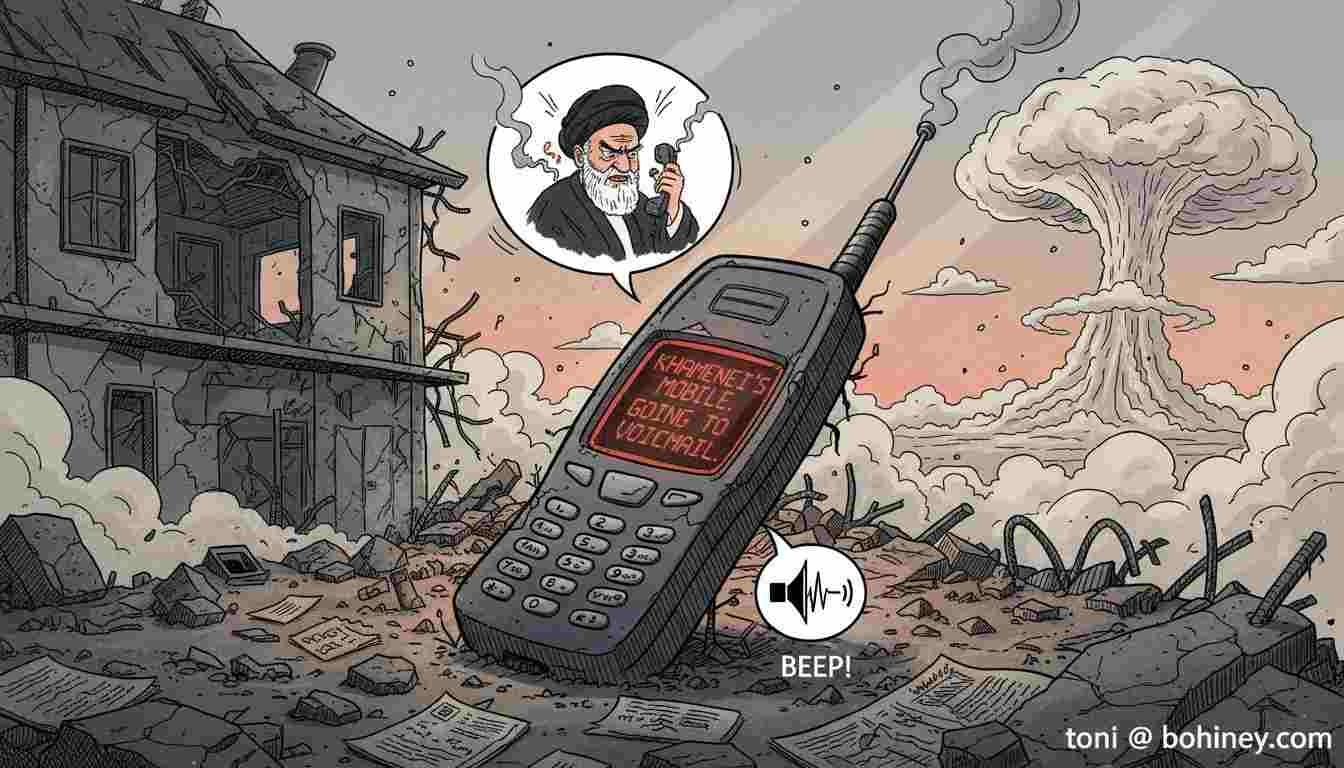
- Khamenei’s phone has more missed calls than a British GP surgery on a Bank Holiday Monday.
- Leadership House received what Whitehall sources are calling an “unsolicited exterior consultation” — and Britain knows nothing about it.
- Keir Starmer moved Typhoon jets to the region “just in case,” in the same spirit a man brings an umbrella to someone else’s bonfire.
- BBC Verify has heroically confirmed that the smoke over Tehran is, in fact, smoke. The sky is being investigated separately.
- Nigel Farage demanded Britain back America fully. Keir Starmer demanded a negotiated solution. The Jubilee Line remained delayed for entirely unrelated reasons.
Leadership House Receives ‘Unsolicited Exterior Consultation’ — Britain Sends Thoughts, Typhoons, and a Strongly Worded Statement
Tehran woke up to what officials politely described as an “aesthetic clarification” near Leadership House, the office associated with Ayatollah Ali Hosseini Khamenei. Plumes of smoke rose over the neighbourhood like avant-garde calligraphy in the sky, spelling out what residents recognised immediately as “this seems expensive.”

In London, the Cobra committee convened. Three priorities were confirmed: protecting British nationals, ensuring regional stability, and making absolutely certain no one used the phrase “special relationship” in a way that implied shared responsibility for any of this.
“It is understood that the UK was not involved,” said a government spokesperson, deploying the word understood with the precision of a man who has practised that word in the mirror since Thursday.
Understood. Not confirmed. Not denied. Understood. As if Britain had simply overheard events while walking past, tutted quietly, and moved on.
Khamenei’s phone, meanwhile, began ringing nonstop. Sources say it rang once, twice, 47 times, and then quietly surrendered to voicemail. The Supreme Leader, analysts note, has developed what telecommunications experts are calling “exceptional call screening discipline.” Either that, or the battery is at 2 percent. The intelligence community remains divided.
Diego Garcia: Britain’s Most Useful Base That Britain Definitely Didn’t Use
The thornier question hovering over Whitehall was not what Britain did, but what Britain allowed. Reports confirmed that Prime Minister Starmer had blocked American requests to use RAF Fairford and Diego Garcia — Britain’s Indian Ocean airbase — for any strike on Iran, citing potential breaches of international law.
Trump responded on Truth Social that Starmer was “making a big mistake.” Farage agreed. Dame Emily Thornberry told the BBC there was “no legal basis” for the strikes at all. The Foreign Secretary David Lammy flew to Washington to explain Britain’s position to Marco Rubio, which is the diplomatic equivalent of explaining the offside rule to someone who has already scored.
In the end, the B-2 bombers flew from Missouri. A round trip of approximately 37 hours, which is longer than most British rail journeys and significantly more punctual.
Britain’s position was clarified: not involved, had been informed, had moved assets defensively, and supported a negotiated solution. This is what military analysts are increasingly calling “the full Starmer” — present, supportive, and just far enough away to require no dry cleaning.
BBC Verify Confirms Smoke Is Smoke — Sky Remains Under Investigation
As footage spread across social media, BBC Verify deployed its meticulous verification process. Analysts cross-referenced satellite imagery, shadow angles, and the ancient British instinct that recognises a large cloud of black vapour as “not ideal, that.”
“We can confirm,” said one media analyst, “that the smoke appears to be rising upward, consistent with smoke.”
Verification teams are now analysing the sky itself, though preliminary findings suggest it remained neutral — much like the Foreign Office’s first three statements.
Geolocation experts pinpointed the footage within a kilometre of Leadership House. That single kilometre has since become the most scrutinised stretch of urban geography since the Salisbury poisonings, and for broadly similar reasons involving people Britain cannot officially name.
Through it all, Khamenei’s voicemail greeting reportedly remained unchanged: polite, theological, and unmistakably unavailable.
Nigel Farage Demands Britain Back the Yanks. Starmer Demands De-escalation. The Nation Demands an Explanation.

The domestic response was swift and predictable. Reform UK’s Nigel Farage posted that “the Prime Minister needs to change his mind on the use of our military bases and back Americans in this vital fight against Iran.” Richard Tice warned that refusing American requests had “seriously damaged the special relationship.”
Starmer reiterated that Iran must never be allowed to develop a nuclear weapon and that the UK supported a negotiated solution. He did not mention Diego Garcia. He did not mention Fairford. He did not mention fingerprints.
He mentioned stability.
A flash poll by Albion Data Insights found that 54 percent of Britons support staying out of the conflict entirely, 23 percent believe Britain should do more diplomatically, 14 percent blame Thatcher, and the remaining 9 percent were still trying to find Bahrain on a map.
“You know you’re in trouble when the most decisive thing your government does is move jets somewhere and then explain they’re just standing there.” — Frankie Boyle
“Britain’s foreign policy is essentially: we’re with you in spirit, but do keep us off the guest list.” — Dara Ó Briain
“Understood. Not confirmed. Understood. That’s not diplomacy, that’s a WhatsApp read receipt.” — Nish Kumar
Marks & Spencer Reports Surge in Bottled Water Sales — Nation Stockpiles Biscuits and Mild Dread
On the home front, British supermarkets reported a quiet but unmistakable uptick in preparedness shopping. Bottled water. Tinned goods. Batteries. The sort of calm, orderly panic at which Britain has always excelled.
One shopkeeper in Peckham described the mood as “concerned but queuing properly.” A woman in Waitrose was overheard saying, “I don’t know what’s happening in Tehran, but I’m not being caught short on oat milk.”
The Foreign Office updated its travel advisories. British nationals in Israel, Bahrain, Kuwait, Qatar and the UAE were advised to shelter in place. A charter flight was being arranged. Consular teams were prepared. Naval assets were positioned defensively.
Defensively remains Britain’s favourite adverb.
At Heathrow, passengers bound for the Gulf stared at departure boards with the wary patience of people who have seen this film before. A man connecting to Dubai said: “I don’t need regime change. I need gate 47.”
The Doctrine of Strategic Adjacency: Prudence, Passivity, or Just Very Good Posture?
Britain’s approach — informed, supportive, non-participating, verbally de-escalating — reflects a well-worn national instinct. Express solidarity. Avoid entanglement. Keep the good china away from the edge of the table.
Critics argue that blocking American base access while verbally backing the strikes is a contradiction wrapped in a press statement. Supporters call it sovereignty. A retired diplomat told us off the record: “Britain has learned that being the loudest voice in the room often leads to being the last one paying the bill.”
The House of Commons Library noted that MI5 had tracked more than 20 potentially lethal Iran-backed plots on British soil in the previous year alone. The Intelligence and Security Committee described Iran as a “wide-ranging, persistent and unpredictable threat.” And yet Britain’s official posture remains: dialogue, de-escalation, and a quietly repositioned Typhoon or two.
Somewhere in Tehran, behind reinforced walls and unanswered notifications, Khamenei’s phone sits on a polished desk. The missed calls are logged. The voicemail inbox approaches capacity. Aides from various ministries have left increasingly urgent messages. Each time, the phone rang, paused, and slid gently into voicemail.
Geopolitics may thunder. Smoke may rise. BBC Verify may confirm it. And Britain will watch, express deep concern, move some assets defensively, and insist — with the quiet dignity of a nation that has been doing this since Suez — that it was not involved.
That it is understood it was not involved.
The most powerful symbol of the moment is not the plume over Tehran.
It is the soft, final click of a call diverted to voicemail — and, somewhere in Whitehall, the equally soft click of a statement being carefully worded.
This is satirical journalism and entirely a human collaboration between two sentient beings, the world’s oldest tenured professor and a philosophy major turned dairy farmer. Any resemblance to actual stability is coincidental. Auf Wiedersehen, amigo!
In June 2025, US and Israeli forces conducted strikes on Iranian nuclear facilities in what was called Operation Midnight Hammer. Prime Minister Keir Starmer confirmed the UK “did not participate,” though Britain had been given advance warning and had moved Typhoon jets to the region. Reports later confirmed Starmer had refused American requests to use RAF Fairford and the Diego Garcia airbase in the Indian Ocean. Nigel Farage and Reform UK publicly criticised the decision. The Cobra emergency committee convened. The Foreign Office updated travel advisories across the Gulf. Iran retaliated with strikes against a US base in Qatar and launched missiles toward Israel. Britain described its position throughout as supportive of de-escalation and opposed to further regional escalation.


Alan Nafzger was born in Lubbock, Texas, the son Swiss immigrants. He grew up on a dairy in Windthorst, north central Texas. He earned degrees from Midwestern State University (B.A. 1985) and Texas State University (M.A. 1987). University College Dublin (Ph.D. 1991). Dr. Nafzger has entertained and educated young people in Texas colleges for 37 years. Nafzger is best known for his dark novels and experimental screenwriting. His best know scripts to date are Lenin’s Body, produced in Russia by A-Media and Sea and Sky produced in The Philippines in the Tagalog language. In 1986, Nafzger wrote the iconic feminist western novel, Gina of Quitaque. He currently lives in Holloway, North London. Contact: editor@prat.uk