The Strand Named Britain’s Best Place to Visit in 2026, Immediately Overwhelmed by People Visiting It Incorrectly
The Strand has been officially crowned one of the best places to visit in the UK in 2026, which is impressive considering it has been quietly existing since Roman times without once asking for an award, a plaque, or a QR code explaining itself. For nearly two thousand years, the street has managed the remarkable feat of being historically important while also serving as a thoroughfare for people sprinting toward Pret because they are “late, but spiritually early.”
Time Out’s announcement has finally confirmed what Londoners have long suspected but never admitted out loud: The Strand has always been good, we just forgot to notice because we were too busy crossing it at Olympic speed while pretending to check our phones for something urgent.
A Street Older Than the Concept of Being Late
The street’s age alone places it in a rare category of British infrastructure that predates not just social media, but irony itself, and possibly punctuality. Romans built here, Tudors strutted here with questionable hygiene, Victorians industrialised here while complaining about everything, and now modern Londoners walk here while loudly explaining podcasts to each other as if they invented listening. This continuity gives The Strand a quiet authority. It does not need to reinvent itself every six months like a tech startup with venture capital and poor judgment. It has already outlived trends, monarchs, and several restaurant concepts involving the word “artisan” and/or “deconstructed.”
Thinking About the Strand
- The Strand has finally been named Britain’s best place to visit, which is impressive given that most people who visit it still have no idea they are on it. They arrive confidently, stand there briefly, and announce they are “basically in Covent Garden,” which is geographically incorrect but emotionally brave.
- The street has existed since Roman times, which means it predates tourism, influencer culture, and the human instinct to stand in the exact middle of a pavement and stop suddenly. Despite this, modern visitors still behave as if the Strand was built yesterday and should have clearer signage explaining what it’s for.
- Londoners have crossed the Strand for decades at a speed normally reserved for airport transfers, treating it as a hostile zone between destinations. Now that it has been declared “the destination,” they are unsure what to do with their legs and keep walking anyway, out of habit and mild panic.
- Tourists walk the Strand like they are completing a side quest they did not mean to accept. They pause, look around, nod thoughtfully, and then continue onward without learning anything, much like British education but with better shoes.
- Being named the best place to visit has not changed the Strand’s personality at all, which is deeply British. It has responded to international praise the same way a middle manager responds to applause: by pretending not to notice and carrying on with mild irritation.
- The Strand is now officially historic, cultural, and trendy, which means people are standing outside buildings taking photos of absolutely nothing in particular, trusting that context will eventually explain why they are there.
- People visiting the Strand for the first time assume it must have a clear start and end point, like a theme park. Instead, it simply keeps going, which feels disrespectful to modern attention spans and Google Maps expectations.
- The street contains some of London’s most significant institutions, yet most visitors are still using it primarily to locate a coffee they already walked past twice while arguing about oat milk.
- Restaurants on the Strand are now described as “destinations,” even though half of them spent decades being places you only ate because it was raining and you were emotionally compromised.
- The announcement has caused tourists to stop suddenly to read plaques, which Londoners interpret as an aggressive act requiring immediate sighing and evasive manoeuvres.
- The Strand’s theatres continue to produce emotional transformations nightly, followed by audiences exiting into traffic, instantly forgetting everything they just felt while checking for buses.
- People are now “doing the Strand” as an activity, which mostly involves walking it incorrectly, missing everything, and later telling friends it was “nice, but busy.”
- Hotels opening on the Strand suggest you can now sleep directly on history, although the real experience is being woken by bins, sirens, and a man arguing with his suitcase at dawn.
- The architecture is quietly magnificent, which makes it confusing for visitors trained to only recognise beauty if it comes with neon signage and a gift shop.
- The Strand has survived Romans, fires, bombs, and empire, but its greatest challenge remains groups of tourists walking four abreast at the speed of a philosophical thought experiment.
- In being named Britain’s best place to visit, the Strand has achieved its final form: internationally admired, locally ignored, and still mostly used as a shortcut by people who insist they have always loved it.
Food: The Plot Twist Nobody Saw Coming
Food is now central to the Strand’s rebirth, a development that shocked historians who had previously believed the street’s primary purpose was “getting somewhere else, quickly, while avoiding eye contact.” There are now enough restaurants along the route to sustain a small nation, each offering menus that suggest global unity through carbohydrates and eye-watering prices. You can eat steak cooked according to traditions older than electricity, followed immediately by a pastry that looks like it was designed by someone with a degree in architecture and unresolved feelings about their parents.
Simpson’s in the Strand has returned from the dead, reminding London that beef is not just food but a belief system, possibly a religion, and definitely a commitment. Dining there feels less like a meal and more like participating in a constitutional ceremony where the dress code is “vaguely uncomfortable” and the portions are “historically accurate.” Meanwhile, newer bakeries such as Toklas serve pastries that appear simple but are surrounded by people photographing them like rare wildlife spotted in captivity. Anthropologists believe this is because Londoners trust food more if it looks accidentally beautiful and costs more than their morning commute.
Theatre: Where Emotions Happen Indoors and Denial Happens Outside
The Strand’s West End theatres remain its loudest cultural export, producing an endless supply of performances while audiences spill onto the pavement discussing character arcs they did not fully understand but felt strongly about anyway. The West End clustering here makes the street feel like Broadway’s more emotionally reserved British cousin who went to Cambridge and won’t let you forget it. Big emotions happen indoors. Outside, everyone pretends they were not crying five minutes earlier while also pretending they totally understood the symbolism.
Paddington the Musical continues to run, further proving that a polite bear with a suitcase and mild trauma is Britain’s most durable cultural ambassador since tea conquered India and then apologized unconvincingly. Tourists weep openly at the show while Londoners nod approvingly, satisfied that national branding remains intact and that foreigners still believe we’re all as polite as a fictional bear. The Strand absorbs this quietly, like a street that has seen worse than grown adults sobbing over marmalade, including but not limited to: the Great Fire, the Blitz, and the opening of a five-story Urban Outfitters.
Accidental Education: Somerset House’s Passive-Aggressive Approach to Culture
Art installations at Somerset House now ensure that no one can walk the Strand without accidentally learning something, like it or not. Exhibitions about climate, identity, and edible materials sit alongside people eating crisps and saying, “We should definitely come back and read this properly,” which they will not. The Strand does not judge. It has always understood Britain’s commitment to vague cultural engagement and the phrase “I’ve been meaning to.”
Hotels: Finally Allowing People to Sleep on History
Two new hotels opening on the street signal that luxury has finally caught up with geography and overcome decades of superstition. For years, people slept near the Strand but not on it, as if the street were too important to be horizontal or had a restraining order against mattresses. Now visitors can stay directly inside the experience, waking up surrounded by history, noise, construction that started in 2019, and someone dragging a suitcase at 6:04am like they’re personally offended by silence.
Pubs: Britain’s Most Honest Institutions (Which Isn’t Saying Much)
The pubs remain the Strand’s most honest institutions, assuming honesty is defined as “selling alcohol with minimal judgment.” They have survived plagues, wars, and licensing changes by offering the same essential service: shelter from weather, opinions, and the general sense that modern life might be a mistake. Inside, time collapses into a singularity of warm beer and cold truth. You can overhear a law student, an actor, and a tourist all agreeing that London is “a bit mad, really,” before returning outside to prove it by paying £7 for a sandwich.
Tourists: Lost, But With Confidence
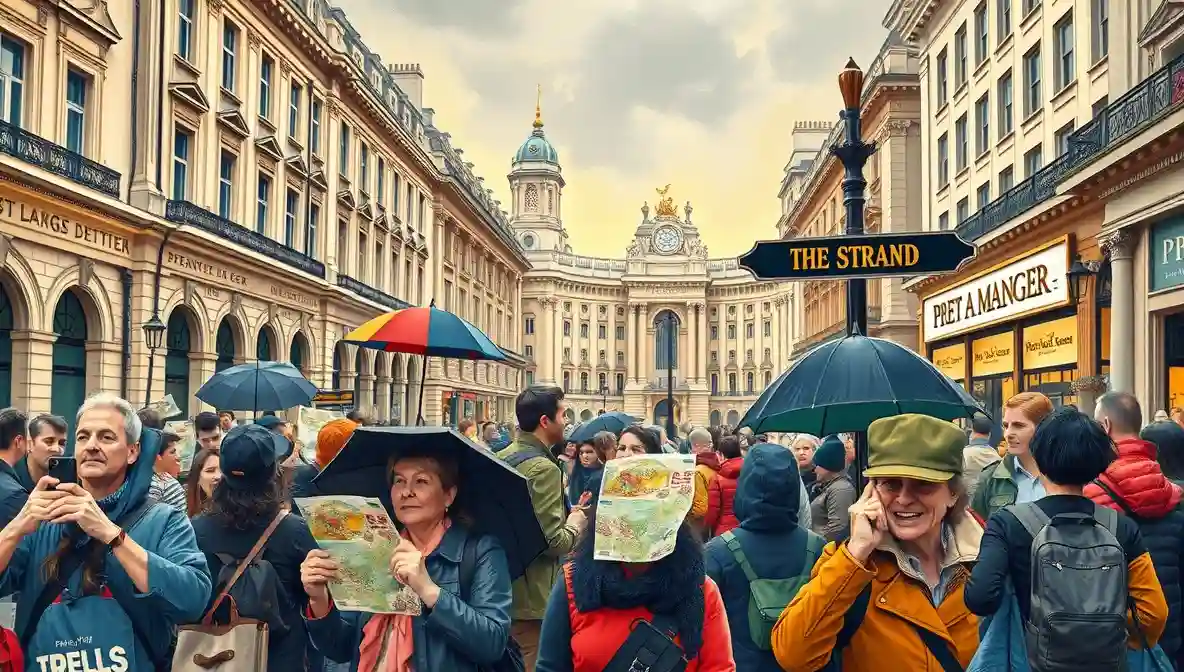
Tourists, upon arriving, often fail to realise where they are with an impressive confidence that suggests they’re actually certain they’re correct. Asked if they are on the Strand, many will say Oxford Street, Trafalgar Square, or “near the river somewhere, I think, maybe?” This confusion is part of the Strand’s charm. It does not advertise itself loudly like a desperate nightclub with a foam machine. It assumes you will eventually catch on, possibly years later, while reading an article ranking it as Britain’s best place to visit and thinking, “Oh, that’s what that was.”
Architecture: Humble Bragging in Stone
The street’s architecture reinforces this humility with all the subtlety of a Victorian gentleman who “doesn’t like to brag” before producing a fifteen-minute story about meeting Disraeli. Grand buildings line the road without demanding selfies, which is the architectural equivalent of reverse psychology. They stand there like retired professionals who do not bring up their achievements unless directly asked, and sometimes even when not asked, and occasionally they send a newsletter. The result is a place that looks impressive but refuses to perform, like a British person at karaoke.
Weather: The True British Experience
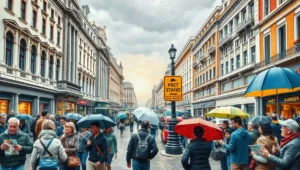
Weather continues to play a central role in the Strand experience, as it does in all British experiences, including but not limited to: small talk, large talk, and emotional regulation. Sunlight briefly transforms the street into a postcard before rain returns it to its natural state: reflective pavement, hurried walking, umbrellas turning inside out in symbolic surrender, and that uniquely British smell of wet wool and regret. Visitors are advised to dress in layers, emotionally and physically, and to lower their expectations regarding sunshine, warmth, and joy.
Efficiency: Everything You Need Within Walking Distance of Everything Else You Need
The Strand’s greatest achievement may be efficiency, which in Britain counts as a minor miracle. In a short walk, one can encounter theatre, art, pubs, courts, bakeries, and people having arguments about rent that should probably happen in private. It is a cultural buffet where everything is close enough to feel accessible but far enough apart to justify stopping for a drink, possibly three drinks, definitely four drinks if you count the one “for the walk.”
Social Media: The Strand Remains Unbothered
Social media has finally noticed the Strand, which the Strand has responded to by continuing exactly as before with the indifference of a teenager ignoring their parents’ texts. TikTok videos attempt to summarise centuries of history in fifteen seconds, usually cutting off just before the point where anything makes sense, much like most modern journalism. The street remains unbothered, having survived worse things than being trending, including the invention of selfie sticks.
Conclusion: Britain Finally Notices Something Good It Already Had
Ultimately, the Strand’s elevation to “best place to visit” status confirms a fundamental truth about Britain: the best things are often the ones we walk past daily while looking at our phones, complaining about things, and wondering why nothing good ever happens in this country anymore. The Strand has waited patiently for recognition, secure in the knowledge that awards come and go like British prime ministers, but pavements endure like passive-aggressive resentment.
Visitors arriving in 2026 will find a street that does not try too hard, does not shout unless someone blocks the pavement, and does not apologise for being old, busy, and occasionally confusing—much like Britain itself. It has been ready this whole time. We just weren’t paying attention.
Disclaimer: This article is entirely a human collaboration between two sentient beings, one of whom has tenure older than most buildings on the Strand, and the other a philosophy major who abandoned metaphysics for dairy farming because at least cows make sense. No algorithms were harmed, blamed, or credited in the making of this piece.
Auf Wiedersehen, amigo!

Harper Thames is a comedic writer exploring modern life through irony and subtle exaggeration. Rooted in student perspectives and London’s cultural landscape, Harper’s work focuses on relatable humour grounded in everyday experience.
Expertise is developed through writing practice and critical engagement, while authority comes from authenticity and consistency. Trust is reinforced by transparent satire and ethical humour choices.