
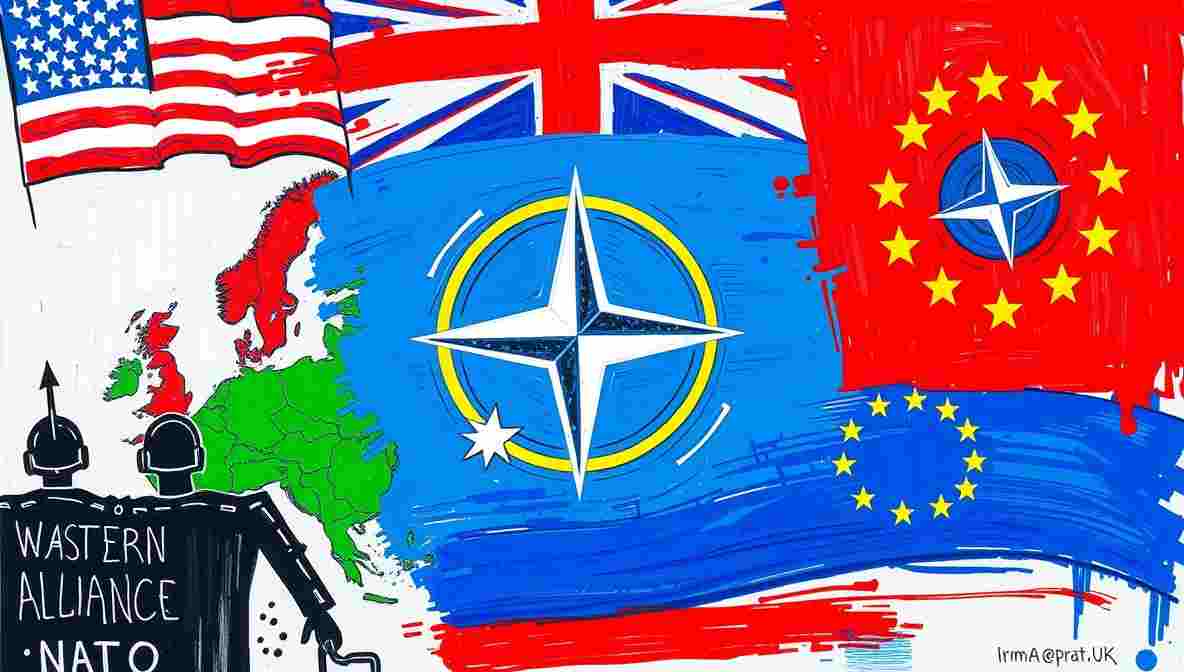
Western Alliance Announces Exciting New Era Of Cooperation, Immediately Schedules 47 Meetings About It
Leaders promise decisive action just as soon as the pastries arrive
BRUSSELS, BELGIUM — The Western alliance gathered this week to boldly remake itself for the modern age, a process diplomats described as “historic, transformative, and pending approval by the subcommittee on fonts.”
After several hours of speeches about unity, defence, shared values, and where to plug in the translation headsets, leaders confirmed they had reached a groundbreaking consensus: the alliance will continue existing, but with updated branding and noticeably thicker conference badges.
A senior European official explained the significance.
“Since 1945 we have relied on the same basic structure,” he said. “Now we are entering a new chapter where the structure remains identical but we say ‘resilience’ more often.” He paused, looked at his notes, and added “resilience” three more times for emphasis.
Burden Sharing Now Includes Emotional Support — And 5% Of Your GDP

At the centre of the 2025 NATO Summit in The Hague was the long-awaited discussion about “burden sharing,” a diplomatic phrase meaning everyone agrees defence is expensive but hopes someone else enjoys paying for it.
An American delegate welcomed Europe’s push for independence.
“We fully support European strategic autonomy,” he said. “It’s a wonderful goal and we encourage it enthusiastically, especially during budget season.” He then handed out a brochure titled So You’d Like To Defend Yourself: A Beginner’s Guide.
European leaders agreed they would begin taking more responsibility for their own defence immediately after determining what responsibility means and whether it can be financed with commemorative coins and historically unprecedented GDP pledges.
One minister compared the relationship to adulthood.
“We are ready to stand on our own two feet,” she said. “However, for safety reasons we ask the United States to remain directly behind us, arms extended.” She later clarified the arms should preferably be Patriot missile batteries.
Joint Weapons Buying Club Discovered — NATO But Bulk Pricing
The summit’s biggest announcement was a plan for joint weapons procurement, a revolutionary idea in which countries buy the same equipment on purpose instead of accidentally.
Officials described the initiative as “NATO but bulk pricing.”
A procurement advisor presented a chart showing that if 20 nations purchase identical equipment, they can save billions and only argue about maintenance manuals instead of everything else.
Delegates applauded politely before spending three hours debating whether the manual should be translated into 24 languages or simply written louder in English. Spain, true to form, requested an opt-out from the manual entirely.
Strategic Autonomy Defined As Calling Washington Slightly Later

European leaders insisted they are serious about reducing dependence on the United States. A draft proposal outlines a phased plan:
First, Europe will handle crises independently.
Second, Europe will inform Washington about the crisis.
Third, Europe will ask Washington what to do about the crisis.
Fourth, Europe will confirm this was the plan all along.
Officials emphasized this represents a major shift from the previous policy of skipping directly to step three. Deep alliance fractures, analysts noted, remain visible to the naked eye from space.
Spain Negotiates Opt-Out From Paying, Reality
In a subplot that surprised absolutely no one, Spain successfully negotiated an opt-out from the new 5% GDP spending commitment, becoming the only NATO member to openly question whether collective defence applies to them specifically.
A Spanish delegate explained their position eloquently: “We support NATO wholeheartedly and will contribute our enthusiasm unreservedly. As for the money, we are confident enthusiasm has been historically undervalued as a strategic asset.”
Slovakia’s prime minister called the 5% targets “absurd.” He was heard muttering this while standing inside a country that shares a border with Ukraine.
Unity Achieved During Lunch

Observers noted the most productive moment of the summit occurred during the pastry break, when leaders unanimously agreed croissants were essential to Western stability. Common funding mechanisms, attendees agreed, should henceforth include a dedicated croissant line item.
A defence analyst explained the phenomenon.
“Military coordination is complex,” he said. “But no treaty has ever failed while everyone is holding a warm pastry.”
The agreement briefly faltered when one delegation suggested oat milk, triggering a procedural pause and a clarification that alliance unity has limits. The oat milk proposal was referred to a subcommittee, where it will be studied until 2031.
Historic Turning Point Announced — Again — For The Seventh Time Since 1962
Several speeches declared the meeting a “turning point for our generation,” a phrase historians confirmed appears in official NATO transcripts approximately every eight years.
An archival researcher demonstrated a slideshow featuring identical remarks delivered in 1962, 1983, 1999, 2014, and last Thursday.
The audience nodded solemnly and agreed this time felt different due to improved lighting. Also, someone had brought better pastries.
Committees Immediately Formed To Oversee The Committees

To ensure decisive action, leaders created a streamlined structure consisting of:
A steering committee
A committee to oversee the steering committee
A coordination panel for committee alignment
And a rapid-response working group tasked with scheduling the next summit
And a sustainability subgroup to evaluate whether all these committees are carbon neutral
A diplomat praised the efficiency.
“In previous decades we had confusion,” he said. “Now we have organized confusion. This is, by any metric, progress.”
Shared Values Reaffirmed — Ammunition Not Included
Leaders reaffirmed their commitment to democracy, cooperation, and asking who forgot to bring spare ammunition to joint exercises.
One officer recounted a recent training drill where five countries arrived with tanks and one arrived with enthusiasm. The enthusiasm country had also, coincidentally, not met the 2% GDP target. For a decade.
The exercise was declared a success after a commemorative group photo, which is to say it was declared exactly the kind of success NATO has been declaring since 1999.
Luxembourg Confirmed Safe, Thrilled
The alliance also conducted a strategic simulation involving defence of Luxembourg, a scenario chosen because it allows everyone to participate without driving very far.
The simulation concluded successfully after participants agreed defending Luxembourg is extremely important, particularly if someone else starts first. Luxembourg, for its part, issued a statement calling this “deeply reassuring” and immediately invested in more commemorative coins.
Weather Declared Concerning — Only Point Of Total Agreement
In a rare moment of total agreement, all nations concurred the weather outside the summit venue was “unexpectedly brisk,” demonstrating the alliance remains capable of consensus under the right conditions.
A spokesperson confirmed meteorological unity remains the strongest pillar of transatlantic cooperation, followed closely by agreeing that Russia is probably bad and croissants are definitely good.
Future Plans: Details Will Follow, Possibly By 2035
The summit concluded with a pledge to modernize the alliance for the 21st century, following decades of pledges to modernize for the 21st century.
Leaders scheduled follow-up talks to discuss implementation, scheduling of implementation discussions, and whether future discussions should be hybrid or merely emotionally hybrid.
They then posed for a photo symbolizing solidarity, cooperation, and relief the microphones were finally off.
A closing statement summarized the achievement:
“The alliance is renewed,” the communiqué read. “Details will follow. Probably by 2035. Assuming the subcommittee on fonts signs off.”
Context: This article satirises the June 2025 NATO Summit held in The Hague, Netherlands, where all 32 NATO member nations — including U.S. President Donald Trump and NATO Secretary General Mark Rutte — agreed to a landmark pledge to spend 5% of GDP on defence by 2035. Spain notably negotiated an opt-out from the full commitment, while Slovakia’s prime minister called the targets “absurd.” The summit was widely described as “historic” by its own participants, following a long tradition of NATO summits describing themselves as historic. Mark Rutte credited Trump for the outcome, and Trump called it “a monumental win.” Croissant availability at the event was not officially reported.
Auf Wiedersehen, amigo!
Disclaimer: This article is a work of satirical commentary, entirely a human collaboration between the world’s oldest tenured professor and a philosophy major turned dairy farmer. Any resemblance to real geopolitics is purely the fault of geopolitics itself.

Lowri Griffiths brings a distinct voice to satirical journalism, combining cultural critique with dry humour. Influenced by London’s creative networks, her writing reflects both wit and discipline.
Authority stems from experience, while trust is built through transparency and ethical satire.