
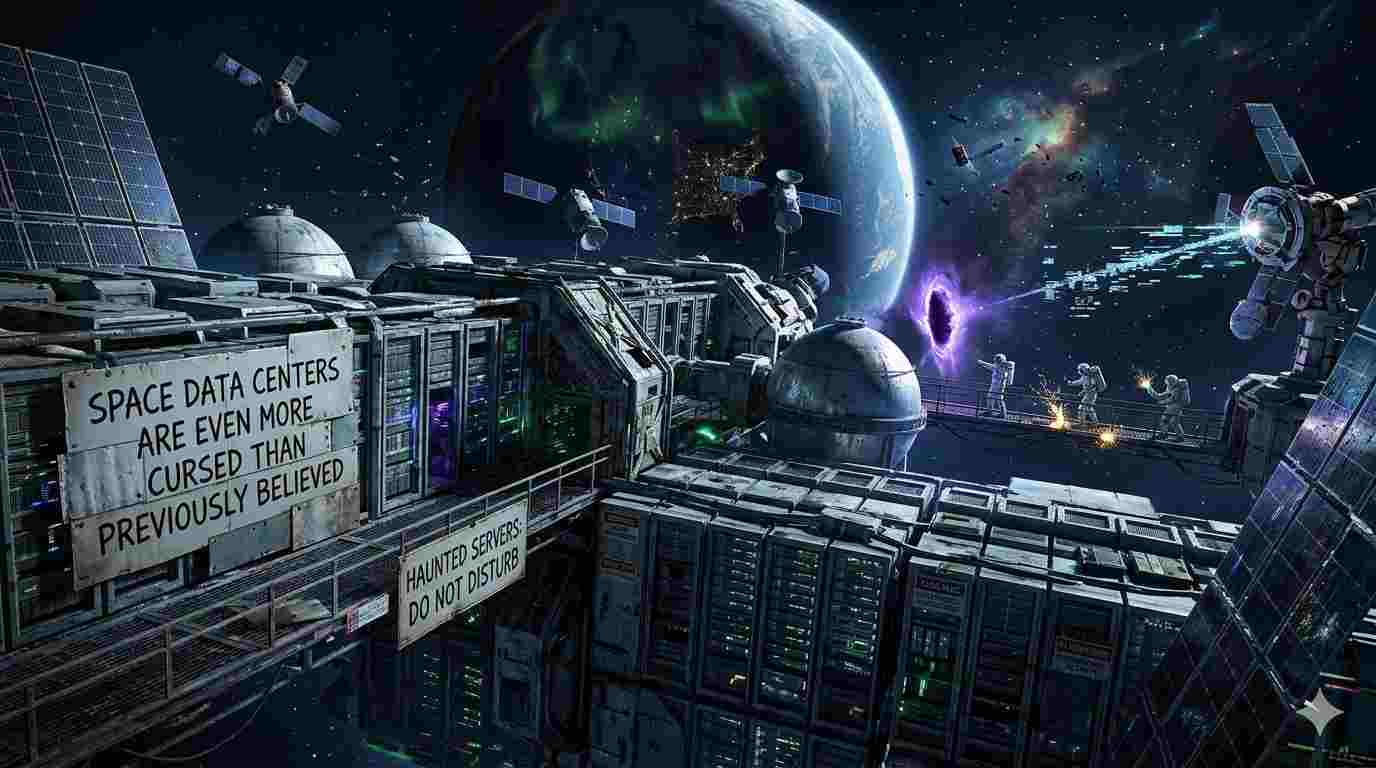
Space Data Centers Are Even More Cursed Than Previously Believed
In the grand tradition of billionaires looking at a problem and thinking “Laser cats!”, today’s tech elites have set their sights — quite literally — on data centers in space instead of on Earth. The idea is simple: take the world’s most power-hungry computers, fire them into orbit, and let sunpower and low gravity work their magic. Except the reality? Experts call it “cursed,” and we’re pretty sure the universe agrees.
Let’s break down this cosmic caper with evidence, expert opinion, and enough satire to justify hiring a Martian court jester.
Orbital Data Centers Cost More Than Earth’s GDP to Run — And That’s the Optimistic Estimate
The dream is to flip data centers into a solar-powered orbital paradise. The punchline is: orbit isn’t just up — it’s upside-down expensive. According to Scientific American, data centers will account for nearly half of U.S. electricity demand growth between now and 2030, which is why certain humans with too much money and not enough hobbies have decided the solution is to simply leave the planet.
SpaceX filed plans with the FCC for millions of satellites. Not thousands. Millions. Their filing reads like a kindergarten drawing captioned “future servers!” — fun to imagine, short on real specifics. Meanwhile, China announced a 200,000-satellite constellation. America’s response: hold my rocket fuel.
For the first time in history, “the server is down” will be a perfectly literal statement — and nobody will be able to do a thing about it.
Sam Altman Thinks Space Servers Are Ridiculous — He’s Also Trying to Buy a Rocket Company
Even the co-founder of OpenAI has publicly chuckled at the idea. Sam Altman said the concept is ridiculous right now — and considering his role in the AI world, that’s a polite way of saying “cool your jets.” Literally.
Altman has also reportedly explored acquiring a rocket company to compete with Elon Musk’s SpaceX, which means he simultaneously thinks orbital data centers are ridiculous and wants a rocket. This is what passes for strategic planning in Silicon Valley.
Calling rockets ridiculous while shopping for a rocket company is Silicon Valley’s version of a balanced portfolio.
Space Junk Apocalypse: Why Satellite Data Centers Could Turn Earth’s Orbit Into a Landfill

Experts warn that scaling this idea to rival terrestrial data centers would turn Earth’s orbit into the aftermath of a Black Friday sale — shattered satellites, tangled hardware, and leftover thermos flasks orbiting for eternity. Space Explored notes that radiation-hardened processors lag behind the most advanced terrestrial chips, meaning your space server farm would be powered by yesterday’s hardware at tomorrow’s prices.
The good news: Axiom Space has already launched two orbital data center nodes as of January 2026. The bad news: they’re about as powerful as a slightly enthusiastic Raspberry Pi compared to what would be needed to run global AI workloads. Baby steps. Tiny, expensive, irradiated baby steps.
When future archaeologists sift through Earth’s orbit, they’ll conclude we were a civilization that outsourced its thinking to the sky and then forgot to pick it up.
Rocket Launch Costs Must Drop 700% Before Space Servers Make Financial Sense
To become financially viable, Google’s own research admits costs need to fall below $200 per kilogram — roughly seven times cheaper than today’s already bargain-basement rocket prices. That’s like demanding a Tesla cheap enough to buy with your leftover pizza money.
Google projects this may happen by the mid-2030s. The same decade we were also supposed to have flying cars, cured cancer, and finished that IKEA bookshelf. We remain optimistic on all fronts.
The space-based AI computing market is currently valued at around $500 million — a small fraction of the $200+ billion global data center market. Analysts project it could reach $15-20 billion by 2030. Analysts also predicted Bitcoin would hit $1 million by 2023, so interpret accordingly.
At current rocket prices, it would be cheaper to cool your data centers by air-conditioning the entire state of Arizona. Twice. With the lights on.
When Your GPU Dies in Orbit, There’s No IT Guy With a Wrench and a Red Bull
When a chip dies on Earth, an IT person swaps it out, probably while sighing heavily and filing a ticket. In space, the solution is either robotic spacemen or leaving the broken piece up there as cosmic debris. Imagine telling your boss your reason for missing a deadline is “orbital hardware degradation.” Please do this. Report back.
CNBC reports that On-Orbit Servicing (OOS) is still an “emerging solution.” Translation: we know robots need to fix the satellites; we just haven’t figured out how to make robots that can fix satellites. Minor detail.
The official space-age job title will be “Senior Orbital Hardware Degradation Specialist” — and the commute will be murder.
Space Data Centers May Produce a Bigger Carbon Footprint Than the Ones They Replace
So much for escaping Earth’s environmental problems by floating above them. Researchers have found that the carbon footprint of space data centers could exceed terrestrial centers once you factor in manufacturing, launch, and re-entry emissions. University of Arizona researchers note that a single large U.S. data center may consume roughly the same amount of water as 2,600 households — which is bad. Shooting the replacement into space on rockets — also bad. We’ve invented a new way to feel guilty about technology.
We’re not saving the planet. We’re just moving the crime scene 250 miles higher and hoping nobody looks up.
Google’s Project Suncatcher Wants AI in Orbit by 2027 — Physicists Are Not Convinced
Google CEO Sundar Pichai thinks space data centers are achievable within a decade. Many top physicists and engineers see them as decades distant at best, and ludicrous at worst. Google’s own Project Suncatcher research blog admits: “significant engineering challenges remain.” Which is scientist for “we have absolutely no idea how to do the hard parts yet, but the concept is cool.”
Hand-waving does not count as engineering. Neither does a very confident TED talk. We checked.
Google has mapped every street on Earth, translated 133 languages, and indexed the entire internet — and their official position on space servers is “significant engineering challenges remain.” Sleep tight.
Nvidia’s Starcloud Is Building a 4-Kilometer Space Server Farm — Yes, Really
Cluttered orbits full of haunted servers might block out the stars and disrupt communications. Picture stargazing through rows of blinking server LEDs — beautiful for tech bros with Eames chairs, horrifying for astronomers who went to actual school for this.
Nvidia-backed Starcloud — the first company to train an AI model in space — plans a 5-gigawatt orbital data center with solar panels roughly 4 kilometers wide and 4 kilometers tall. That’s not a data center. That’s a Death Star with better PR.
At 4 kilometers wide, Starcloud’s solar array will be the only man-made structure visible from Earth with the naked eye — and it’ll probably crash your phone’s GPS while you’re trying to find a parking spot.
Engineers Can’t Agree If Orbital AI Infrastructure Is Genius or an Extremely Expensive Meme
Some engineers insist that one day, once interplanetary pizza delivery is common, so will servers in orbit. Others on Hacker News argue it’s innovation hype dressed in a spacesuit. No polls exist, but trust us — surveys would be funny.
What everyone agrees on: the race is officially on, with Google, Alibaba, Nvidia, Axiom Space, Blue Origin, and approximately seventeen well-funded startups all sprinting toward a finish line that is, technically, in low Earth orbit.
The engineers who think it’s genius and the engineers who think it’s a meme are both billing $450 an hour to argue about it, so really everyone wins except the planet.
Solar Radiation Can Fry Your Server Chips Faster Than a Texan Summer — And Nobody Has a Fix
Space is unpredictable. Solar panels might get shaded, chips could get fried by radiation, and the whole concept rests on assumptions about physics that humans barely understand. Compared to that, a laptop overheating on your desk seems downright comforting. Relatable. Grounded. Atmospheric.
AI News Hub confirms: radiation can flip bits, thermal management in a vacuum is radically different from blowing cold air through server racks, and the whole operation needs to survive solar storms that would make your Wi-Fi issues seem quaint.
A solar storm will one day wipe out a billion-dollar orbital data center and the official post-mortem will read: “We knew about the sun. We just didn’t think it would do that.”
Why Silicon Valley Is Betting Billions on Orbital Computing Anyway
When billionaires look at skyscrapers powered by grid electricity and say, “What if we put all that in space?” — you know we’ve crossed the threshold where logic meets interstellar comic relief.
Continuous Solar Power in Orbit Sounds Great Until You Do the Math
In theory, orbiting servers could sip endless sunlight without weather interruptions. Solar irradiance in orbit is 36% higher than on the surface, and there’s no night, no clouds, no weather. Just pure, uninterrupted, extremely hard-to-access sunshine. Yet technology has to catch up. The space environment is far harsher than a Texas summer: radiation can flip bits faster than a gamer with a broken controller, and heat management in vacuum is radically different from blowing cold air through racks.
Infinite free solar energy, available exclusively in the place that’s hardest and most expensive to reach. Nature has a wicked sense of humor.
Microgravity Maintenance Is a Comedy in Three Acts
When a chip or GPU fails in orbit, you can’t send a techie with a wrench and an energy drink. You need robots — or astronauts trained in hardware sarcasm — at a cost far higher than any AI startup has budgeted. Axiom Space is working on this problem, bless their hearts.
Act One: The chip fails. Act Two: We argue about whether to send a robot or an astronaut. Act Three: The warranty has expired.
The Real Competition Isn’t Other Companies — It’s Basic Physics
Bringing AI computing to orbit isn’t just about deploying satellites — it’s about surviving cosmic radiation, re-entry pollution, and ensuring these servers don’t become space junk that eventually impales a weather satellite mid-forecast. We’re not racing against competitors. We’re racing against entropy. Entropy has a better track record.
Entropy has never missed a deadline, never run over budget, and has a perfect 100% success rate. It is, by any measure, the most reliable force in the known universe.
Will Orbital AI Data Centers Actually Happen This Decade?
Odds are we won’t see massive orbital AI data centers this decade. Instead we’ll get a ton of patents, movies about it, and conference talks comparing orbiting servers to sci-fi lore. As one skeptical aerospace engineer might mutter over espresso: “If cosmic computation were cheap and easy, NASA would’ve done it already.”
The most likely outcome is a very expensive documentary on Netflix, buffered by a data center in New Jersey, narrated by someone who definitely owns stock in Starcloud.
DISCLAIMER: This story is entirely a human collaboration between a philosophical dairy farmer turned space humorist and the world’s oldest tenured professor of cosmic pragmatism. Any resemblance to real plans for space data centers is intentional, especially if that resemblance feels too ridiculous to be true. No AI was harmed in the making of this satire, nor is any to blame for its content.
What the Funny People Are Saying About Space Servers
“Putting servers in space is like heating your home with a rocket engine — dramatic, noisy, and completely unnecessary.” — Stand-up tech comedian
“If we wanted to look at blinking lights in the dark, we’d go camping.” — Amateur astronomer with a sense of irony
“Space is big enough already — do we really need WiFi above the clouds?” — Cloud computing engineer, somewhere, weeping softly
Auf Wiedersehen, amigo!
This piece satirizes the very real and very expensive race to build data centers in Earth’s orbit. In November 2025, Nvidia-backed Starcloud successfully launched a satellite carrying an H100 GPU and became the first company to train an AI model in space. Google announced Project Suncatcher — a plan to deploy TPU-equipped satellites in sun-synchronous orbit. Axiom Space launched two orbital data center nodes in January 2026. SpaceX filed FCC plans for millions of satellites. Launch costs must fall below $200/kg to be economically viable — roughly seven times lower than current prices. Most serious experts believe fully operational orbital data centers are 10-15 years away, if they happen at all. The carbon footprint concerns are real, the debris concerns are real, and the maintenance-in-microgravity problem remains very much unsolved. The dairy farmer is metaphorical. Probably.

Alan Nafzger was born in Lubbock, Texas, the son Swiss immigrants. He grew up on a dairy in Windthorst, north central Texas. He earned degrees from Midwestern State University (B.A. 1985) and Texas State University (M.A. 1987). University College Dublin (Ph.D. 1991). Dr. Nafzger has entertained and educated young people in Texas colleges for 37 years. Nafzger is best known for his dark novels and experimental screenwriting. His best know scripts to date are Lenin’s Body, produced in Russia by A-Media and Sea and Sky produced in The Philippines in the Tagalog language. In 1986, Nafzger wrote the iconic feminist western novel, Gina of Quitaque. He currently lives in Holloway, North London. Contact: editor@prat.uk