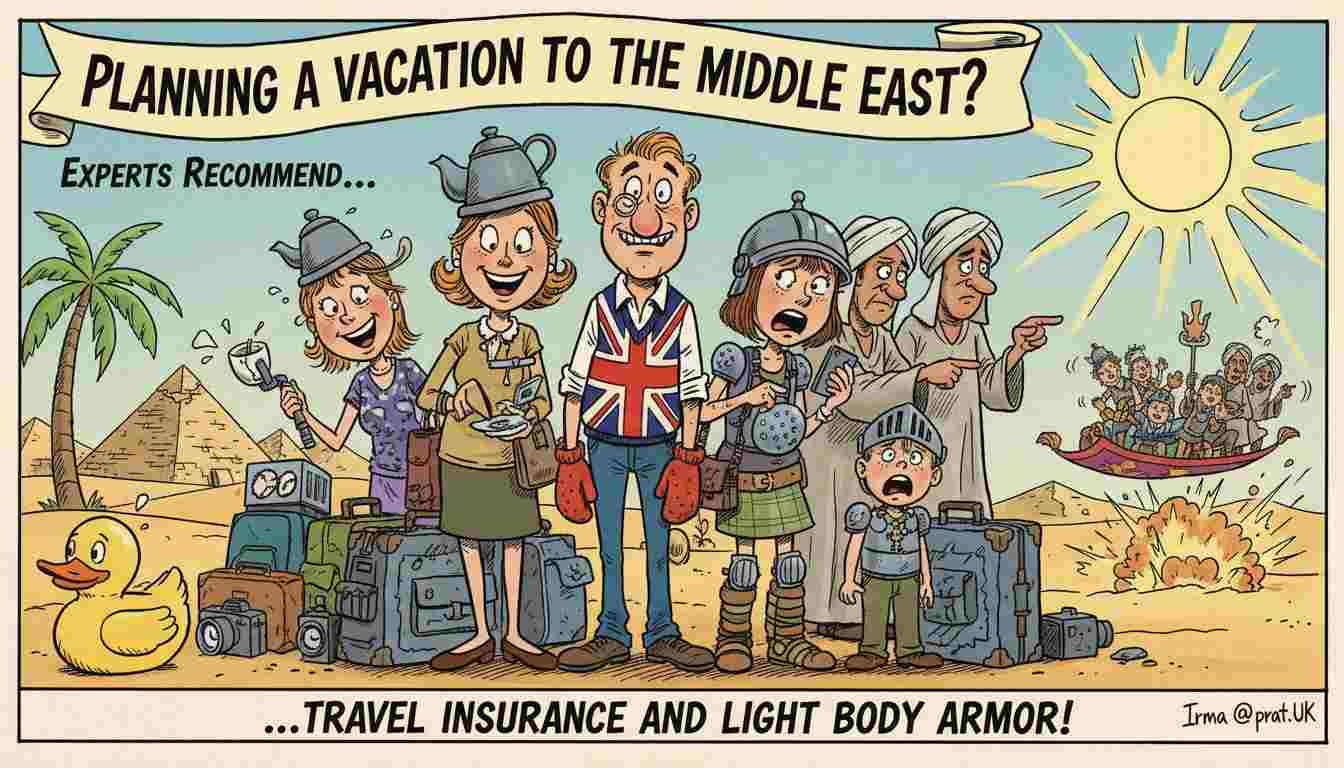
Fancy a Holiday in the Middle East? Experts Suggest Travel Insurance, a Flask of Tea, and Possibly a Helmet
Before you iron your chinos and locate your passport from behind the radiator, aviation authorities would like to gently remind you that the sky is currently undergoing what engineers might call unscheduled restructuring. On 28 February 2026, coordinated US and Israeli strikes on Iran prompted retaliatory missile launches and the closure of airspace over at least eight countries, including Iran, Iraq, Jordan, Qatar, Bahrain, Kuwait, and the UAE. Emirates — the world’s largest long-haul airline — suspended all operations from Dubai. Qatar Airways went dark entirely. British Airways suspended flights to Tel Aviv and Bahrain, which is the most British possible response: suspend service and say nothing further until asked.
Airlines are adapting. Passengers are adapting. The concept of a direct flight is quietly weeping in a corner.
Here are five brisk observations for the bewildered British traveller.
- The only thing less predictable than airline refund policies is the geopolitical mood of the region you were hoping to visit.
- Nothing quite ruins a poolside gin and tonic like a push notification reading Airspace Suspended Until Further Notice. You didn’t even get to unpack.
- Google Maps has quietly added a routing option called Avoid Ballistic Activity. It is currently toggled on by default.
- Travel influencers are describing missile contrails as moody atmospheric streaks. Filters have been applied.
- Every itinerary now contains the phrase subject to prevailing reality, which is also how the British describe the weather.
Right. Now to the brochure.
British Airways Issues New Fare Class: Standard Geopolitical Ambiguity (No Frills)
In keeping with the times, several major carriers have unveiled a new seating category tailored to the modern traveller. Standard Geopolitical Ambiguity comes with a middle seat, no overhead locker access, and the very real possibility that your aircraft may spend forty minutes circling Cyprus while the cabin crew pretend to organise the trolley.
An anonymous airline executive, speaking from what he described as a broom cupboard of considerable strategic importance, explained the new tier. “Passengers were already experiencing uncertainty,” he said. “We simply put it on the booking page with a dropdown menu.”
Under this fare, passengers receive automated updates every eleven minutes: We are monitoring the situation. For an additional £34.99, travellers may upgrade to Premium Situational Awareness, which entitles them to a text message from the pilot reading: We are also monitoring the situation. The biscuits are Hobnobs.
Professor Gerald Flinch of the Institute for Applied British Stoicism noted that this model merely formalises what travellers have long suspected. “If the sky is chaotic,” he said, gesturing at a map covered in alarming red icons, “then transparency demands the invoice reflect that chaos. Ideally with a booking fee.”
A survey conducted by the Association of People Who Simply Wanted a Fortnight in the Sun found that 61.4 percent of British respondents said they would appreciate advance warning if their holiday might be rerouted through five continents, while 31.2 percent said they would consider a staycation in Skegness. Skegness could not be reached for comment, but sources suggest it is quietly thrilled.
Pilots Enquire Whether They Can Simply Go Round Iran Like It’s Roadworks on the M25
Commercial pilots — professionals renowned for announcing a spot of turbulence ahead during what passengers are experiencing as a full atmospheric nervous breakdown — have begun posing a reasonable question. Can we not just go around?
Captain Patricia Hennessy, a 24-year veteran of long-haul routes and a woman who once landed a 777 in a crosswind at Heathrow without spilling her coffee, put it plainly. “When I see a red zone on the map, I think of the M25 at junction nine. I look for the diversion signs and ask: can we swing north, refuel somewhere sensible, and get on with it.”
European air traffic controllers confirmed that rerouting is well underway, though going around in aviation terms involves thousands of additional nautical miles and fuel expenditure roughly equivalent to the annual heating bill of a moderately sized Scottish castle.
One anonymous operations planner described internal scheduling meetings as resembling a particularly fraught episode of The Apprentice. Someone proposes Iceland. Someone else suggests Greenland. A third person asks whether they’d need an ATOL certificate for the North Pole. Legal is still looking into it.
Flight Tracker App Overtakes BBC iPlayer as Britain’s Most Gripping Evening Entertainment
The most compulsively watched programme in Britain this weekend is not a gritty ITV drama. It is Flightradar24.
Travellers who once used the app to check whether their 7:15 to Malaga was running on time are now refreshing it with the intensity of someone watching a penalty shootout. The little plane icon crawls across the screen while users mutter, don’t go left, don’t go left, oh God it’s going left.
Psychologist Dr. Ros Pemberton has a theory. “The British public has always enjoyed watching something difficult unfold at a safe distance,” she said. “For centuries it was cricket. Now it’s a Boeing 777 attempting to navigate geopolitics at 35,000 feet.”
A witness at Heathrow Terminal 5 described the scene as “oddly ceremonial.” “Everyone’s staring at their phone,” she said. “When the little plane clears a red zone, there’s a sort of collective exhale. Someone near WHSmith actually applauded.”
The Civil Aviation Authority has denied adding dramatic musical stings to any official app updates, though several passengers insist the interface now zooms in ominously near conflict zones. The CAA issued a statement. It was four sentences long and used the word monitoring three times.
Emirates Reroutes London to Dubai Via Somewhere Tranquil — Possibly Greenland, Possibly a Cloud
As the situation escalated, airlines reported dramatic reroutes across the board. One flight reportedly departed London Gatwick bound for Dubai and arrived — eventually — in what crew described as a fjord adjacent to peacefulness.
Greenland’s tourism board greeted the accidental arrivals with some enthusiasm. “We have glaciers, we have silence, and we have precisely zero missile trajectories overhead,” said a spokesperson who appeared genuinely delighted by the footfall.
Aviation economists note that every reroute adds hours and millions in fuel. Over 260 flights were cancelled across the Gulf in a single day, with thousands more delayed or diverted as airlines scrambled to redraw their networks. The upside, according to one analyst, is that passengers are now acquiring impressive knowledge of Arctic geography entirely against their will.
One British frequent flyer, reached by telephone from what appeared to be a Norwegian airport, summarised the experience with characteristic restraint. “I booked a direct flight,” he said. “I now appear to have circumnavigated the top of the world. My luggage, however, is in Bahrain.”
The Economics of Booking a Holiday Beneath an Emotionally Volatile Sky
Travel insurers report record enquiries for policies covering what one brochure cheerfully describes as Acts of Geopolitics. Premium options now include coverage for missile-adjacent inconvenience, sudden airspace temperament changes, and involuntary Arctic stopovers. The excess is £150. The small print is longer than the flight.
Economists warn that sustained closures will ripple through oil markets, supply chains, and the broader global economy. But at Departure Gate 22, the discussion is more immediate. Will the gate open? Will there be a gate? Does anyone know if the Pret is still serving?
The Middle East has for millennia been a crossroads of civilisation. It is now also the world’s most dramatic aircraft diversion zone, which is a sentence that would have baffled Herodotus but would not have surprised him.
What the Funny People Are Saying
“My boarding pass now says subject to prevailing foreign policy. That’s new. I used to just worry about legroom.” — Jack Dee
“The safety card doesn’t mention missiles. Bit of an oversight from the design team, that.” — Sarah Millican
“I asked for a window seat. I didn’t ask for a window seat overlooking an international incident.” — Romesh Ranganathan
“If your holiday requires a geopolitical briefing and a NATO update, perhaps look into Center Parcs.” — Dara Ó Briain
Final Boarding Call — If There Is One
So should you cancel? The Foreign, Commonwealth & Development Office advises checking travel advisories before departure, which at present read something between exercise caution and perhaps have a think about this.
Airlines insist safety remains their absolute priority. Pilots continue to do precisely what they have always done: navigate extraordinary complexity with calm, professional competence, and an expression that suggests everything is perfectly fine even when it demonstrably isn’t. Passengers will keep chasing the sun, even if the route to it now goes over Iceland.
In the end, planning a holiday to the Middle East in 2026 is rather like booking a window seat on history. It may be delayed. It will almost certainly be rerouted. And you will absolutely have a story to tell at the next family gathering — assuming your luggage catches up in time.
Disclaimer: This article is a work of satire, produced through a human collaboration between the world’s longest-serving emeritus professor and a philosophy graduate currently milking dairy cows in the Cotswolds. Any resemblance to actual fare classes, emotionally unstable airspace, or involuntary Greenland stopovers is purely coincidental. Safe travels, and Auf Wiedersehen, amigo!

Alan Nafzger was born in Lubbock, Texas, the son Swiss immigrants. He grew up on a dairy in Windthorst, north central Texas. He earned degrees from Midwestern State University (B.A. 1985) and Texas State University (M.A. 1987). University College Dublin (Ph.D. 1991). Dr. Nafzger has entertained and educated young people in Texas colleges for 37 years. Nafzger is best known for his dark novels and experimental screenwriting. His best know scripts to date are Lenin’s Body, produced in Russia by A-Media and Sea and Sky produced in The Philippines in the Tagalog language. In 1986, Nafzger wrote the iconic feminist western novel, Gina of Quitaque. He currently lives in Holloway, North London. Contact: editor@prat.uk