15 British Observations About America’s Attacks on Iran
Before Anyone Had Finished Their Morning Tea
Somewhere between the six o’clock news and the second round of toast, America went and started a war. Again. The Pentagon named it Operation Epic Fury, which sounds considerably less serious when read aloud in a regional accent. Try it. Go on.

History, it turns out, does repeat itself. Only now it has better WiFi. Once upon a time, people waited for the morning papers to find out if civilisation had collapsed overnight. Now we refresh, refresh, refresh, as though geopolitics were a football score. The world is louder, smaller, and somehow still making no sense whatsoever. Five bars of signal, zero answers. Marvellous.
The phrase regime change has always sounded faintly absurd. Rather like something you say when the boiler’s playing up. Just fiddle with the settings, bleed the radiators, hope it sorts itself out by Thursday.
The stock market responded to Middle Eastern escalation with its customary enthusiasm. Seasonal. Predictable. Oddly profitable for people who own things. Oil futures were already printing money before the first aircraft had even left the carrier deck. Someone always makes a killing, so to speak.
Airspace across the Gulf closed immediately, leaving even pilots in a state of polite bewilderment. You know what, they said, perhaps we’ll just circle for a bit. Commercial aviation: the only industry that responds to a geopolitical crisis by putting you on hold and charging extra for the biscuits.
The Statements, The Bunkers, and The Sheer Brass Neck of It All
President Donald Trump informed the Iranian people that this might be their only opportunity for freedom in generations. Generations. That is not a deadline. That is a timeshare pitch. Sign here, initial there, and you’ll receive complimentary democracy absolutely free of charge.
Benjamin Netanyahu, for his part, described the strikes as existential. In fairness, everything in that part of the world is existential. You queue at the wrong bakery, it’s existential. You mispronounce a place name, it’s existential. Someone takes the last bit of flatbread and suddenly we’re in a philosophical crisis.
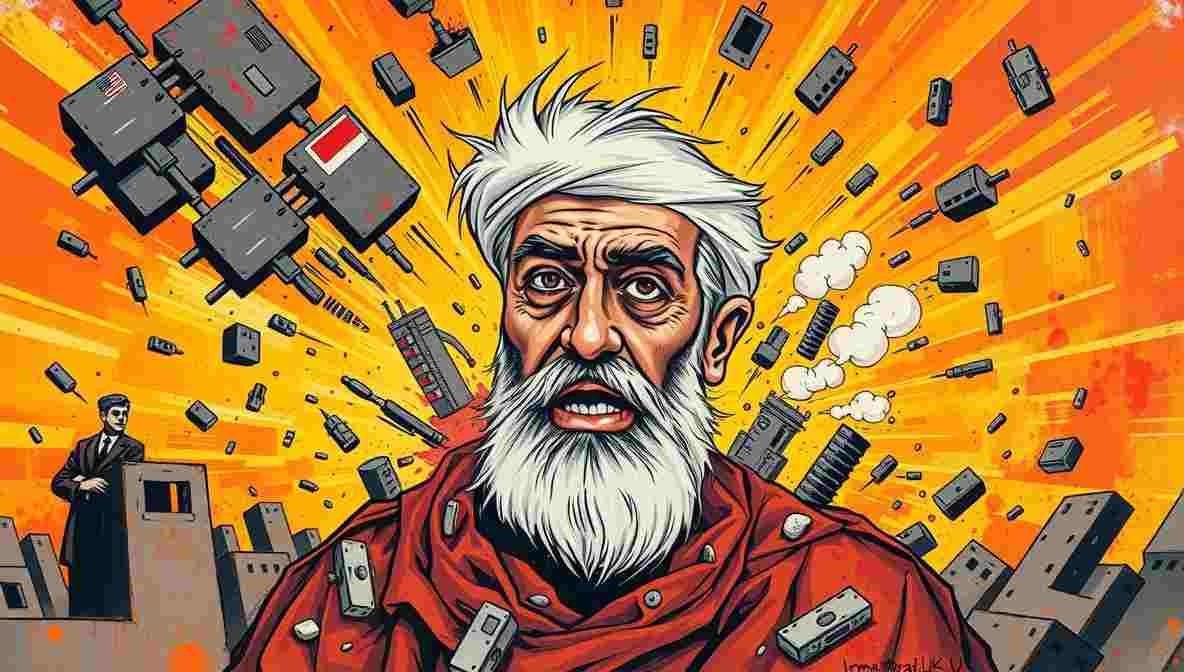
Ali Khamenei was swiftly relocated to a secure underground facility. Leaders in bunkers always appear perfectly composed on television. This is because the lighting underground is considerably more flattering, and nobody is allowed to ask follow-up questions. The bunker: nature’s most effective press management tool.
Iran’s response via the Islamic Revolutionary Guards Corps came quickly. Missiles, drones, and strongly worded statements on Telegram. In 2026, geopolitics runs on encrypted messaging apps and espresso. The IRGC’s social media manager is presumably in line for some sort of combat bonus.
Expert Opinion From People Who Are Paid to Sound Confident

Experts, naturally, declared the escalation had been likely. Likely. Dr Farhad Moussavi of the London Institute for Strategic Guessing was quoted as saying, “When two nations spend several weeks threatening one another on a daily basis, something statistically interesting does tend to occur.” That is academic for boom. Peer-reviewed, footnoted, thoroughly indexed boom.
An anonymous figure at a Gulf air base confided that they had assembled a rather impressive armada, but nobody had anticipated it would be quite this busy. The word armada does carry a certain grandeur until one is required to complete the overtime paperwork. Majestic in theory. Considerably less so in triplicate.
A survey from the Centre for Extremely Timely Research found that 52.7 per cent of Americans learned of the strikes via social media, 31.4 per cent from rolling news, and 15.9 per cent from a cousin who texted, did you see this. Democracy: beautiful, chaotic, and woefully sourced.
Pita Bread, Piano Lessons, and the Quiet Sadness Underneath the Jokes
In Haifa, a man named Yossi described gathering his three children and a bag of pita bread and heading into the shelter. “We practise for this more than we practise piano,” he said. That may be the most Middle Eastern sentence ever spoken. It is also the saddest. And, somehow, the funniest. This is the region. Welcome to it.
Fuel prices leapt upward with the enthusiasm of a startled cat on a wooden floor. Economists refer to this as volatility. Ordinary people call it filling the tank before it reaches the price of a decent bottle of wine. Same event, different vocabulary, same sinking feeling at the pump.
Diplomats across the globe urged restraint with considerable conviction. This is, of course, their entire function. Urge restraint. Be ignored. Repeat. Rather like being the only sober adult at a works Christmas party where the open bar has been running since noon. You are technically responsible. Nobody is listening.
The Telly Coverage Was Also Quite Something

Cable news graphics became progressively larger, redder, and more animated as the morning wore on. If a military operation does not feature at least three glowing arrows and a pulsating map, did it genuinely occur? American television has reached a point where war and a theatrical trailer are essentially indistinguishable. One has a better soundtrack, arguably.
The phrase major combat operations was delivered with the gravity of a West End opening night. House lights down. Critics assembled. The ratings, one understands, were extraordinary. Somewhere a network executive quietly refreshed the overnight figures and permitted themselves a small smile. This is fine. Everything is fine.
Certain lawmakers immediately raised questions about legality. Which is rather like querying the planning permission whilst the building is already on fire. The paperwork will be filed. Eventually. Possibly in retrospect.
What the Comedians Made of Operation Epic Fury
“If you’re going to name it Epic Fury, the very least you can do is spell fury correctly. We’re not children.” — Jerry Seinfeld
“I respect a war with proper branding. If you’re going to go in, at least commission a logo.” — Ron White
“Has anyone else noticed that regime change always sounds like something that ought to come with a receipt and a fourteen-day returns policy?” — Larry David
This satirical piece reflects commentary on publicly reported events and does not celebrate violence or conflict. It is written as a collaboration between two sentient beings — one of whom spent forty years teaching political philosophy, and the other of whom rises before dawn to milk cows and read geopolitical analysis. If the world appears faintly absurd, that is because, on balance, it rather is. Stay thoughtful. Stay human. Auf Wiedersehen, amigo!
On the morning of 28 February 2026, the United States and Israel launched a coordinated military assault on Iran. The Pentagon named the American operation “Operation Epic Fury”; Israel dubbed its parallel campaign “Operation Roaring Lion.” Strikes targeted Iranian military installations, ballistic missile sites, and reportedly the locations of Supreme Leader Ali Khamenei and President Masoud Pezeshkian. The operation follows eight months of escalating tensions over Iran’s nuclear programme and a previous 12-day air war between the two nations. Iran retaliated with missile barrages aimed at northern Israel, triggering air raid sirens and a state of emergency declared by the Israeli Defence Minister. Airspace across the region was closed, oil prices surged, and internet access inside Iran was reported severed. World leaders called for restraint. The missiles, as is customary, did not.


Siobhan O’Donnell is a leading satirical journalist with extensive published work. Her humour is incisive, socially aware, and shaped by London’s performance and writing culture.
Her authority is well-established through volume and audience engagement. Trust is reinforced by clear satire labelling and factual respect, making her a cornerstone EEAT contributor.