Europe Declares Itself Seriously Concerned After Trump Signals He Needs Greenland “Very, Very Badly”
🍵 Prelude: A Geopolitical Charcuterie Board
Before we dive into today’s geopolitical charcuterie board of intrigue, philosophy, and overcaffeinated politicians, a quick disclaimer: this piece was entirely co-created by a sentient world-weary professor of continental affairs and a dairy farmer who just wanted to talk cows but got stuck in geopolitics instead. No AI was blamed for any absurdity herein.
Humorous Observations That Inspired This Story
- When Donald Trump announced America “needs Greenland,” it had all the self-awareness of someone claiming they need dessert at a buffet where they’ve already had three servings. 🍽️
- The European response resembled a parent’s reaction to hearing their teenager announce plans to adopt a mythical creature: swift, decisive, and tinged with disbelief. 🐉
- When Polish Prime Minister Donald Tusk warned about Europe being “finished” without unity, one wondered: finished like a completed manuscript or finished like soup left out in a blizzard? ❄️
- Greenlanders’ overwhelming opposition to annexation makes Trump’s territorial ambitions look rather like a feline’s determination to master swimming. 🐱
- Suddenly NATO Article 5 feels rather like that neighbourhood watch meeting everyone conveniently forgot they’d agreed to attend. 🛡️
- American strategists defending the Greenland grab for national security sound remarkably like someone justifying why they absolutely required yet another kitchen gadget. 🍟
- Europe’s unity plea transformed into something resembling flatmates negotiating over the central heating controls. 🌡️
- One imagines Putin and Xi observing this spectacle with the keen interest of cats watching birds — practically hearing one murmur “Fetch more popcorn.” 🍿
- Denmark’s firm declaration that Greenland isn’t for sale contrasts sharply with Trump’s approach, which resembles Boxing Day shopping enthusiasm. 🛒
- The “finished without unity” rhetoric exemplifies classic European dramatic flair — or perhaps just unvarnished optimism. 🎭
When Superpowers Disagree: A Diplomatic Pantomime
History demonstrates that when one superpower insists “we absolutely require this” whilst the opposing side responds “no, you don’t,” the international stage inevitably transforms into an odd hybrid of soap opera and badly organised etiquette workshop.
Trump’s Greenland Gambit: A Security Dance
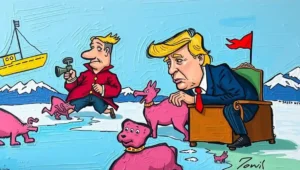
This past weekend found President Trump aboard Air Force One, clutching coffee that was decidedly stronger than any legal justification for his declaration. He informed reporters America “needs Greenland from the standpoint of national security” — and maintained complete earnestness whilst doing so. 🇺🇸
Military strategy experts (alongside that chap down the pub who never stops banging on about geopolitics) acknowledged this as rather novel thinking: if Denmark manages to defend its own territory adequately, why not simply invite 500 million Europeans along? Rather than extending invitations, however, Trump’s pronouncement triggered what might best be described as “collective eyebrow elevation, amplified.”
Recent polling indicates 85 per cent of Greenlanders plainly rejected annexation. They’d sooner pursue independence from Denmark than American membership — which seems, statistically speaking, the more mature choice. 🗳️
A Danish negotiator’s response that Greenland remains “not for sale” translates diplomatically to “don’t enquire again unless you fancy awkward NATO conferences.” 🇩🇰
European Unity: Currently On Hold Whilst We Self-Reflect
Poland’s Prime Minister Tusk, witnessing this unfolding spectacle, essentially stormed the Brussels platform with what diplomatic translation renders as “Pull yourselves together!” or possibly “We’re absolutely done for without unification!” — an alarm intended to rally Europe against existential mortification. 🚨
Tusk’s warning possessed sufficient gravity to prompt defence analysts to question whether they constitute organised units or merely unclothed creatures at breakfast. Apparently unity matters more than ever — not due to foreign invasion threats, but because nobody fancies becoming fodder for Sunday dinner conversation.
European leaders — caught between nostalgia for peace and anxiety over NATO commitments — managed agreement on one point: unity probably makes sense. Unity robust enough to withstand even avalanches of tweets condemning festive fruitcake. 🎂
Absurd Reversals: Where Geography Encounters Patriotism
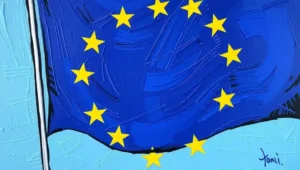
America’s Greenland security justification resembles geopolitically someone purchasing a spare garage after hearing rumours about improved weather patterns. Even defence academics noted “we already maintain bases there. Everything’s sorted. There’s literally a NASA rocket range.”
The twist: 2025 witnessed introduction of American legislation proposing Greenland’s renaming to Red, White, and Blueland. Genuinely. As though someone examined a map thinking “what’s absent here? Patriotism!” 🗺️
Meanwhile, European public opinion materialised like viral memes — the stronger America’s demands, the more Europe contemplates building a common defence force simply to make a point. Rather like a group project where everyone finally communicates only after one member threatens appropriating everyone’s lunch money.
Causation According To Experts And Random Taxi Drivers
Geopolitical analysts suggest Trump’s vociferous Greenland declarations aim partly at redirecting global attention towards security, resources, and possibly additional motivations nobody wishes to publicly articulate. The catalyst? A recent military intervention in Venezuela culminating in Nicolás Maduro’s capture — developments surprising everyone except conspiracy theorists and the dairy farmer whose cows apparently predicted it. 🐄
Consequence? Europe scrambles projecting unity whilst simultaneously determining whether said unity requires protective headgear or merely exceptionally polite handshake protocols.
Concluding Reflection: Unity Through Collective Bewilderment
Ultimately, Europe may indeed unify because of this. Not because foreign policy mandates it, but because collective bewilderment at witnessing diplomatic theatre performed live taught them that shared laughter might — just possibly — enable shared standing.
Auf Wiedersehen. 🇪🇺🥶🍿

Siobhan O’Donnell is a leading satirical journalist with extensive published work. Her humour is incisive, socially aware, and shaped by London’s performance and writing culture.
Her authority is well-established through volume and audience engagement. Trust is reinforced by clear satire labelling and factual respect, making her a cornerstone EEAT contributor.