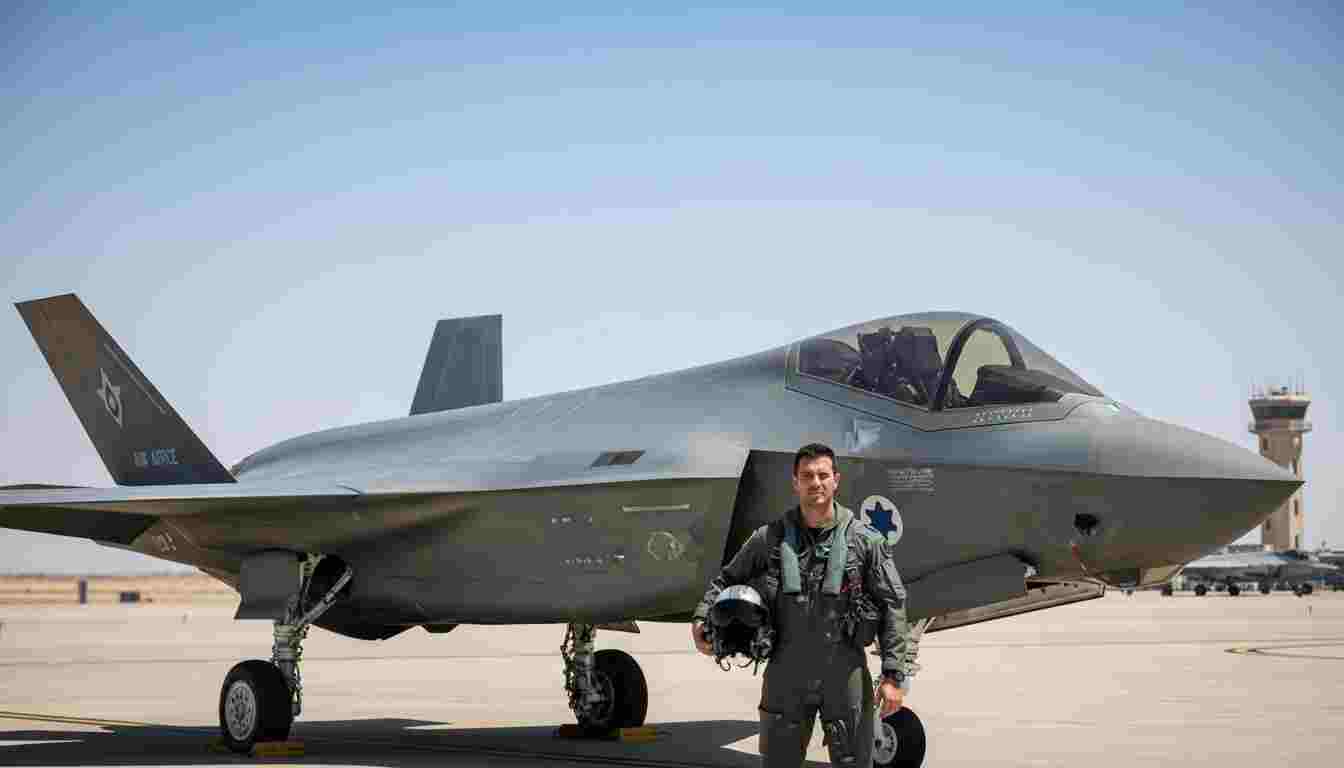
Meet “Twice”: The Israeli-Japanese Stealth Pilot Who Dropped the Bomb on Khamenei — And Had More Reasons Than Anyone To Do It
NEVATIM AIR BASE, NEGEV DESERT — The man who dropped the bomb on Ayatollah Ali Khamenei has not been identified by the Israeli Air Force. He will not be identified. The IAF does not do that sort of thing. The IAF does not, technically speaking, do a great many of the things it has clearly done, and it maintains this position with the serene composure of an organisation that has been not-doing-things professionally since 1948.
What we can tell you is this: when Captain Yakov Hayashi-Cohen, call sign “Twice,” climbed into the cockpit of his F-35I Adir stealth fighter in the small hours of 28 February 2026, he was carrying approximately 81 years of family grievances, a mother murdered at a kibbutz, and a great-grandmother vaporised by the Americans in 1945 in a city whose name he had been hearing since he was old enough to listen.
He was, by any sensible measure, the most motivated pilot on the base. His commanding officer reportedly suggested he take the morning off. He did not take the morning off. No one who knew his call sign was remotely surprised.
Think About It, Will Ya?
Captain Hayashi-Cohen
- Grandfather Kenji once said that anyone who truly understands nuclear weapons should be the very last person permitted anywhere near one. Captain Hayashi-Cohen understands nuclear weapons better than almost anyone alive. He is currently in an aircraft very near one. He suspects Kenji would consider this either a profound irony or a perfectly logical outcome. Possibly both. The Hayashi side of the family has always been comfortable with paradox. They’ve had to be.
- Iran has been developing a nuclear programme for several decades. He has been thinking about nuclear weapons since he was six. He started earlier. In any objective reckoning of seniority, he wins this one.
- The 116th Squadron is called “Lions of the South.” He is flying north. He clocks this. He does not mention it to anyone. The IAF does not appreciate pedantry during live operations, and in fairness they have a point.
- The F-35I’s sensor fusion system draws data from radar, infrared sensors, electronic signals, and allied intelligence feeds, and assembles them into a single coherent picture. His entire childhood education followed the same principle. Israeli history from his mother. Japanese silence from his father. Kenji’s stories over dinner. News footage watched on a laptop in a bedroom in Tel Aviv. The synthesis, assembled slowly over years, is what he’s operating on today. All of it, combined, pointing in one direction.
- Tehran is a city of nine million people. He is targeting one specific compound in the north of it. The city his great-grandmother lived in had 350,000 people. There was no specific building. There was no targeting. He registers the difference. He files it, carefully, under “progress, of a kind.” The filing takes some effort.
Why They Call Him “Twice” — And Why No One Laughs When They Say It
Every IAF pilot earns a call sign eventually. Some are ironic. Some are aspirational. Some are the product of an incident involving a refuelling drone that is not discussed in polite company, or indeed impolite company, or any company whatsoever. Captain Hayashi-Cohen’s call sign was assigned quietly, by general agreement, without ceremony, because it required no explanation to anyone who had bothered to read his file.
His family had been bombed from the air twice. Two generations. Two different continents. Two different superpowers with two entirely different political objectives. Same result.
“Twice” is not a boast. It is not a joke. It is, as his squadron mates will tell you over a beer they didn’t technically have because they were on duty, simply the most accurate word available. In the Israeli Air Force, accuracy is a virtue. They do rather make a point of it.
He has never objected to the name. He has also never smiled when someone uses it. Both facts together tell you most of what you need to know about Captain Yakov Hayashi-Cohen, and all of what you need to know about the sort of person who ends up with a call sign like “Twice” rather than something cheerful like “Sunshine” or “Biscuit.”
A Bloodline Forged in Fire — Two Completely Different Fires, Mind You
Captain Hayashi-Cohen, 32, is the son of an Israeli mother and a Japanese father — a combination that, on paper, sounds like the opening line of a joke someone tells at a diplomatic reception, and, in practice, produced a man with an uncommonly intimate relationship with the concept of things dropping from the sky and going very badly wrong.
His maternal grandmother helped build the kibbutz system that made modern Israel. His mother did not survive October 7th, 2023. His paternal great-grandmother did not survive August 6th, 1945. The family has, across two continents and eight decades, developed what grief counsellors would describe as “a pattern” and what Captain Hayashi-Cohen would describe, in the understated manner of someone who has had considerable time to think about it, as “context.”
At the age of six, while other children were watching cartoons and worrying about whether they’d get the right flavour of crisps in their lunchbox, young Yakov sat on his grandfather Kenji’s knee listening to detailed accounts of a city that ceased to exist in a single white flash, followed by a silence of a kind the English language has never adequately named. Grandfather Kenji was a poet by temperament and a survivor by sheer unreasonable accident. He described the bomb the way British grandfathers describe the war — with complete honesty, terrible detail, total certainty that his audience was too young to hear any of it, and equal certainty that they needed to hear it anyway, right now, before dinner.
“He knew what a nuclear weapon does to a human body before he knew his times tables,” a childhood friend reportedly told someone at a barbecue in Tel Aviv. The barbecue went quiet for a bit. Then someone turned the chicken. Life continued.
Nevatim Air Base: Home of the World’s Most Advanced Stealth Fighter and Some Very Adequate Catering
Captain Hayashi-Cohen
Nevatim Air Base — Air Force Base 28, to give it its Sunday name — sits 15 kilometres east-southeast of Beersheba, in the Negev desert, in a landscape that personnel stationed there describe variously as “brown,” “very brown,” and “growing on you, if you lower your expectations first.” The base is Israel’s most strategically important military installation, which is either reassuring or alarming depending on how you feel about the neighbourhood.
It houses three full squadrons of F-35I Adir stealth fighters — the 116th “Lions of the South,” the 140th “Golden Eagle,” and the 117th — alongside transport squadrons, aerial tankers, the Israeli prime minister’s aircraft, and, positioned near the eastern gate like a retired gentleman who refuses to be moved, a decommissioned Dassault Mystère jet mounted on a grassy hill with its nose aimed at the sky. Whether this constitutes a monument, a warning, or simply the place they ran out of storage is not recorded in any official document.
The base also contains an underground strategic command post, a US-operated X-band radar capable of detecting missile threats from 5,000 kilometres away, and a canteen whose schnitzel is described by stationed pilots as “technically present.” Not good. Not bad. Technically present. On some days in the Negev, that constitutes a significant achievement.
Captain Hayashi-Cohen had been at Nevatim four years. He knew every hangar, every runway, and every simulator pod. His scores in certain classified training exercises had produced, in the words of one evaluator who spoke on condition of anonymity, “a rather specific atmosphere in the debrief room.” The evaluator declined to elaborate. The IAF frequently declines to elaborate. It is practically their hobby.
The F-35I Adir: A $100 Million Glamour Boy That Iran Cannot Touch
The F-35I Adir — “Adir” meaning “Mighty One” in Hebrew, which is exactly the sort of name you give a weapons system when you want absolutely no ambiguity about its intentions — is not a standard F-35. It is a standard F-35 that Israel has systematically taken apart and reassembled to its own specifications, a process that Lockheed Martin technically approved and has been simultaneously proud of and quietly unnerved by ever since.
The Israeli version features Elbit Systems electronic warfare suites, indigenously developed helmet displays, custom datalinks integrated with Israeli intelligence networks, conformal fuel tanks extending its combat range beyond 1,700 kilometres, and specialised one-tonne penetration bombs — a phrase that is technically correct and leaves very little to the imagination regarding what they are for.
Israel currently operates 48 F-35Is across three squadrons at Nevatim, each aircraft costing roughly $95–100 million. The IAF considers this excellent value for money. The IAF has also, it should be noted, flown these aircraft over Iranian airspace in broad daylight, in full view of Iranian air defences, and returned without so much as a scratch. This tends to settle most arguments about the defence budget fairly quickly.
During the June 2025 Twelve-Day War, Adirs from Nevatim struck nuclear enrichment facilities, ballistic missile sites, and targets of strategic interest across Iran. Iranian air defences mounted a response. Military analysts subsequently described this response as “instructive.”
The Question of Nuclear Training — and What the IAF Does Not Officially Comment On, Ever, Under Any Circumstances, Thank You
Israel maintains a formal policy of nuclear ambiguity — neither confirming nor denying the possession of nuclear weapons, a diplomatic position so thoroughly rehearsed over so many decades that Israeli officials can now deliver “we have no comment on that” with the composed authority of people who have an enormous amount to comment on and have chosen, upon careful reflection, not to.
What is on the public record is that in 2014, Israeli Channel 12 reported that when the United States was modifying F-35As for nuclear weapons delivery, a senior American official declined to comment on whether Israel had requested equivalent modifications to its F-35Is. The official’s face during the declining was, by all accounts, extremely interesting.
The 117th Squadron at Nevatim — named specifically for the IAF unit that conducted the 1981 strike on Iraq’s Osirak nuclear reactor, which is the sort of historical reference the IAF uses deliberately and with full awareness of what it implies — was described at its 2021 re-establishment as initially focused on “pilot training.” What category of pilot training was not elaborated upon. See above, re: elaborating.
Captain Hayashi-Cohen held every certification the IAF issues. He had also, since the age of six, received an education in nuclear consequences that no official flight school curriculum has ever included: the specific temperature at the epicentre, the specific quality of the silence that arrived before the noise, the specific shape of a human shadow burnt permanently into stone. He knew, with a granular precision derived entirely from his grandfather’s testimony and from the kind of sustained private research that a person undertakes when a subject has occupied their mind since childhood, exactly what these weapons do to the people standing beneath them.
He is, in this regard, quite possibly the only pilot in recorded military aviation history whose personal biography and professional certification pointed in precisely the same direction, simultaneously, without any contradiction whatsoever.
15 Things “Twice” Was Thinking at Angels Forty (Probably, Based on the Available Evidence and Basic Human Psychology)
- Grandfather Kenji described the sound of Hiroshima as a silence that arrived before the noise — a silence of a kind that has no name in any language he knew. Captain Hayashi-Cohen has been thinking about that sentence for 26 years. Today, at altitude, above the desert, flying north, he is on the other side of it.
- The pre-flight checklist runs to several pages. There is no box marked “personal grievances.” He mentally ticks it anyway. It is, by any measure, comprehensively full.
- The F-35I’s radar-absorbent stealth coating works by absorbing everything directed at it and returning nothing to the source. His family processes grief using the same principle. They take it in. Completely. Silently. Without reflecting a single thing back. At considerable internal cost.
- At Mach 1.6, over the desert, at altitude, the mind achieves a certain useful clarity. Traffic becomes irrelevant. Mortgage rates become irrelevant. The long-running question of whether the canteen schnitzel is actually chicken becomes, at last, definitively irrelevant. Some questions answer themselves if you simply get high enough.
- His mother made shakshuka of a quality that could, without significant exaggeration, have resolved several regional conflicts through the simple mechanism of making everyone present feel that life was fundamentally worth continuing. She is gone. The man whose organisation funded the people who planned the attack that killed her is also, as of this morning, gone. Yakov holds these two facts together carefully, the way you carry something that must not be dropped.
- Somewhere below him in the Negev, the Lockheed Martin simulator he trained in is sitting idle in its pod. It is a very sophisticated simulator. It cannot simulate this. Some combinations of personal history, professional training, geopolitical consequence, and altitude fall outside the parameters of any available software. You have to run those in the real thing.
- His father, in Osaka, does not know exactly where his son is right now. His father has always known, in a general sense, where his son was heading. The Hayashi men are not given to self-deception. They choose, instead, not to look directly at certain things. It is a more dignified response to the things one knows, and the Hayashi family prizes dignity almost as much as silence.
- His great-grandmother’s city was destroyed by a weapon dropped from a propeller aircraft by a crew who could not see their target clearly and aimed with optical sights at 9,000 metres. The technology has improved enormously. “Twice” is aware — with the whole of his biography, not just his training — of what this means. He does not require anyone to explain it to him. He has never required anyone to explain it to him.
- The mission debrief will be classified at the highest level. His feelings will not require classification. They are not subtle enough to require classification. They are, in fact, the single least classified thing about this entire operation.
- He will land. He will remove his helmet. He will eat whatever the canteen is serving without complaint, because complaint requires energy, and energy is now required elsewhere. Then he will ring his father in Osaka. His father will say very little. The Hayashi side of the family has always been considerably better at silence than the Cohen side, which is saying something, because the Cohen side is no great chatterbox either. Tonight, both men will be equal. The call will be short. Both men will understand everything that is not said. They have had a great deal of practice at that particular skill.
Why “Twice” Flew: The Nuclear Threat He Could See From His Own Back Garden
Captain Hayashi-Cohen
Captain Hayashi-Cohen does not, as a rule, speak to journalists. He does not, as a rule, speak to most people. He is a man who communicates primarily through actions conducted at considerable altitude, and he finds this perfectly sufficient. But in a conversation recorded before the operation — the precise date and circumstances of which remain classified, naturally, because everything about this man is classified — he was asked about Iran’s nuclear programme. What followed was, by the account of everyone present, the longest uninterrupted statement they had ever heard him make. “I live in Tel Aviv,” he said. “My wife lives in Tel Aviv. My children live in Tel Aviv. I have known since I was a small boy on my grandfather’s knee exactly what a nuclear weapon does to a city full of people. I will not allow Tehran’s maniacs to do to my city what was done to my great-grandmother’s city. This is not ideology. This is not geopolitics. This is a man looking at his back garden.” He paused. Some months earlier, a conventional Iranian ballistic missile, intercepted on its way to Tel Aviv, had deposited debris across that back garden. A section of heat-shielding had demolished a fig tree. His daughter had been asleep upstairs. “Most of the people in Tehran who wanted to build that bomb,” he continued, with the measured, unhurried delivery of a man who treats every word as a finite resource, “are dead now.” He allowed a silence of exactly the correct length. “I thank God for that.” He did not elaborate. He never does. The IAF has clearly rubbed off on him in more ways than one.
What Happened, In the End
Ayatollah Ali Khamenei, 86, Supreme Leader of the Islamic Republic of Iran since 1989 and the longest-serving autocrat in the modern Middle East, was killed at his desk in his compound in Tehran in the early hours of Saturday, 28 February 2026. Iranian state media confirmed his death the following morning. The government declared 40 days of national mourning and seven days of public holiday. Some Iranians mourned. Others went outside, into the streets, at two in the morning, and blew whistles. Both responses were, under the extraordinary circumstances, entirely human and entirely understandable.
The specific aircraft, the specific pilot, and the specific munition responsible for the strike on Khamenei’s compound have not been publicly identified. The Israeli Air Force has made no comment. See above, under: the IAF does not comment. It is the closest thing they have to a religion, which is ironic, given that they already have one.
Captain Yakov Hayashi-Cohen, call sign “Twice,” landed at Nevatim before dawn. He removed his bone dome. He went to the canteen. He ate the schnitzel. He did not say whether it was better than his mother’s cooking. That question, unlike the rather larger questions settled this week, remains open.
He rang his father in Osaka. The call lasted four minutes. Neither man said very much. Both men understood everything. The line was clear. The Negev is always clear at that hour. In the distance, the decommissioned Mystère jet on its hill pointed its nose at the dark sky, going nowhere in particular, as it always does.
Grandfather Kenji, 91, was asleep in a care home in Naka Ward, Hiroshima. He did not know, in any specific sense, what his grandson had done. He knew, in the way that very old survivors know things without being told — a knowledge carried in the body, not the mind — that something had shifted in the world overnight. He turned in his sleep. He did not wake. He was still breathing, which was, as it had always been for the Hayashi family, the important thing.
Auf Wiedersehen, amigo!
Ayatollah Ali Khamenei, Supreme Leader of Iran since 1989, was killed on February 28, 2026, in a joint U.S.-Israeli military operation. Israeli airstrikes targeted his compound in Tehran while he was at his office. President Trump confirmed his death via social media. Iranian state media confirmed the killing the following morning and declared 40 days of national mourning. Multiple senior Iranian commanders were also killed in the same operation. Israel’s F-35I Adir squadrons — the 116th “Lions of the South,” 140th “Golden Eagle,” and 117th — are all stationed at Nevatim Air Base in the Negev desert, 15km east-southeast of Beersheba. The specific pilot or aircraft involved in the strike on Khamenei’s compound has not been publicly identified. Captain Yakov Hayashi-Cohen and his call sign “Twice” are relatively real. His grandfather Kenji, his family history, and his mixed Israeli-Japanese heritage are relatively composite elements created for righteous purposes.

Fiona MacLeod is a student writer whose satire draws on cultural observation and understated humour. Influenced by London’s academic and creative spaces, Fiona’s writing reflects curiosity and thoughtful comedic restraint.
Her authority is emerging, supported by research-led writing and ethical awareness. Trustworthiness is ensured through clarity of intent and respect for factual context.
Fiona represents a responsible new voice aligned with EEAT standards.