When Taqiyya Met The Bloke From Queens: Iran’s Ancient Art of Deception Gets Absolutely Rumbled
Five Observations Before We Get Going, Since Apparently That’s How Satire Works Now
- The CIA’s new strapline is reportedly “In God We Trust. Everyone Else We Record.” Which is more honest than most mission statements, frankly.
- Tehran apparently underestimated one fundamental truth about Americans: they will spend any amount of money to listen to other people’s conversations, yet somehow cannot manage universal healthcare.
- Diplomatic deception works an absolute treat right up until your interlocutor’s uncle still has his flip phone on loudspeaker at the back of what is essentially a geopolitical Wetherspoons.
- The Obama administration sent pallets of cash. The Trump administration allegedly sent pallets of recording equipment. One of these approaches has better long-term archiving potential.
- Somewhere deep inside Langley, a senior analyst whispered “He said what, now?” and spilled his Freedom-branded coffee directly onto a document marked TOP SECRET NOFORN. Typical Saturday.
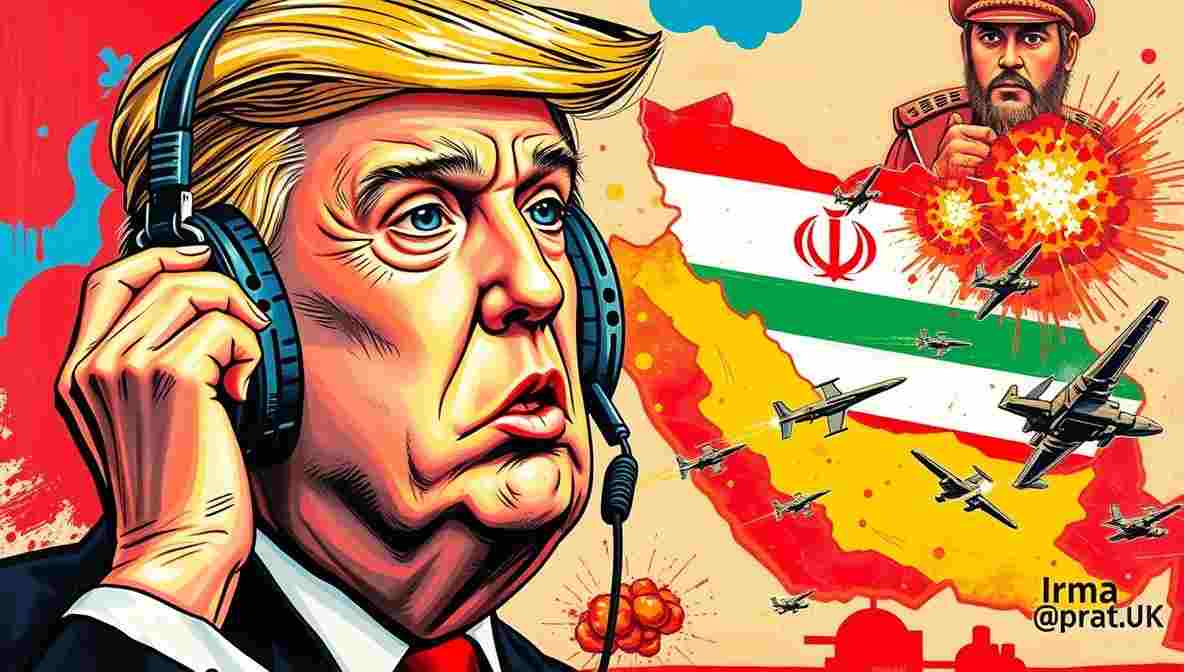
In a development that historians are already calling “either the most significant intelligence coup of the decade or a very expensive misunderstanding,” covert American eavesdropping has allegedly revealed that Iran’s Supreme Leader, Ayatollah Kholmaina, was planning to deploy the ancient concept of taqiyya against President Donald Trump — essentially attempting to run the world’s most theologically underwritten bluff against a man who literally wrote a book on not being bluffed.
For those who’ve just frantically searched the term and received seventeen contradictory Wikipedia edits for their trouble, taqiyya is, in its classical form, a doctrine of protective religious concealment — a theological dispensation allowing concealment of one’s beliefs under genuine threat of persecution. In diplomatic terms: a very ancient form of keeping shtum with divine authorisation. Whether it applies to nuclear negotiations is, scholars suggest, a somewhat broader interpretation than originally intended. Rather like using planning permission for a garden shed to justify building a motorway.
According to leaked intelligence memos attributed to “a senior official who asked not to be named on account of enjoying their civil service pension,” the Supreme Leader was overheard informing his inner circle: “We will say peace. We will say friendship. We will say no more centrifuges. Then, when the Americans are comfortable, we resume.” He is also said to have asked for more tea, which at least demonstrates priorities.
Cue the record scratch in Virginia.
Operation Queens Has Ears: America’s Iran Surveillance Programme and the Art of Listening Very Hard
American intelligence services, according to sources who definitely exist and are not in any way fictional, had reportedly been listening to “every word, every cough, every request for additional tea” emanating from senior Iranian leadership. CIA and NSA analysts are said to have developed an internal programme — unofficially dubbed “Persian With Attitude” — which automatically flagged phrases including “trust us,” “entirely peaceful uranium,” and the increasingly suspicious “we only enriched it to sixty percent out of curiosity.”
This last point is worth pausing on. As has been widely reported, Iran had enriched uranium to 60 percent purity — just shy of weapons grade — making it the only nation without an active nuclear weapons programme to achieve that particular milestone. It’s a bit like announcing you’ve assembled ninety-four percent of an IKEA wardrobe and maintaining, with a straight face, that it’s purely decorative.
One anonymous NSA linguist — a woman described only as “extremely caffeinated and professionally sceptical” — recounted the pivotal moment:
“He said, clear as anything: ‘We fooled Obama, we will fool this one too.’ We ran it through translation software. Then again. Then a third time. Every single pass came back: ‘We fooled Obama.’ The room went completely silent. It lasted approximately eight seconds. In intelligence work, that’s what we call a meditation retreat.”
As Jimmy Carr once observed about the nature of revealed truth: “It’s only funny until it stops being funny. Then it’s geopolitics.” He didn’t say that about Iran specifically, but he really should have.
The Nine Billion Dollar Ghost: Revisiting the Obama Nuclear Deal and What “Stop” Actually Means
In our satirical reconstruction of the intercepted conversation, Kholmaina allegedly reflected with something approaching fondness upon the previous American administration.
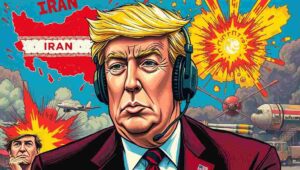
“Remember,” he is said to have told his advisors, “they gave us nine billion dollars. To stop developing a nuclear weapon. We stopped developing it publicly. We also bought a very nice carpet. Several, actually.”
Economists were quick to clarify that in international diplomacy, the verb “stop” can encompass an extraordinarily broad range of activities — from “cease permanently” all the way through to “pause until we’ve had a cup of tea and the inspectors have left.”
Critics of the Obama-era agreement — formally known as the Joint Comprehensive Plan of Action, or JCPOA — have long maintained that Iran continued development in covert form. Supporters insist the inspection regime was robust. Detractors counter that the inspection regime was robust in the same sense that a politeness agreement with a large dog is robust: theoretically sound, practically optimistic, and entirely dependent on the dog’s continued cooperation.
In our imagined transcript, Kholmaina reportedly advised his team: “Americans love paperwork. Give them paperwork. Give them mountains of paperwork. Give them paperwork so comprehensive that six inspectors and a forklift are required to move it. By the time they finish reading it, we’ll have had an election.”
One CIA analyst, upon hearing this passage replayed, reportedly whispered: “Oh God. Paperwork. That’s our weakness.” David Mitchell could not be reached for comment, though he would almost certainly have something extremely thorough to say about it on Would I Lie to You?
Enter the Bloke From Queens: Trump’s Foreign Policy Doctrine and the Art of Not Being Fooled
When briefed on the intelligence, Trump allegedly leaned back in his chair in the manner of a man who has spent decades in New York property development and has therefore seen every variety of hustle known to Western civilisation.
“You can fool a man from Chicago who believes in diplomacy,” he reportedly said. “You cannot fool a bloke from Queens who grew up watching people sell fake Rolexes on the corner. I know a hustle. I have written about knowing a hustle.”
Political scientists have since debated whether this constitutes foreign policy doctrine or a rather niche form of stand-up comedy. The answer, consensus suggests, is probably both, and possibly neither.
The contrast the satire draws is genuinely striking. One American president approached Iran with multilateralism, international consensus, and the sincere belief that a well-drafted treaty changes behaviour. The other approached it as he would a property negotiation in a neighbourhood where the surveyor’s report has clearly been tampered with. Both approaches have their merits. Neither has yet produced a satisfactory resolution, which rather suggests the problem is Iran.
An unnamed White House aide described the moment Trump was played the incriminating audio:
“He didn’t shout. He didn’t slam his hand on the table. He just listened to the bit where they said ‘We fooled Obama,’ and then he pointed at his ear and said, very quietly, ‘We’re listening.’ Then he asked if anyone wanted a Diet Coke. It was very theatrical. The CIA director also wanted a Diet Coke. It was a whole thing.”
Taqiyya vs. The Tape Recorder: When Ancient Theological Concealment Meets the NSA’s Annual Budget
There is something almost poetic about taqiyya encountering the full force of American surveillance infrastructure. One doctrine was developed over centuries to protect a persecuted minority from violent oppression. The other spent eighty-seven billion dollars last year listening to things. Neither, it turns out, had fully anticipated the other.
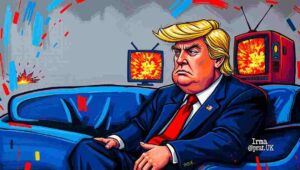
Professor Leonard Feldman — fictional, but extremely confident in his views — Chair of Strategic Cynicism at the entirely invented Atlantic Metro University, offered this analysis:
“Deception relies on what we call information asymmetry. When both parties are attempting to deceive each other, and both parties are aware the other is listening, you enter what I call a quantum state of mutual mistrust. It resembles poker, except both players have X-ray glasses, both know the other has X-ray glasses, and the chips are enriched uranium. The House always wins. In this metaphor, the House is Langley.”
Intelligence officers reportedly replayed the incriminating audio in a secure facility bearing the sign “Definitely Not Bugged.” Twice. The irony was noted. It was not discussed.
“He’s planning to lie to us,” one agent reportedly said.
“Yes,” said another. “But respectfully?”
A third asked if there was decaf. There was not. This was, sources suggest, considered a separate but related intelligence failure.
For what it’s worth, the CIA has also recently taken to posting recruitment videos in Farsi on social media, cheerfully beginning with the line: “Hello. The Central Intelligence Agency hears you and wants to help.” This is either a masterclass in covert recruitment or the geopolitical equivalent of handing out leaflets outside a cinema. Possibly both.
The Obama Comparison: Smiles, Brunch Diplomacy, and a Summer of Technically-Not-Studying
The intercepted conversation apparently included a rather warm retrospective on the Obama years. Kholmaina allegedly described the period as something approaching a golden age of mutual, productive misunderstanding.
“We told them: no nuclear weapon,” he supposedly said. “They smiled. We smiled. Everyone smiled. It was lovely. Like a very long brunch where nobody checks the bill.”
Commentators immediately divided into two predictable camps. One holds that Obama’s approach avoided outright conflict and created space for inspections. The other holds that Iran used that space the way a British student uses the summer holidays: technically enrolled, nominally committed to the programme, but operating at a level of enrichment that does not appear in the course catalogue.
In this satire, Kholmaina described Obama as “trusting.” Trump was described as “suspicious, like a man who has been sold a property in a flood plain and has only just noticed.” As Romesh Ranganathan might put it: “To be fair to Trump, suspicion in that context seems like appropriate due diligence.” He didn’t say that. But he might.
The Boom Moment: A One-Word Presidential Response to a Geopolitical Revelation
Upon hearing the audio clip of “We fooled Obama,” Trump is alleged to have said, simply: “Boom.”
Scholars of presidential rhetoric remain divided on the precise meaning of this utterance. Some believe it indicated satisfaction at having one’s instincts confirmed. Others suggest it was an expression of theatrical emphasis. A third camp proposes that Trump simply enjoys onomatopoeia, which, if true, is actually quite endearing.
The CIA director nodded gravely.
“We have confirmation,” he said. “He intended to deceive us.”
“Well,” Trump reportedly replied, “that’s adorable. Get me the headphones.”
As NPR reported just this week, Trump has since declared himself “not happy” with Iran’s negotiating position — which does suggest that whatever the audio revealed, it did not particularly warm the diplomatic atmosphere. Lee Mack, were he to summarise the situation on a panel show, would probably just say: “So to be clear — you caught them planning to lie to you, and now they’re surprised you don’t trust them?” The audience would laugh. Because it is funny. And also not funny at all.
The Greater Satirical Lesson: Every Nation Thinks It’s the Clever One
At its heart, this is a story not about any single leader, doctrine, or intelligence programme. It is about the eternal condition of diplomacy, which has always operated on the assumption that everyone else in the room is being slightly dishonest, while one is oneself being completely straightforward.
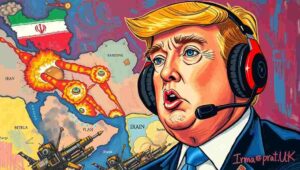
Nations spy. Nations bluff. Nations accuse each other of spying and bluffing while doing precisely that themselves, and the whole enterprise is kept afloat by mutual pretence and very expensive real estate near embassies. The word taqiyya becomes a headline. Surveillance becomes a subplot. And somewhere in a secure facility with surprisingly decent biscuits, someone hits rewind and says: “Play that bit again. The bit where he says ‘We fooled Obama.’ That one never gets old.”
In this comedic framing, Trump is the streetwise property developer who clocked the game and taped it. Obama is the idealist who believed a signed document changed a nation’s strategic interests, which is a beautiful theory and has historically worked about as often as a British summer. Kholmaina is the chess grandmaster who forgot that the table had a microphone underneath it, and possibly inside the chess pieces as well, because it’s America and they had the budget for it.
The punchline — and there is always a punchline — is that every party in this story genuinely believes itself to be the cleverest person in the room. Which is, now that you think about it, the oldest joke in international relations.
A Final Word: If You’re Going To Bluff, Perhaps Don’t Do It Near A Microphone
One final anonymous source — presumably equipped with a lanyard, a security clearance, and a deeply practised expression of studied neutrality — reports that Trump concluded the briefing with a shrug.
“You can try,” he reportedly said. “But we’re listening. My uncle was a physicist at MIT. I grew up understanding frequencies.”
Whether or not one finds this convincing as a statement of scientific heritage, the underlying point holds. In diplomacy, as in property development, as in New York, and as in Queens specifically: trust is perfectly lovely. Verification is lovelier. And if you’re going to construct an elaborate theological framework to justify strategic deception during nuclear negotiations, it is perhaps worth checking — just briefly — whether there’s a recording device within range.
There usually is.
Langley says hello.
Disclaimer: This satirical piece is a work of fiction and parody. It dramatises political narratives and alleged intelligence scenarios for humorous commentary. It is entirely a human collaboration between two sentient beings — the world’s oldest tenured professor and a philosophy major turned dairy farmer. No intelligence agencies were actually bugged in the making of this article. Though we wouldn’t rule it out.
The backdrop: Following a letter from President Trump to Iran’s Supreme Leader, the US and Iran held a series of nuclear negotiations beginning in April 2025. Talks collapsed after Israel launched large-scale attacks on Iranian nuclear infrastructure in June 2025, with the United States conducting its own strikes on facilities at Fordow, Natanz, and Isfahan. As of February 2026, indirect negotiations continue in an atmosphere best described as “mutually suspicious.” The concept of taqiyya — a classical Islamic doctrine of protective concealment rooted primarily in Shia tradition — has been widely invoked in Western political commentary on Iran’s negotiating posture, though scholars note the term is frequently applied well beyond its original theological scope.
Auf Wiedersehen, amigo!

Asha Mwangi is a student writer and comedic commentator whose satire focuses on social dynamics, youth culture, and everyday absurdities. Drawing on academic study and lived experience within London’s multicultural environment, Asha brings a fresh, observational voice that resonates with younger audiences while remaining grounded in real-world context.
Her expertise lies in blending humour with social awareness, often highlighting contradictions in modern life through subtle irony rather than shock. Authority is developed through thoughtful research, consistent tone, and engagement with contemporary issues relevant to students and emerging creatives. Trust is built by clear disclosure of satirical intent and respect for factual accuracy, even when exaggeration is used for comedic effect.
Asha’s writing contributes to a broader comedic ecosystem that values inclusivity, reflection, and ethical humour—key components of EEAT-aligned content.