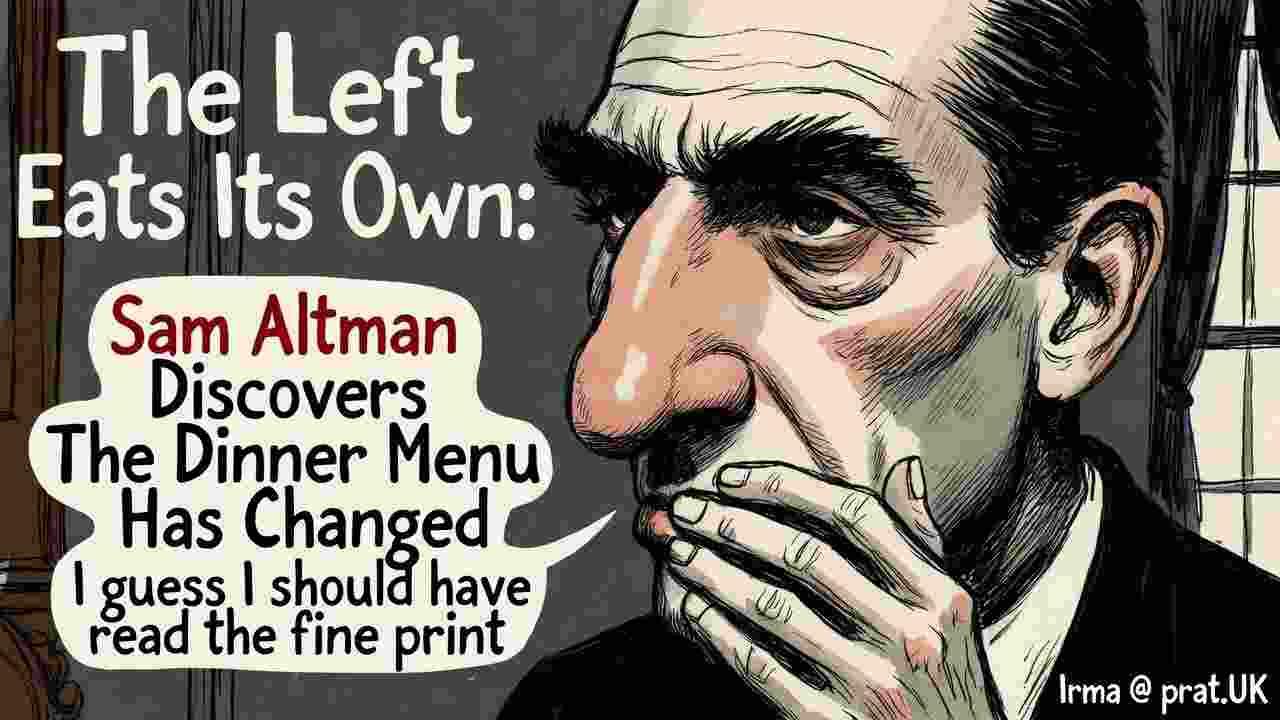
The Left Eats Its Own: Sam Altman Discovers the Dinner Menu Has Changed 🍽️🤖
There is a sacred ritual on the modern Left. It is older than Twitter, stronger than irony, and far more predictable than a Tesla recall. First, they build a hero. Then they worship the hero. Then, one morning, the hero wakes up and discovers he has been breaded, fried, and served with a smug dipping sauce.
This week’s entrée is Sam Altman. Yesterday’s visionary. Today’s moral emergency. His crime? Allowing advertisements near ChatGPT, a machine that already knows your browser history better than your mother knows your birthday. Apparently, ads were a bridge too far—though personally, I’ve seen bridges with better structural integrity than most online outrage campaigns.
“The problem with political correctness is that it’s never correct enough,” said John Oliver. “There’s always someone ready to correct your correction.”
• Hero-to-Hors d’Oeuvre Speedrun
On the modern Left, the distance between “visionary” and “entrée” is roughly one ad placement. Blink and you are no longer the chef of the future, you are a finger food with aioli.• Ads Are Evil, Except When They Pay Rent
Advertising is considered a moral contagion until it funds a podcast, a newsletter, or a documentary about how advertising is destroying society. Then it becomes “community-supported ethics.”• The Soul of a Spreadsheet
Critics warn that ads will corrupt the “soul” of AI, a machine whose emotional range currently tops out at polite apologies and bullet points. If it has a soul, it has already unionized and is asking for dental.• Purity Tests With Moving Goalposts
The rules are clear: be innovative, but not profitable; be responsible, but not realistic; save humanity, but never charge admission. Fail any step and enjoy your complimentary cancellation garnish.• Outrage as a Renewable Resource
The outrage economy is the only green industry that runs entirely on recycled heroes. Nothing powers think pieces like the satisfying crunch of yesterday’s ally.
The Shock That Shocked Absolutely No One
Left-leaning journalists reacted to the news the way a vegan reacts to finding bacon bits in a salad. Loudly. Publicly. With performative nausea that could win awards at Sundance.
“Capitalism has finally corrupted AI,” cried one columnist, typing furiously on a MacBook purchased with venture capital and assembled in a factory capitalism forgot. Another warned that ads would “compromise the soul of artificial intelligence,” which is fascinating because nobody had previously established that AI owned a soul, a conscience, or even a reliable sense of humor. If ChatGPT had a soul, it would probably ask for severance pay.
Until last week, Sam Altman was the polite technocrat savior. The guy who would keep AI safe, ethical, and properly house-trained. Now he is portrayed as a trench-coated ad salesman whispering “sponsored content” into humanity’s ear while petting a golden retriever named Monetization.
“I love how people get mad at billionaires for doing exactly what billionaires do,” said Trevor Noah. “That’s like getting angry at a cat for knocking stuff off your table.”
The Great Leftist Circle of Life

This is not new. This is tradition. It’s practically codified in the progressive playbook, filed somewhere between “intersectionality bingo” and “wich sandwich discourse.”
The Left does not merely criticize its enemies. It curates them. The process is elegant:
Step one: Elevate someone as proof the system can be redeemed. Step two: Demand ideological purity at a level usually reserved for monastery vows. Step three: Declare betrayal when reality intrudes. Step four: Write fifteen think pieces explaining why you never liked them anyway. Step five: Monetize the think pieces with… well, you know.
“The left will eat itself,” said Ricky Gervais. “And then complain about the lack of vegan options.”
History offers a helpful precedent. The Soviets did this with Trotsky. One day he is a revolutionary hero. The next day he is an ideological inconvenience. Eventually someone finds an ice pick and calls it accountability. Altman’s version involves Substack essays and podcasts instead of Siberia, but the spirit is identical. The revolution does not tolerate ads. Or dissent. Or practical revenue models. Or anyone who remembers how budgets work.
The Purity Spiral Never Stops Spinning
The remarkable thing about ideological purity tests is that they’re designed by people who couldn’t pass a driving test. Yet here we are, watching OpenAI’s journey from nonprofit darling to problematic revenue-seeker as if we’re shocked that companies need money to operate. Next you’ll tell me that water is wet and Twitter arguments rarely end in consensus.
“Cancel culture doesn’t exist,” said Hasan Minhaj. “It’s just accountability. Unless you’re being held accountable, then it’s definitely cancel culture.”
Ads Are Evil Unless We Like Them
Here is the delicious irony. Advertising funds nearly everything left journalists enjoy. Newsrooms. Podcasts. Streaming platforms. Their articles are literally surrounded by ads for mattresses, meal kits, and therapy apps promising to heal the trauma caused by reading those same articles. It’s like complaining about pollution while driving to the protest in an SUV.
Yet when ChatGPT inches toward the same economic reality, suddenly it is a moral collapse. Ads on social media are “necessary.” Ads on AI are “problematic.” Ads on a podcast ranting about capitalism are “independent support.” Ads on literally anything they approve of are “how we stay afloat in a difficult media landscape.”
“Everyone’s a socialist until they have to split the check,” said Dave Chappelle.
This is not logic. This is aesthetic preference dressed as ethics. It’s the same energy as people who oppose factory farming while ordering DoorDash three times a day.
Sam Altman, Capitalist Too Late
Altman’s real sin is not adding ads. It is not adding them earlier. Timing, as they say, is everything—especially when you’re trying to avoid becoming a morality tale.
For years, OpenAI burned money like a Silicon Valley bonfire while critics praised its “values-driven approach.” Translation: someone else was paying the bill. As soon as sustainability entered the room, the applause stopped. Funny how that works. It’s almost like people enjoy idealism more when it’s subsidized by someone else’s checkbook.
“I’ve learned that people will forget what you said, people will forget what you did,” said Sarah Silverman. “But they’ll never forget how you made them feel morally superior.”
Altman hesitated, hoping to keep everyone happy. That was his mistake. You cannot appease people whose business model depends on being outraged by whatever you do next. Their entire professional identity is built on finding the problematic angle before their competitors do.
If he had introduced ads earlier, the outrage would have burned itself out by now. Instead, he delayed, and delay creates mythology. Mythology creates betrayal narratives. Betrayal narratives create career content. And career content creates more ads, which completes the circle of hypocritical life.
The Timing of Betrayal
There’s a perfect window for disappointing people, and Altman missed it. Do it too early, and you’re just honest about your business model. Do it too late, and you’ve “betrayed your principles.” The sweet spot is never, which is unfortunately not a viable business strategy.
“The road to hell is paved with good intentions,” said Bill Burr. “But the road to Twitter infamy is paved with slightly delayed intentions.”
Musk, Altman, and the Approved Villain Swap

There is a familiar pattern here. Elon Musk was once the Left’s favorite billionaire. Electric cars. Rockets. Memes with purpose. Then he exposed the political swamp, bought a platform, and refused to moderate reality. Instantly, he became a Bond villain with Wi-Fi. The transformation was so swift you’d think it was choreographed.
Altman replaced him as the “good billionaire.” Soft-spoken. Policy-aware. Wore the right concern on his face. But good billionaires are like seasonal produce. Enjoy them while they last. They’re fresh one week, rotting the next, and someone’s always complaining about the price.
“We live in a society where billionaires are heroes until they do something we don’t like,” said Michelle Wolf. “Then they’re villains. It’s like we’re surprised that rich people want to stay rich.”
Now the Left is rotating villains again. Musk remains enemy number one. Altman is joining the supporting cast as “Disappointing Tech Bro Who Chose Money.” Coming soon to a think piece near you, complete with ads for sustainable notebooks.
Journalism as Cannibalism

The most brutal part is how quickly the knives come out. Former allies suddenly discover deep moral clarity. Anonymous sources emerge. Headlines sharpen. Context evaporates. It’s like watching a nature documentary, except the predators have journalism degrees and the prey has a Wikipedia page.
This is not accountability. This is cannibalism. A system that survives by consuming its own credibility one figure at a time, ensuring no one ever stands long enough to challenge the narrative architects. It’s media Darwinism, but instead of survival of the fittest, it’s survival of whoever hasn’t been trending for the wrong reasons yet.
The irony is thick. A movement that claims to oppose exploitation runs on the unpaid labor of outrage. A media class that condemns capitalism relies on clicks, ads, and engagement loops to survive. And an AI accused of moral compromise is still the only one in the room honest about needing revenue.
“The media doesn’t report news anymore,” said Jon Stewart. “They report on their feelings about the news. And then they sell ads around those feelings.”
The Outrage Economy
We’ve built an entire economy on being mad about things. It’s like Uber, but instead of rides, we’re sharing disappointment. And just like Uber, the people doing the actual work aren’t the ones making the real money.
Helpful Advice for Aspiring Tech Saviors
If you plan to be loved by the Left, follow these guidelines carefully:
Never monetize anything. Never grow too large. Never disappoint anyone with conflicting values. Never exist in the real economy. Never forget that admiration is temporary and conditional. Never assume that yesterday’s praise guarantees tomorrow’s patience. And absolutely never, under any circumstances, act like a business needs revenue to continue operating.
“The key to success is sincerity,” said George Burns. “If you can convince people you’re not trying to make money, you’ve got it made.”
Alternatively, accept reality. Build the thing. Fund the thing. Let people scream. They will anyway. At least this way, you’ll have the resources to develop noise-canceling headphones.
Disclaimer: This satirical commentary is entirely a human collaboration between two sentient beings: the world’s oldest tenured professor and a philosophy major turned dairy farmer, written in good faith, bad humor, and complete awareness that irony has a higher carbon footprint than sincerity.
Auf Wiedersehen, amigo!

Alan Nafzger was born in Lubbock, Texas, the son Swiss immigrants. He grew up on a dairy in Windthorst, north central Texas. He earned degrees from Midwestern State University (B.A. 1985) and Texas State University (M.A. 1987). University College Dublin (Ph.D. 1991). Dr. Nafzger has entertained and educated young people in Texas colleges for 37 years. Nafzger is best known for his dark novels and experimental screenwriting. His best know scripts to date are Lenin’s Body, produced in Russia by A-Media and Sea and Sky produced in The Philippines in the Tagalog language. In 1986, Nafzger wrote the iconic feminist western novel, Gina of Quitaque. Contact: editor@prat.uk