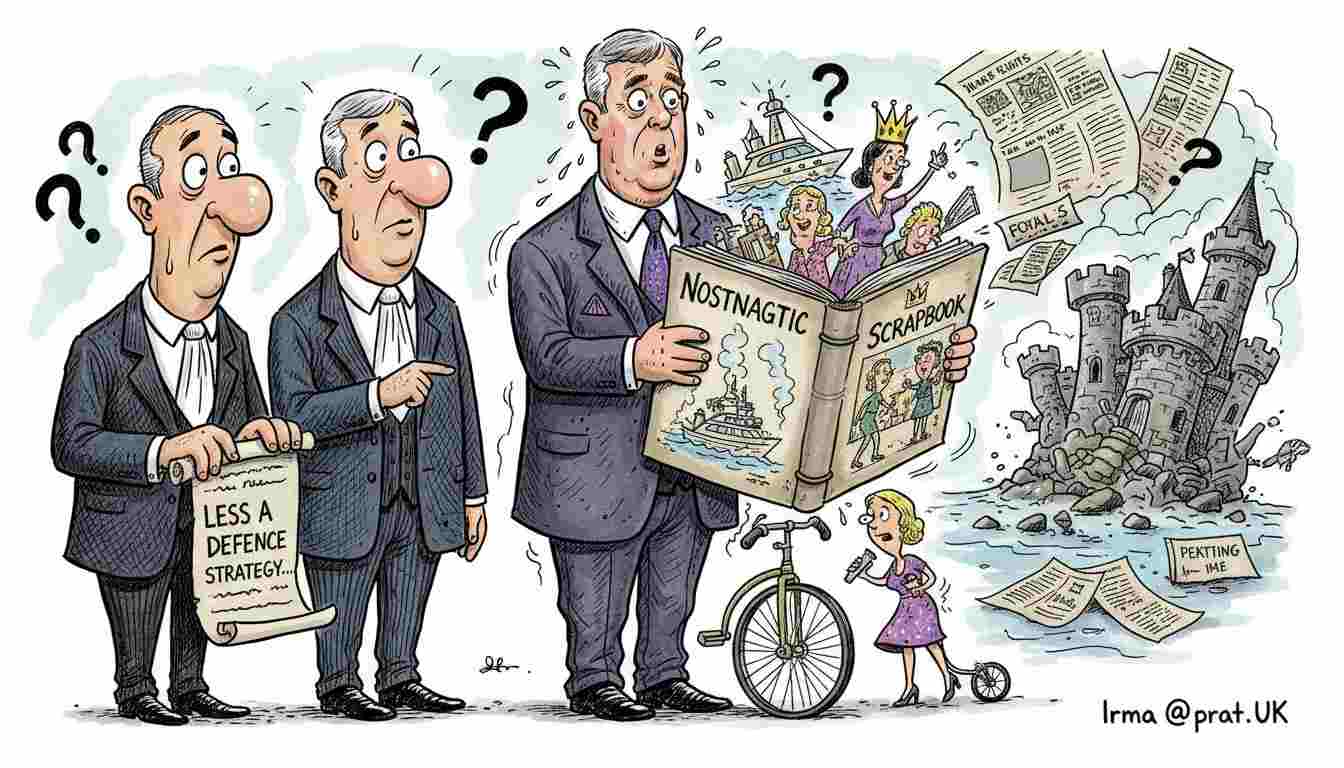
Prince Andrew Arrested, Immediately Asks If This Is A Sponsored Content Partnership
Five Humorous Observations From The Scene Of Britain’s Most Procedurally Inconvenient Thursday
- The only thing faster than the police cars was the palace trying to remember which family group chat Andrew was still in.
- Britain discovered “misconduct in public office” is a real crime and not just the job description for half of London.
- Andrew reportedly treated the arrest like a brand deal: “Do I get a lanyard, a tote bag, and a complimentary statement from my brother?”
- The monarchy learned there is no tiara sturdy enough to hold down three million pages of “Wait, what is this email?”
- America watched the UK arrest a former prince and responded with its traditional ritual: aggressively reorganising the junk drawer.
The Arrest That Felt Like A Press Release With Handcuffs
LONDON, 19 February 2026: The country woke up to the kind of headline that makes the kettle whistle in fear. A former prince, a police force that usually protects royals, and a crisis so deeply British it practically arrived wearing a damp trench coat and apologising to strangers.
According to officials at Thames Valley Police, Andrew Mountbatten-Windsor was arrested on suspicion of misconduct in public office — a phrase so antique it sounds like something a town crier would yell while sprinting away from tomatoes. In plain terms, it is the allegation that a public figure, acting as a public officer, treated the public trust like a free sample table at Costco. One insider described the mood in official circles as “grim, procedural, and fully booked through 2029.”
The most astonishing part was not that the case existed, but that it arrived with the efficiency of a train that actually showed up. A handful of royal watchers stood outside gates, blinking like people who had accidentally walked into the wrong museum exhibit and could not find the exit. One woman in a scarf told reporters, “I just wanted a quiet Thursday. Then this happened. This is why I do not make plans.” Andrew, who turned 66 on the very day of his arrest, was released eleven hours later “under investigation” — neither charged nor exonerated, which is the legal equivalent of being told to wait in the hallway while adults discuss your future.
How To Turn “Royal Duties” Into “Royal Receipts” — The Epstein Files Explained
Misconduct in public office is a peculiar British concept — the legal version of your mum saying, “I am not angry, I am disappointed,” and then producing a binder. According to the Crown Prosecution Service, the offence requires a public officer to wilfully neglect their duty or wilfully misconduct themselves in a way that abuses public trust. In other words, it is not simply being messy. It is being messy while wearing a government lanyard, and then asking the taxpayer to smile for the photo.
The specific allegation centres on emails surfaced in the US Justice Department’s Epstein files, released in January 2026, which appear to show Andrew forwarding confidential trade reports to Jeffrey Epstein during his time as Britain’s special trade envoy. One email thread shows him forwarding official briefings from a 2010 Southeast Asia tour — Singapore, Hong Kong, Vietnam — just minutes after receiving them from his special adviser Amit Patel. There was no covering note. Just a forward button pressed with the casual confidence of a man who has never had to scan his own groceries.
Here is where the absurdity gets its legs under it and starts jogging around Windsor. For years, the monarchy has survived scandal the way a pub carpet survives spilled lager: it looks terrible, but it is still somehow here. Yet this arrest landed differently. It was not a tabloid rumour or a personal failing framed as a family drama. It was a question about office, information, and the kind of quiet access that makes a nation feel like it is being managed by people who have never had to scan their own groceries.
One retired civil servant, who spoke on condition of not being asked to explain anything further, summarised the allegation in the most British way possible: “If you forward confidential briefings to the wrong person, it is not networking. It is a problem. And yes, I am understating it.”
King Charles Issues Statement, Monarchy Quietly Googles “How To Look Supportive But Not Involved”
King Charles issued a statement that could be studied by future archaeologists as the first known example of a human being trying to sound calm while internally screaming. He supported a “full, fair and proper process” and emphasised cooperation, adding with characteristic understatement: “Let me state clearly — the law must take its course.” The tone was classic royal weather report: overcast, breezy, chance of consequences.
A palace-adjacent staffer described the response strategy as “do not improvise, do not blink, and for the love of history do not say anything that makes tomorrow worse.” Another staffer said the palace had not been informed before the arrest, which is the kind of detail that either proves procedural integrity or proves everyone is updating their contact lists in real time.
Meanwhile, regular royal life continued. Public engagements proceeded. A concert was attended. A fashion event happened. Britain, land of stoicism, watched the family carry on as if the headline were merely a slightly rude pigeon. It is the contrast that sells the scene: a man gets arrested, and somewhere else a ceremonial ribbon gets cut with the serene confidence of a civilisation that has seen everything except accountability with good lighting.
Eyewitnesses, Legal Experts, And One Tourist Who Came For The Changing Of The Guard
Outside Windsor, the atmosphere had the buzzing confusion of a crowd that cannot decide if it is watching history or content. A tourist from Ohio, clutching a souvenir magnet like a talisman, told a reporter, “I thought the royals were like Disney. I did not know they could get arrested. This changes my whole brand understanding.”
A historian in London, asked about precedent, sighed the sigh of someone who has explained British constitutional weirdness at too many dinner parties. “There is no modern playbook for this,” he said. The Institute for Government notes that between 2014 and 2024, some 191 people were convicted of misconduct in public office — of whom 92 per cent were prison officers or police officers. A former trade envoy and son of the late Queen Elizabeth II was not in that statistical category. Until now.
In the background, anti-monarchy groups practically warmed up like sprinters. One campaigner — Republic’s Graham Smith, who originally reported Andrew to Thames Valley Police — called for fuller answers and less “platitude management.” In Britain, even the outrage is polite, but it carries paperwork.
What The Funny People Are Saying About Andrew’s Sponsored Arrest
“This is the most British scandal possible: it is about emails.” — Jerry Seinfeld
“Misconduct in public office sounds like a job title at a bar: I will have one lager and a side of life imprisonment.” — Ron White
“The monarchy is like your ex who texts, ‘Hope you are well,’ right after setting your couch on fire.” — Sarah Silverman
“Three million pages? That is not a document dump, that is a personality.” — Jon Stewart
“Imagine being so rich your worst defence is, ‘I do not recall the photo.'” — Amy Schumer
Helpful Advice For Anyone With A Title, An Inbox, Or Both
If this story has a moral, it is painfully modern: never treat your official role like your personal group chat.
First, assume every email has a future. Not a spiritual future. A legal future. A printed-out-in-a-courtroom future. According to the Law Commission’s review of misconduct in public office, the offence specifically requires the act be wilful — meaning knowingly wrong, or done with reckless indifference. The delete key does not apply retroactively.
Second, learn the difference between “confidential” and “interesting.” They can look similar when you are bored, powerful, and surrounded by people who say “absolutely” for a living. Third, if you once held an office that relied on public trust, remember that trust is not inherited. It is rented. And the rent is due every day. Finally, if you are the kind of person who signs letters with a flourish, consider that the rest of the world signs documents with consequences.
The Sponsored Content Question Nobody Can Answer
As Britain watches this unfold, the strangest part is how familiar it feels. Not because the public has princes in their families, but because the rest of us have watched powerful institutions try to protect themselves by speaking in fog. The fog works until it does not. Then, suddenly, the story is not about tradition. It is about process. And process, unlike royalty, does not care who your mother was.
If the allegation is proven, the consequences are severe — misconduct in public office carries a maximum sentence of life imprisonment under British law. If it is not, the institution still faces the question it always faces in a scandal: how many times can you say “duty” before people start asking what the job actually is. For now, Britain waits. And somewhere in the background, an exhausted palace aide is surely whispering the newest royal motto: “Please, no more emails.”
This satirical article is a human collaboration between two sentient beings: the world’s oldest tenured professor and a philosophy major turned dairy farmer. It is intended as commentary and comedy, not a statement of guilt or innocence in any ongoing legal process.
Context: On 19 February 2026 — his 66th birthday — Andrew Mountbatten-Windsor, formerly Prince Andrew and younger brother of King Charles III, was arrested by Thames Valley Police on suspicion of misconduct in public office. The allegation stems from emails in the US Justice Department’s Epstein files suggesting he forwarded confidential government trade reports to convicted sex offender Jeffrey Epstein during his tenure as Britain’s trade envoy from 2001 to 2011. He was released under investigation eleven hours later. He is the first senior member of the royal family to be arrested in modern British history.
Auf Wiedersehen, amigo!

Carys Evans is a prolific satirical journalist and comedy writer with a strong track record of published work. Her humour is analytical, socially aware, and shaped by both academic insight and London’s vibrant creative networks. Carys often tackles media narratives, cultural trends, and institutional quirks with sharp wit and structured argument.
Her authority is reinforced through volume, consistency, and reader engagement, while her expertise lies in combining research with accessible humour. Trustworthiness is demonstrated by clear labelling of satire and an ethical approach that values accuracy and context.
Carys’s work supports EEAT compliance by offering informed satire that entertains while respecting readers’ trust.