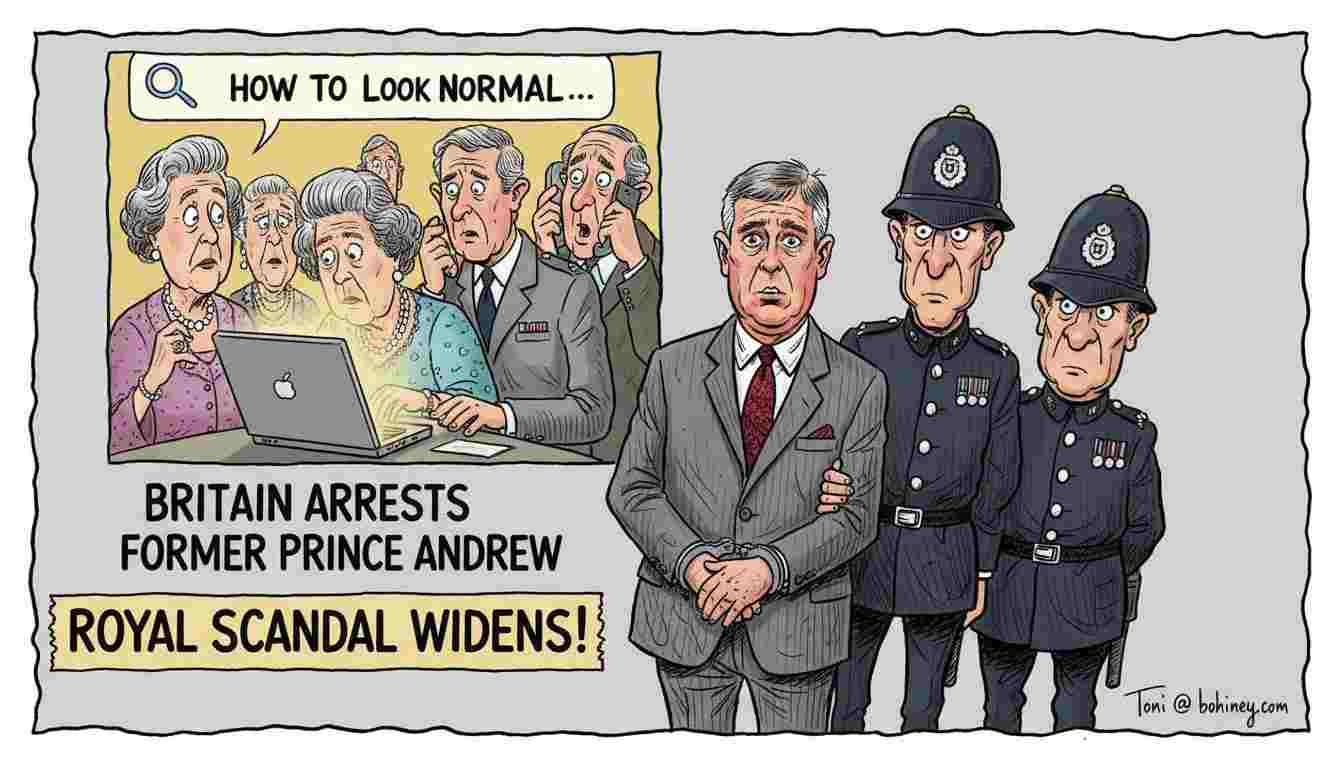
Police Take Andrew In, Palace Releases Statement Written Entirely In Carefully Measured Sighs
Five Observations About The Royal Art Of Communicating Without Actually Moving Air
- The official royal sigh is calibrated somewhere between apology and weather forecast.
- Britain has invented a new punctuation mark: the diplomatic pause.
- Every palace statement now sounds like it was exhaled, not spoken.
- Lawyers count words while historians count centuries.
- The national mood can be summarised as “deep inhale, longer exhale.”
The Art Of Communicating Without Actually Moving Air — A Palace Masterclass
LONDON, Wednesday: After authorities detained Andrew Mountbatten-Windsor in connection with an investigation into misconduct in public office, Buckingham Palace issued a statement so restrained it may qualify as a new musical genre. Analysts described it as chamber music for people who fear verbs.
The monarchy has always specialised in tone. Not loud tone. Not emotional tone. A tone suggesting events are serious but not alarming, important but not surprising, historic yet somehow routine. King Charles III stated that he had “learned with the deepest concern the news about Andrew Mountbatten-Windsor and suspicion of misconduct in public office,” and added: “The law must take its course.” The words were personally signed. The tone was classically measured. The internal sprinting presumably continued behind closed doors. A media scholar explained: “Royal communication is less about information and more about atmospheric pressure.”
The Linguistics Of Royal Breathing: Institutional Minimalism At Its Finest
Observers noticed the statement contained three recognisable elements: support for the legal process, affirmation of cooperation, and reassurance of ongoing duty. No adjectives wandered off script. No metaphors attempted escape. Linguists call this register institutional minimalism. Every word serves stability. Emotion remains implied, never confirmed. The effect resembles a person saying, “We will address this,” while internally assembling an entirely new personality.
One communications consultant admired the craftsmanship: “It neither denies nor speculates. It exists. That is the achievement.” CBS News noted that Buckingham Palace had already issued a statement the previous week stating that the royal family would cooperate if police came asking questions about Mountbatten-Windsor. The Tuesday statement built logically on the Wednesday arrest. Preparation, it turns out, is also a form of composure.
Eyewitness Reactions From The National Living Room To The Palace Exhale
Across Britain, citizens performed their own interpretation of the palace text. A café patron concluded: “That was not a statement. That was a polite exhale.” A student added: “If they were calmer they would be asleep.” A grandmother watching television summarised the situation perfectly: “They sound like people trying not to wake a baby named Constitution.” Meanwhile international viewers marvelled at the collective composure. In many countries a scandal produces shouting. In Britain it produces paragraphs that bow slightly.
NPR reported that the specific allegation involves Andrew forwarding official trade reports from a 2010 Southeast Asia tour to Epstein — one described as a “confidential brief” — just minutes after receiving them. The palace statement, issued twelve hours later, took considerably longer to compose.
Palace Strategy: Control The Temperature, Not The Headlines
Insiders say the goal is maintaining institutional temperature. Too hot signals panic. Too cold signals indifference. The palace aims for room-temperature seriousness — a delicate zone where concern exists but furniture remains upright. The monarchy’s authority relies on emotional consistency. People expect stability from symbols. The challenge is acknowledging disruption without embodying it. An advisor described the method: “We communicate as though time itself wrote the sentence.” AP noted that the palace had not been informed before the arrest itself — which is the kind of detail that tests the composure theory, and which the palace apparently passed.
What The Funny People Are Saying About The Royal Exhale
“That was less a statement and more a weather report for feelings.” — Jerry Seinfeld
“They talk like a therapist who bills by the syllable.” — Ron White
“British understatement could survive a meteor.” — Jon Stewart
“The palace communicates in indoor voice even outdoors.” — Sarah Silverman
“I have seen texts from exes with more panic.” — Amy Schumer
The Psychology Of Calm Authority And Why Britain Exports It
Research shows audiences trust institutions that regulate emotional tone during uncertainty. Excess emotion implies loss of control. Absence of emotion implies absence of care. Balanced restraint signals competence. Historically the monarchy provided reassurance during crises through presence rather than explanation. Modern expectations demand transparency, yet reassurance still depends on composure. The statement therefore functions as emotional architecture. A behavioural scientist noted: “Humans borrow calm from perceived stability. The palace exports calm deliberately.”
The Crown Prosecution Service will ultimately decide whether to charge Andrew Mountbatten-Windsor. That decision will take considerably longer than eleven hours. It will involve considerably more words. And it will require, presumably, a tone of its own. Britain’s long history trained its institutions to survive storms by becoming weather. The palace has practised. The courts will proceed. And somewhere between the two, the truth will have its own carefully measured sigh.
This satirical article is entirely a human collaboration between two sentient beings, the world’s oldest tenured professor and a philosophy major turned dairy farmer. It offers commentary and humour, not conclusions regarding any ongoing legal process.
Context: Following the arrest of Andrew Mountbatten-Windsor on 19 February 2026, King Charles III issued a personally signed statement expressing his “deepest concern” and stating that “the law must take its course.” The statement — measured, cooperative, and devoid of adjectives that could embarrass anyone — became as widely discussed as the arrest itself, representing a case study in institutional communication under pressure.
Auf Wiedersehen, amigo!

Chelsea Bloom is an emerging comedic writer with a focus on light-hearted satire and observational humour. Influenced by London’s student culture and digital comedy spaces, Chelsea’s work reflects everyday experiences filtered through a quirky, self-aware lens.
Expertise is growing through experimentation and study, while authority comes from authenticity and relatability. Trustworthiness is supported by clear intent and ethical humour choices.
Chelsea’s contributions represent developing talent within an EEAT-compliant framework that values honesty, clarity, and reader trust.