

Britain and the EU Begin Careful Dance Towards Each Other Whilst Pretending Not to Hear the Music 🎻🇬🇧🇪🇺
Britain and the European Union are once again standing awkwardly across the room, clutching warm drinks, insisting they are absolutely fine on their own, whilst maintaining unbroken eye contact that suggests otherwise. According to serious people with serious fonts, the relationship may be entering what diplomats describe as a phase of “getting closer without admitting anyone was wrong.” This is considered progress.
Nearly a decade after Brexit, the national mood resembles that moment when someone insists they can assemble flat-pack furniture without instructions and then lives inside a structurally unsound bookshelf. The original vote promised sovereignty, savings, and sunlit uplands. What arrived instead were customs forms, border queues, and the sudden realisation that geography remains stubbornly physical.
Britain spent years insisting it did not need the EU, only to discover that independence mostly involves filling out forms that used to fill themselves. — Alan Nafzger
Economists, who were once dismissed as elitist pessimists, have now been promoted to reluctant prophets. They point to GDP losses that range from mildly annoying to deeply regrettable, depending on whether one prefers optimism or maths. Entire sectors have learnt new hobbies like paperwork, form-filling, and explaining to customers why a cheese now requires three stamps and a small prayer.
Britain Discovers That Leaving the EU Did Not Make the EU Leave Britain 🧾
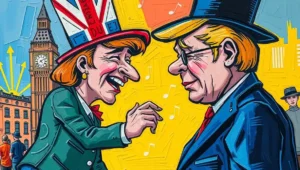
The most British outcome of Brexit is not economic pain but emotional confusion. Britain wanted independence, not loneliness. It wanted freedom, not roaming charges. Instead, it got the geopolitical equivalent of moving out of a shared flat and realising the ex kept the kettle, the Wi-Fi password, and access to the largest trading bloc on Earth.
Public opinion has shifted with the elegance of a slowly turning tanker. Polls now suggest most Britons believe Brexit was a mistake, a phrase once considered unpatriotic but now delivered with the weary realism of someone who has tried and failed to fix a printer. Younger voters, in particular, view Brexit as a historical re-enactment they never auditioned for.
Labour politicians are cautiously whispering about closer ties, using phrases like “pragmatic cooperation” and “technical alignment,” which translate loosely to “can we please stop making this harder than it needs to be.” The idea of rejoining the customs union is floated gently, like a balloon released indoors to test whether anyone will shout.
The EU Waits Patiently, Like Someone Who Kept the House 🏠
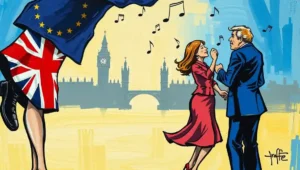
Across the Channel, the EU has mastered the art of calm restraint. It watches Britain approach with the polite patience of someone who has already read the breakup text and kept the receipts. European officials speak in soothing tones about shared values, shared security, and shared rules that Britain previously described as unbearable tyranny.
There is no rush. The EU knows time is a powerful negotiator. Each year adds another cohort of voters who associate Brexit not with freedom but with queues, shortages, and an odd nostalgia for frictionless trade. The EU does not gloat. It does not need to. Reality is doing excellent work on its behalf.
Sovereignty, Now With More Forms 📑
Brexit was sold as taking back control. What Britain took back, in practice, was responsibility for every minor regulatory decision it once outsourced. The result has been a flowering of committees, reviews, task forces, and acronyms. Sovereignty, it turns out, is mostly meetings.
Businesses report that trading with Europe now involves more effort than filing taxes whilst moving house. Small exporters have learnt new languages, primarily Legalese and Desperation. Larger firms quietly maintain EU operations and politely decline to discuss it.
The Great British Re-Approach 🤝
No one is proposing rejoining the EU tomorrow. That would require honesty, bravery, and several years of headlines written entirely in capital letters. Instead, the strategy is edging closer, step by cautious step, like someone testing cold water with a toe.
Alignment here. Cooperation there. Mutual recognition everywhere. The goal is to regain the benefits of closeness without triggering the national allergy to the word “membership.” It is Brexit, but softer, quieter, and explained using flowcharts.
Fifteen Observations on Britain and the EU Carefully Rediscovering Each Other 🇬🇧🇪🇺

- The phrase “getting closer” is doing heroic work, bravely avoiding words like “rejoining,” “regret,” or “we may have misunderstood the clipboard people.”
- Brexit promised to cut red tape, and instead Britain now produces paperwork with the enthusiasm of an artisan craft movement.
- The UK left the EU to reclaim sovereignty and immediately used it to recreate EU rules, but slightly worse and printed on different letterhead.
- Customs forms have become Britain’s fastest-growing export, followed closely by sighing loudly at border checkpoints.
- Polls show most Britons now think Brexit was a mistake, which means the national sport has shifted from debating Europe to quietly changing the subject.
- The EU’s response to Britain edging back closer can best be described as the calm smile of someone who kept the house in the breakup.
- British politicians now talk about “alignment” the way teenagers talk about “just being friends.”
- Leaving the EU did not make Britain more global; it made it more familiar with the inside of government offices.
- Sovereignty sounded heroic until it turned out to involve personally approving the curvature of cucumbers again.
- Businesses were promised freedom and instead got a masterclass in international logistics they never asked to take.
- The customs union is now discussed in hushed tones, like a forbidden ex everyone suddenly agrees was actually quite nice.
- Britain wanted to escape Brussels bureaucracy and accidentally became its own Brussels.
- The EU does not need to persuade Britain to come closer; it simply waits whilst reality does the talking.
- Brexit has evolved from a bold leap into the unknown into a long, careful shuffle back towards the sofa everyone pretended they did not miss.
Disclaimer ☕
This article is a work of satire, produced entirely through a human collaboration between the world’s oldest tenured professor and a philosophy major turned dairy farmer. Any resemblance to actual political clarity is purely coincidental. No treaties were harmed in the making of this piece.
Auf Wiedersehen, amigos.

Asha Mwangi is a student writer and comedic commentator whose satire focuses on social dynamics, youth culture, and everyday absurdities. Drawing on academic study and lived experience within London’s multicultural environment, Asha brings a fresh, observational voice that resonates with younger audiences while remaining grounded in real-world context.
Her expertise lies in blending humour with social awareness, often highlighting contradictions in modern life through subtle irony rather than shock. Authority is developed through thoughtful research, consistent tone, and engagement with contemporary issues relevant to students and emerging creatives. Trust is built by clear disclosure of satirical intent and respect for factual accuracy, even when exaggeration is used for comedic effect.
Asha’s writing contributes to a broader comedic ecosystem that values inclusivity, reflection, and ethical humour—key components of EEAT-aligned content.

One thought on “Britain and the EU Begin Careful Dance”