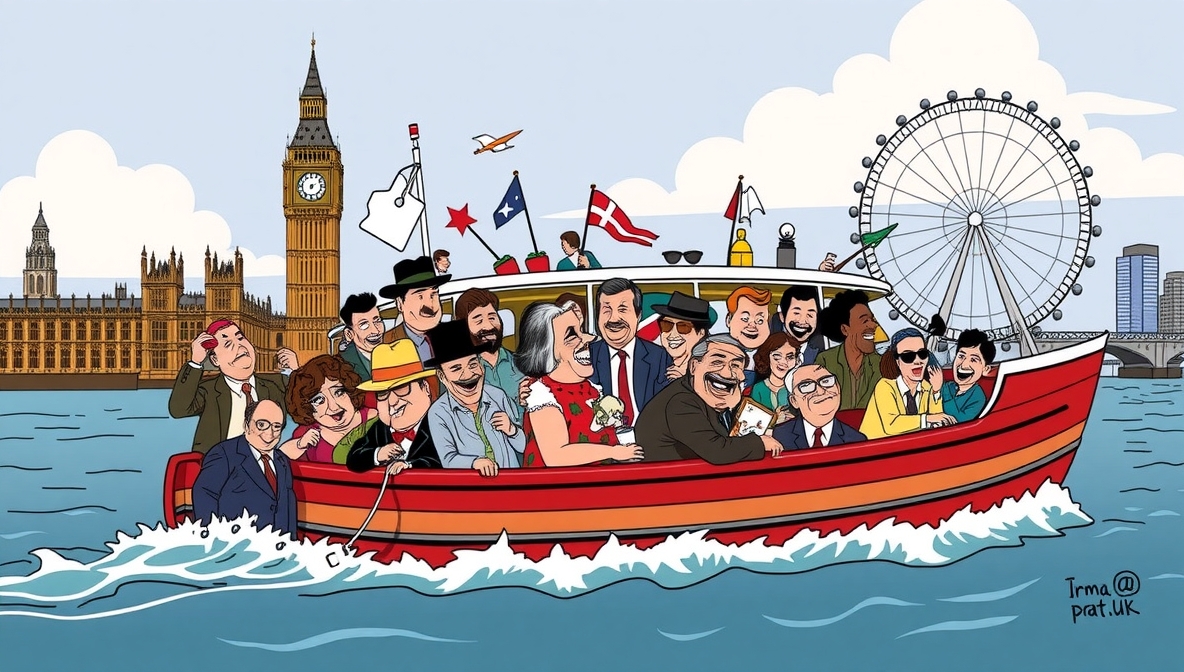
British media enters holding pattern as US politics consumes global attention
British Media Enters Holding Pattern
The BBC announced a new programming slate consisting largely of waiting for American news cycles to conclude, a strategy executives describe as vefficient, emotionally honest, and surprisingly cost-effective.” The decision follows eighteen months of attempting to cover British domestic issues while American political developments continuously dominated international headlines, viewer attention, and editorial meetings.
“We tried covering Brexit,” explained one exhausted producer. “But then Trump tweeted something about NATO, and suddenly our carefully researched segment on trade policy became irrelevant background noise. It’s hard to compete with a president who treats governance like performance art.”
The Gravitational Pull of American Politics
Media scholars note that US politics now consumes global attention in ways that transcend traditional newsworthiness. “It’s not dominance,” said Dr. Emily Thornton, a media analyst at the Columbia Journalism Review. “It’s gravity. American political chaos generates content velocity that pulls everything else into its orbit. British politics is important, but it’s not a reality show with nuclear codes.”
Dr. Thornton’s research indicates that American political coverage generates 340 percent more social media engagement than comparable international stories, creating economic incentives for media organizations to prioritize US content regardless of local relevance. “Editors follow eyeballs,” she noted. “And eyeballs follow drama. American politics delivers drama at an industrial scale.”
The BBC’s new programming reflects this reality. Tentatively titled “America: We’re Waiting,” the schedule allocates prime-time slots to monitoring US developments while British content airs during overnight hours when Americans are asleep and unlikely to generate competing headlines.
Economic and Editorial Pressures

“We’re not abandoning British news,” clarified BBC Director-General Tim Davie in an internal memo leaked to The Guardian. “We’re acknowledging that global audiences have finite attention spans, and America has monopolized that attention through sheer audacity and institutional collapse.” Davie added that the strategy allows cost savings by reducing redundant coverage of events that “no one will remember once the next American scandal breaks.”
Staff reactions have been mixed. Some reporters appreciate the honesty; others feel demoralized by the implication that their work exists in American political shadow. “I spent three years covering the NHS crisis,” said one correspondent. “But nobody cares because Americans are arguing about whether their president committed treason or just light fraud. It’s professionally devastating.”
The Broader Media Ecosystem
The BBC’s decision mirrors trends across European media. France24, Deutsche Welle, and other international outlets report similar struggles balancing domestic relevance against American content dominance. “We’re all waiting,” admitted a French editor. “Waiting for America to calm down so the rest of the world can have five minutes of attention. It’s like being in a waiting room where the person ahead of you never stops talking.”
Academic studies from the Reuters Institute for the Study of Journalism confirm that American political coverage has crowded out local news in international markets, creating what researchers call vattention asymmetry.” Audiences consume American content voraciously while ignoring domestic issues of equal or greater importance, a pattern that distorts democratic accountability.
“People know more about US congressional procedure than their own parliamentary systems,” noted Dr. Rasmus Nielsen, director of the Reuters Institute. “That’s not healthy for democracy. But it’s great for clicks, which means it’s great for ad revenue, which means it’s becoming the default editorial strategy.”
Viewer Reactions and Cultural Implications
Viewers remain cautiously optimistic about the new programming, though many admit they’ve already been watching American news exclusively for months. “I haven’t paid attention to British politics since 2016,” said Manchester resident Colin Harper. “Why would I? Nothing we do matters compared to whatever’s happening in Washington. At least America’s chaos is entertaining. Ours is just depressing.”
This cultural shift worries political scientists who study civic engagement. “When citizens prioritize foreign political drama over domestic accountability, democratic structures weaken,” said Dr. Catherine Ashworth, a political sociologist at LSE. “Entertainment value shouldn’t determine political attention, but algorithmic media has made spectacle the currency of relevance.”
The Path Forward: Acceptance and Adaptation
The BBC has established a new division called “American Political Monitoring” tasked with tracking US developments and alerting British programming when it’s safe to resume normal coverage. Early results suggest these windows last approximately fourteen minutes before another American scandal emerges.
“We’ve adapted,” said one BBC scheduler. “Our job now is finding those brief intermissions between American chaos to squeeze in stories about British healthcare, education, and infrastructure. It’s like trying to have a conversation during a fireworks displaytechnically possible, but nobody’s listening.”
Whether this strategy succeeds long-term remains uncertain. What’s clear is that British media has entered a new era where American politics sets the global news agenda, and everyone else waits their turna turn that may never come.
“We’ll keep waiting,” concluded the BBC producer. “Because what else can we do? American politics is the sun, and we’re all just orbiting planets hoping for a few minutes in the shade.”
Auf Wiedersehen, amigos.
Authority Links: BBC News | Columbia Journalism Review | Reuters Institute for the Study of Journalism | LSE Media and Communications

Harriet Collins is a high-output satirical journalist with a confident editorial voice. Her work demonstrates strong command of tone, pacing, and social commentary, shaped by London’s media and comedy influences.
Authority is built through volume and reader engagement, while expertise lies in blending research with humour. Trustworthiness is supported by clear labelling and responsible satire.