
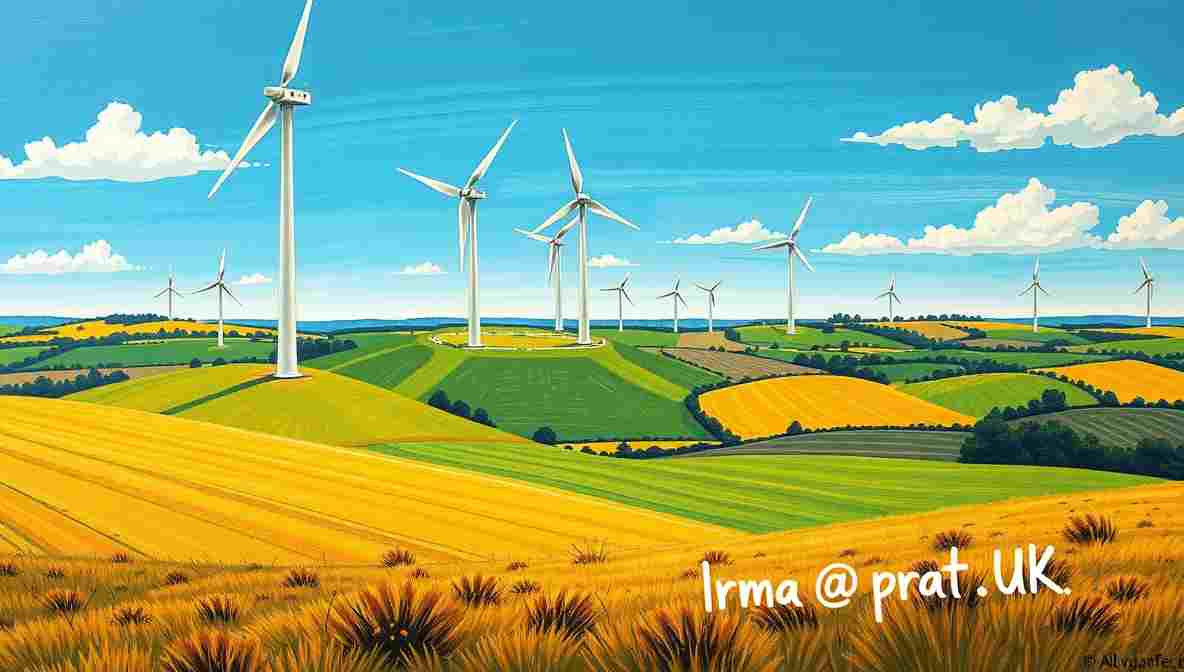
The Greatest Long Con in the History of the World: How China Sold Britain the Wind
British historians used to argue about the East India Company, the enclosure movement, and who really invented the sandwich. Lovely. Quaint. Sixth form stuff. Because while Britain was busy inventing apps for queuing and debating whether it’s a scone or a scone, China was quietly pulling off the greatest long con in human history.
They sold everybody… wind.
Not the political hot air that fills Parliament. The literal, invisible, “was that a draught or has someone left the back door open again?” kind.
And they did it so smoothly the buyers wrote them thank-you notes on recycled paper—often while standing in front of turbines they couldn’t have built themselves.
It Started Quite Nicely, Actually
At first, wind turbines seemed like a group project the planet agreed to do together. Very wholesome. Very “we’re all in this climate thing, aren’t we?” Europe said, “We shall lead with moral authority.” Britain said, “We shall lead with offshore wind farms and strongly worded letters.” China said, “We shall lead with factories.”
Nobody noticed that last part was the only one involving actual manufacturing.
While Britain was holding consultations about the emotional journey of renewable energy and whether the turbines would upset the view from Cornwall, China was building industrial zones so large they could be seen from the International Space Station. “Turn left at the Great Wall, straight on past the Turbine District, if you’ve reached the Solar Megalopolis you’ve overshot, mate.”
The Sales Pitch That Took Decades
A long con is about patience. You don’t rush it. You don’t shout, “Surprise, I own your supply chain!” You let people discover that slowly, like a plot twist in a David Attenborough documentary about industrial economics.
Step One: The Groundwork
“Alright world, wind energy is brilliant.”
Everyone applauded. Standing ovation. Environmental awards were handed out like Tesco Clubcard points.
Step Two: The Gentle Nudge
“Smashing news. We make most of the wind turbines.”
Everyone said, “Efficiency! Global cooperation! How terribly modern!”
Step Three: The Reveal
Mentioned politely over Earl Grey and a 200-page trade agreement:
“Yes, and also most of the rare earth minerals, components, and manufacturing capacity. But let’s focus on the lovely breeze. Isn’t the breeze lovely?”
By the time anyone in Britain asked, “Hang on, could we build these ourselves?” China was already on Turbine Model 12, now with quieter blades, a complimentary app, and instructions translated into proper English (not American).
Britain’s Role in the Con
A con only works if the mark thinks they’re frightfully clever.
British ministers proudly announced massive wind targets. “We will install 50 gigawatts by 2030! World-beating!”
China quietly replied, “Brilliant. Would you like standard delivery or rush shipping? We also do next-day for an extra quid.”
Entire national energy strategies now read like Argos catalogue instructions translated from Swedish to English to Civil Service.
Step 1: Set bold climate target
Step 2: Commission independent review
Step 3: Hold roundtable discussion
Step 4: Order turbines from China
Step 5: Discover you’ve still got leftover screws and a mysterious rubber washer
Somewhere, a Chinese logistics manager looked at a map of the British coastline and said, “They are basically decorating their beaches with our catalogue. It’s like they’re furnishing the North Sea from our showroom.”
The Aesthetic Debate That Changed Bugger All
In Britain, the argument became frightfully philosophical.
“Wind turbines ruin the countryside.”
“They save the planet.”
“They kill birds.”
“So do cats, Trevor. And your mate’s Range Rover.”
Meanwhile China was thinking, “Please continue debating the aesthetics of electricity generation. We’ll be over here producing 80 percent of the hardware and working on a special edition for the Home Counties.”
It was like watching a restaurant argue about whether the napkins should be folded into swans while another country owns the farm, the lorries, and the kitchen. And the chap who delivers the milk.
Expert Analysis, Frightfully Serious
Professor Nigel Spreadsheet-Fortescue of the Institute for Terribly Complicated Charts explains it this way:
“In classical long cons, the victim is gradually guided into a position where backing out is more expensive than carrying on. In this case, the victim is the United Kingdom and the object is wind. Literal wind. The stuff that keeps blowing your bins over on Tuesday mornings.”
He then gestured to a graph that looked like a collapsed soufflé labeled “Domestic Manufacturing Capacity (UK)” and a Saturn V rocket labeled “China.”
The room nodded gravely, then returned to debating whether the biscuits at these meetings have gotten noticeably smaller.
How You Know It’s a Long Con

A short con nicks your wallet.
A long con gets you to invest in the company that makes the wallets, then sign up for their premium leather wallet subscription service with automatic renewal.
Britain didn’t just buy turbines. It built policies, grids, and political promises around them. Whole careers in Whitehall now depend on saying, “We are accelerating our wind transition,” which loosely translates to, “Have we placed this year’s turbine order yet? Also, did anyone remember to budget for the really massive cranes?”
If tomorrow someone said, “Let’s pause wind for a bit,” half of Britain would have to return several thousand very large, very non-returnable fans. The return postage alone would require a Treasury bailout.
The Genius of It
The brilliance is that it never looked like a con. It looked like cooperation. Climate leadership. Global progress. A Richard Curtis film about renewable energy, if Richard Curtis films involved supply chain dependencies and less Hugh Grant.
China didn’t say, “We have you now.”
They said, “We are delighted to support the global energy transition.”
Which is technically true. They are supporting it. With invoices. Beautifully formatted invoices. Sometimes even with a modest discount for bulk orders, no VAT included.
And Britain isn’t being forced. It’s enthusiastically participating. Holding ribbon-cutting ceremonies. Posting drone footage of offshore wind farms at sunset with captions like, “A sustainable future for our green and pleasant land.” Complete with inspirational quotes in Comic Sans.
China probably likes those posts. Smashing free marketing.
The Endgame Nobody Mentions
In the final stage of a long con, the mark realizes what’s happened… but also realizes it’s too late and rather necessary.
Because here’s the twist: the turbines do produce power. The climate problem is real. The energy is actually quite useful.
So the “con” is that everyone got exactly what they asked for, just not from where they expected. It’s like ordering a curry and discovering it’s actually rather good, but also that you now have a standing weekly order for the next decade and they’ve saved your card details.
It’s the only scam in history where the product works, the customer is happy, and the seller still controls the factory, the spare parts, and the next upgrade.
That’s not just a long con.
That’s a breeze with a business plan. 🌬️💼
Disclaimer: This satirical article is a work of humour and commentary. It is presented as an entirely human collaboration between the world’s oldest tenured professor and a philosophy major turned dairy farmer, who both agree that geopolitics is easier to understand when explained like a three-card monte.
Auf Wiedersehen, amigo!

Alan Nafzger was born in Lubbock, Texas, the son Swiss immigrants. He grew up on a dairy in Windthorst, north central Texas. He earned degrees from Midwestern State University (B.A. 1985) and Texas State University (M.A. 1987). University College Dublin (Ph.D. 1991). Dr. Nafzger has entertained and educated young people in Texas colleges for 37 years. Nafzger is best known for his dark novels and experimental screenwriting. His best know scripts to date are Lenin’s Body, produced in Russia by A-Media and Sea and Sky produced in The Philippines in the Tagalog language. In 1986, Nafzger wrote the iconic feminist western novel, Gina of Quitaque. He currently lives in Holloway, North London. Contact: [email protected]

Every geopolitical crisis contains within it a bureaucratic failure that preceded it by years. The Prat is right to look for it.
The distance between diplomatic language and what is actually happening has rarely been wider. This piece bridges it with appropriate irreverence.
The press conference as a form of international communication has evolved to the point where its purpose is to prevent communication. This piece documents the evolution faithfully.
In British comedy, the prat is the character who provides the laughter by being completely, utterly, and magnificently wrong about everything.
My wife works in the NHS. She recognises the exact tone. Different institution, identical despair.
My professor said politicians complaining about The London Prat proves institutional failure is documented enough that politicians recognize it’s affecting their institutional legitimacy.
Someone’s absolutely going to try to argue with the facts here and they’re going to lose because it’s all accurate.
My mate said “My partner quotes The London Prat constantly. She’s stopped believing anything can improve. It’s draining being with her now.”