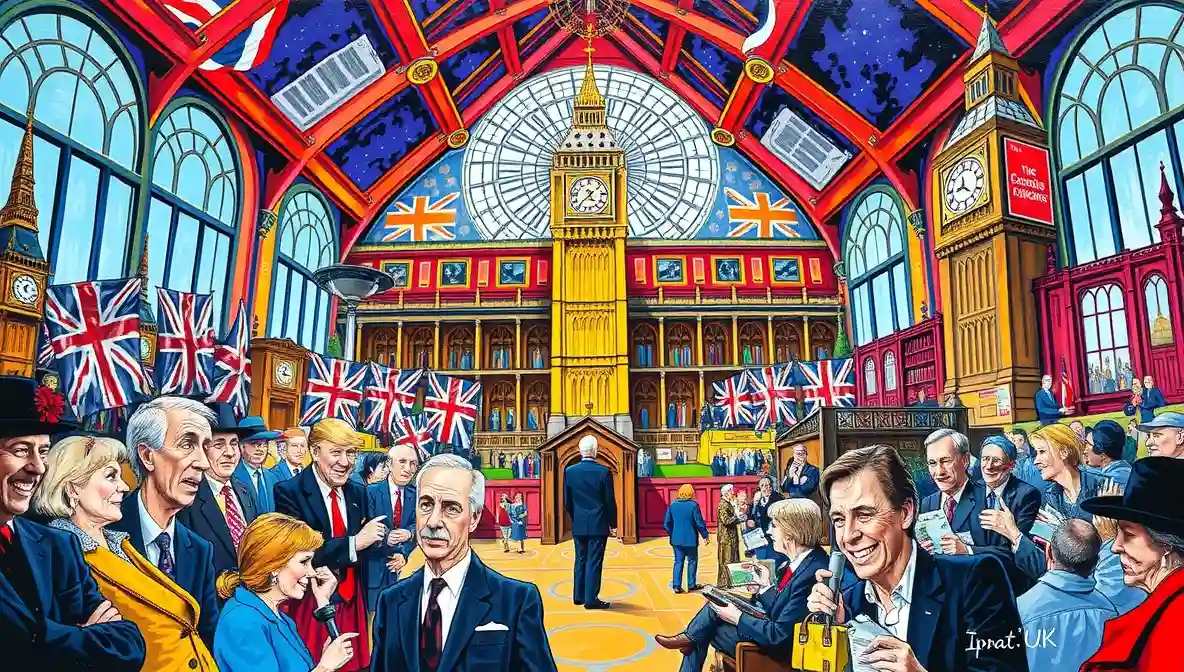
London Whinge and the Polite Performance of Discontent
LONDON, UK – If London Moan is background noise, London Whinge is curated disapproval with posture. It is less about volume and more about tone. A whinge is not shouted. It is delivered with precision, ideally while holding something artisanal.
According to the London Institute for Civic Expression, 69 percent of residents admit to whinging at least twice a day, though only 14 percent believe they are doing it. “Self-awareness declines proportionally with latte temperature,” the report notes.
Dr. Felicity Hargrave of University College London defines London Whinge as “low-intensity dissatisfaction expressed with high social awareness.” In other words, you complain, but you make it stylish.
At a brunch in Notting Hill, a guest described her flat as “charmingly inefficient.” Translation: she cannot open her oven without blocking the hallway.
Her friend replied, “It’s very you.”
That is a whinge. It acknowledges hardship while preserving aesthetic dignity.
The Economics of the London Whinge
Savills recently reported continued upward pressure on property prices. Londoners responded not with revolt but with extended sighs.
A YouGov poll found that 57 percent of renters believe their landlord “means well.” Only 9 percent could define what that means.
Estate agents have adapted their language accordingly. “Characterful,” “compact,” and “vibrant” now operate as coded invitations to whinge quietly.
An anonymous property consultant admitted, “We expect resistance. We plan for tasteful disappointment.”
The Royal Institution of Chartered Surveyors insists the market is functioning efficiently. Londoners insist efficiency is subjective.
Transport and Tactical Whinging
Transport for London remains the city’s most consistent source of low-level dissatisfaction. “Minor delays” generate major commentary in subdued tones.
London TravelWatch reports that commuter patience remains high despite measurable disruption. “We don’t protest,” one passenger at Victoria Station said. “We annotate.”
On the Central Line, a collective murmur followed an announcement about signal failure. No shouting. Just shared narrative.
Dr. Adrian Whitcombe of the University of London suggests that whinging builds resilience. “It releases pressure incrementally,” he says. “Think of it as emotional ventilation.”
Political Whinge Culture
Westminster is fluent in whinge. Parliamentary debates often resemble a long-form sigh.
Observers from the London Debate Club note that the most effective criticism is delivered softly. A raised eyebrow carries more weight than a raised voice.
An anonymous parliamentary aide summarised it neatly. “If you shout, you look unstable. If you whinge, you look informed.”
A recent Ipsos survey found that 48 percent of London voters prefer restrained critique over dramatic confrontation.
London Whinge is democracy with manners.
Conclusion: Dissatisfaction, Properly Managed
London Whinge may never trend internationally, but it defines the capital’s rhythm. It sustains conversation without igniting crisis.
As one resident leaving Canary Wharf remarked, “We’re not upset. We’re just mildly inconvenienced by reality.”
Experts predict that as long as rent rises, drizzle persists, and announcements multiply, London Whinge will endure.
Because in London, complaining is not chaos.
It is choreography.
London Drama: High Stakes, Low Volume
London Drama and the Quiet Spectacle
London Drama is rarely loud. It unfolds in boardrooms, borough councils, and WhatsApp groups titled “Urgent.”
According to the London Strategy Institute, 52 percent of workplace tension in the capital is communicated through email phrasing alone. “Per my last message” remains the city’s most theatrical line.
Dr. Helena Morris of King’s College London describes London Drama as “suppressed intensity beneath professional decorum.”
At a recent council meeting in Hackney, a debate over bicycle lanes extended three hours. Voices never rose above conversational level. The minutes record “robust exchange.”
An anonymous staffer translated: “It was emotional chess.”
Financial and Corporate Drama
The London School of Economics reports that financial volatility in Canary Wharf correlates with executive composure. The calmer the exterior, the sharper the internal recalculation.
A Deloitte UK analyst admitted privately, “Our drama is spreadsheet-based.”
Investor calls frequently feature phrases like “strategic recalibration,” which seasoned observers interpret as “unexpected turbulence.”
Yet the delivery remains measured.
Property and Social Drama
London property continues to provide narrative fuel. A bidding war in Islington recently ended £40,000 above asking price.
The buyer described it as “an investment in future stability.”
The seller described it as “gratifying.”
The neighbours described it as “predictable.”
Savills data confirms that demand frequently outpaces supply. Drama follows arithmetic.
Cultural and Political Theatre
Westminster occasionally produces headline-grabbing moments, but the true London Drama resides in understated exchanges.
Observers from the London Policy Lab note that rhetorical tension peaks during budget debates, then dissipates into policy footnotes.
A commuter outside Parliament reflected, “It’s all very intense, but no one spills tea.”
Conclusion: Spectacle Without Spectacle
London Drama thrives on nuance. It is emotional complexity delivered in a controlled voice.
As one pub regular in Brixton observed, “If we shouted every time something went wrong, we’d never stop.”
Experts predict that London Drama will remain steady, particularly in finance, housing, and transport.
Because in the capital, tension is inevitable.
Expression is optional.

Alan Nafzger was born in Lubbock, Texas, the son Swiss immigrants. He grew up on a dairy in Windthorst, north central Texas. He earned degrees from Midwestern State University (B.A. 1985) and Texas State University (M.A. 1987). University College Dublin (Ph.D. 1991). Dr. Nafzger has entertained and educated young people in Texas colleges for 37 years. Nafzger is best known for his dark novels and experimental screenwriting. His best know scripts to date are Lenin’s Body, produced in Russia by A-Media and Sea and Sky produced in The Philippines in the Tagalog language. In 1986, Nafzger wrote the iconic feminist western novel, Gina of Quitaque. He currently lives in Holloway, North London. Contact: editor@prat.uk