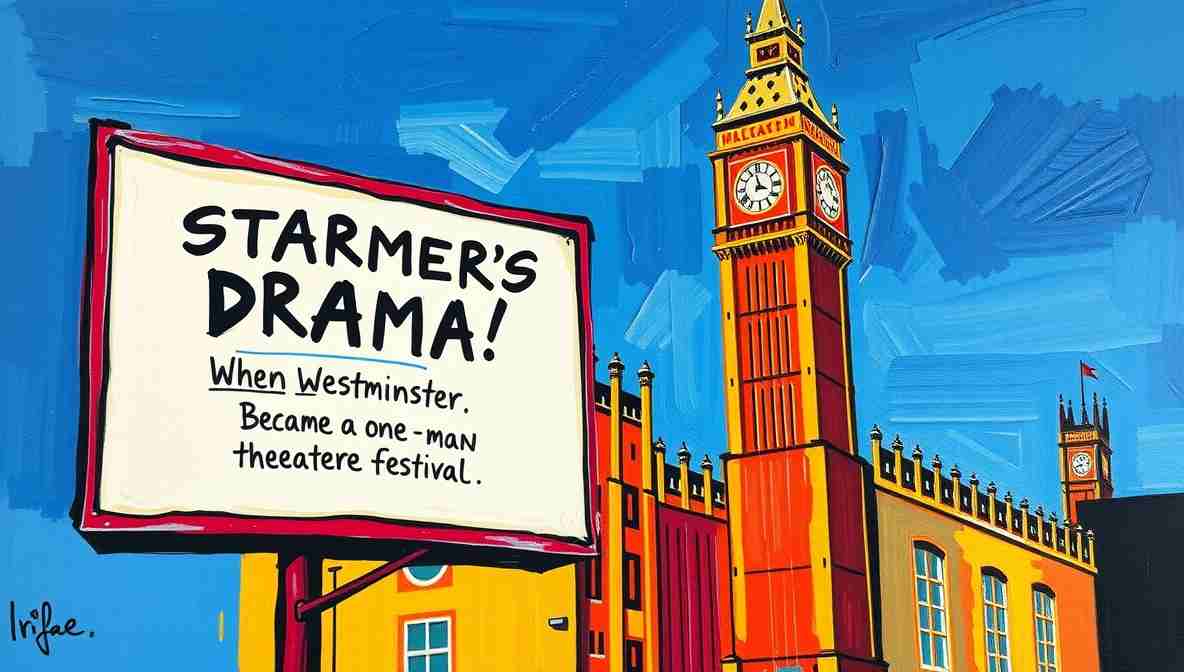
Drama School Starmer: When Westminster Became a One-Man Theatre Festival
There are moments in British politics when history taps you on the shoulder. There are other moments when it clears its throat, adjusts the spotlight, and announces that tonight’s performance will be an intimate monologue delivered by Keir Starmer, featuring interpretive pauses, emotional recalibration, and a plot nobody fully understands until the reviews come out three days later.
Starmer’s return to public view after his near-toppling did not feel like a press appearance. It felt like opening night. The kind where the programme is printed on recycled paper, the audience is unsure when to clap, and everyone agrees afterward that it was “important” without being able to explain why. Critics in the stalls are still trying to work out if it was experimental theatre or a very long PowerPoint presentation with feelings.
The Comeback That Came With Stage Directions

Starmer re-emerged like a man who had spent weeks rehearsing the idea of confidence rather than confidence itself. This was not the swaggering return of a conquering hero. This was the careful step-back-onstage of someone who knows the critics are in the front row, sharpening pencils, whispering things like “third act problem” and “is this still Labour?”
His body language suggested less “Prime Minister Returns” and more “One-Man Shakespeare Festival Nobody Asked For.” He spoke with the intensity of a man delivering a soliloquy to an audience that had accidentally wandered in looking for the toilets. You could practically see the invisible stage manager mouthing, slower… pause… now look statesmanlike. Method acting meets parliamentary procedure.
The Sofa Cushion Triumph
Watching Starmer give his first remarks after the wobble was like witnessing someone find the TV remote under the sofa. There was triumph, yes, but also confusion. Relief mixed with the dawning realisation that he still had to decide what to watch. He knew he had survived. He was less sure what survival meant. Or whether he’d accidentally sat on the remote again.
Westminster, of course, applauded politely. Journalists nodded as if this all made perfect sense. Somewhere, a civil servant quietly updated a briefing note titled “Narrative: Still Loading.” The spinning wheel of governance continued its mesmerising rotation.
Eyes Wide Starmer
The atmosphere had the feel of a low-budget political remake. Same mystery as a Kubrick film, fewer masks, more knitwear. Westminster insiders leaned in, squinting, wondering if this was a reset, a reinvention, or simply a very British way of pretending nothing alarming had happened.
Starmer looked like a man who had stared into the abyss, found it administratively untidy, and resolved to reorganise it into a set of manageable talking points. Perhaps with colour-coded folders. Definitely with proper filing systems.
Fighting Public Opinion With Determination
When Starmer “comes out fighting,” the opponent is rarely visible. It is usually public opinion, armed with polls, vibes, and that special British talent for quiet disapproval. The referee, as always, is a journalist with a notebook, trying to work out who exactly is winning.
Starmer swings carefully. No wild punches. Just precise, lawyerly jabs aimed at abstractions like “perception” and “expectation.” If this were boxing, the crowd would be murmuring, “Yes, but who is he actually fighting?” The ring announcer gave up and went for a tea break.
Political Choreography With a Recalculating GPS

His political movement now resembles someone following a satnav that keeps recalculating. Turn left. No, actually, bear slightly right. Re-routing. In 500 yards, question your entire political philosophy. Every decision is delivered with conviction, even as the destination quietly changes. The estimated time of arrival remains “uncertain.”
To watch Starmer navigate policy is to watch a man deeply committed to getting somewhere, while remaining refreshingly open about not being entirely sure where that is. Google Maps has given up and suggested he pull over at the next service station for a proper think.
The Audition Nobody Knew Was Happening
If politics held auditions, Starmer would perform the soliloquy while everyone else read Hamlet. He does not dabble in soundbites. He commits. He leans into the drama of responsibility, the weight of office, the importance of appearing serious at all times, even when saying very little.
It is earnestness turned up to eleven, delivered with the intensity of a man who once considered whether democracy itself needed a footnote. And probably cross-referenced it. Twice. In alphabetical order.
Strictly Come Governing
Whitehall insiders have begun to suspect that the “Plan for Change” was actually a secret audition for a government dance competition. Each week brings a new routine. Same cast, different rhythm. Judges nod thoughtfully. Nobody is eliminated, but nobody wins either. The sequins are implied rather than literal.
Civil servants smile bravely, translating grand gestures into bullet points, hoping the music eventually settles into something you can march to. Or at least waltz to without stepping on anyone’s toes. The scoring system remains classified.
Apply Narrative Twice Daily
Starmer’s speeches now feel like pharmaceutical inserts. For best results, apply narrative twice daily. Side effects may include mild reassurance, moderate confusion, and a strong urge to describe everything as “serious.” Do not operate heavy policy while under the influence. Consult your local MP if symptoms persist.
He speaks in the language of intention. Outcomes are implied, not guaranteed. It is less policy as destination and more policy as mood lighting. Dimmer switch sold separately.
Strategic Recalibration, Also Known as Tuesday
In Westminster, a rough week traditionally involves a missing brief or a tea trolley malfunction. Starmer has elevated this into “strategic recalibration.” Every stumble is a pivot. Every pause is reflection. Every silence is depth. Every awkward cough is a philosophical breakthrough.
It is a masterclass in reframing. If nothing else, he has proved that with enough gravitas, even standing still can be marketed as movement. The PR team are considering trademarking “Stationary Progress™”.
Turning Mission Statements Into Puzzles
Civil servants have reportedly started turning Starmer’s longer mission statements into crosswords, partly for morale, partly to see if meaning emerges diagonally. Clues include phrases like “long-term stability” and “working people,” with answers that never quite fit the grid. Several have resorted to making up their own definitions.
Even seasoned Whitehall veterans admit that not even The Times crossword could crack some of these passages in one sitting. Some are considering switching to Sudoku. At least numbers make sense.
The Post-It Prime Minister
Aides whisper that Starmer’s policies now exist primarily on sticky notes. They are colour-coded, carefully worded, and occasionally fall off during budget discussions. When they do, nobody panics. Another note is produced. Continuity is maintained. The stationery budget, however, requires urgent recalibration.
It is governance by stationery, flexible, removable, and easily repositioned depending on the temperature of the room. 3M executives are delighted. Political commentators remain baffled.
Emerging Like a Cat From a Bath
Starmer’s return after nearly being toppled had the energy of a cat emerging from a bath. Dignity damaged. Trust issues heightened. Absolute determination never to repeat the experience, immediately followed by circumstances suggesting it might happen again. The towel remains just out of reach.
He shook himself off, pretended nothing traumatic had occurred, and resumed looking faintly irritated by the entire concept of politics. And possibly water. Definitely Westminster’s central heating system.
Drama School, Westminster Edition

In modern politics, drama school is no longer about acting. It is about learning to remain upright while everyone around you yells “plot twist.” Starmer has clearly done the coursework. He may have even taken extra modules in Maintaining Composure During Existential Threats.
He delivers lines with sincerity, even when the script is still being revised. It is less deception than endurance performance. The director is nowhere to be found, but the show must go on. Interval is cancelled due to parliamentary scheduling.
Forecast: Theatrical Pauses
The political forecast now predicts a high chance of robust engagement, a slim chance of clarity, and frequent theatrical pauses. These pauses do heavy lifting. They suggest thoughtfulness. They imply depth. They give everyone time to check their phones. The Met Office refuses to comment.
Starmer understands the power of silence. Sometimes it says more than the words that follow it. Sometimes it just means he’s lost his place in the autocue. Both are equally profound.
A Recipe For Earnestness
If this moment in Starmer’s leadership were a recipe, it would call for equal parts earnestness and existential crisis, simmered slowly over tea-soaked policy notes. Serve with a side of reassurance and a garnish of caution. Pairs well with British reserve and a robust sense of irony.
It is not flashy. It is not dramatic in the traditional sense. But it fills the plate, and in British politics, that often counts as success. Mary Berry would give it a polite nod. Paul Hollywood would raise one eyebrow. That’s as good as it gets.
Disclaimer
This article is satire. It is a work of commentary, exaggeration, and affectionate scrutiny, intended to explore the theatre of modern British politics rather than document it literally. Any resemblance to actual drama schools, stage managers, or fallen Post-it notes is entirely intentional. This story is the result of a human collaboration between the world’s oldest tenured professor and a philosophy major turned dairy farmer.
Auf Wiedersehen, amigo!