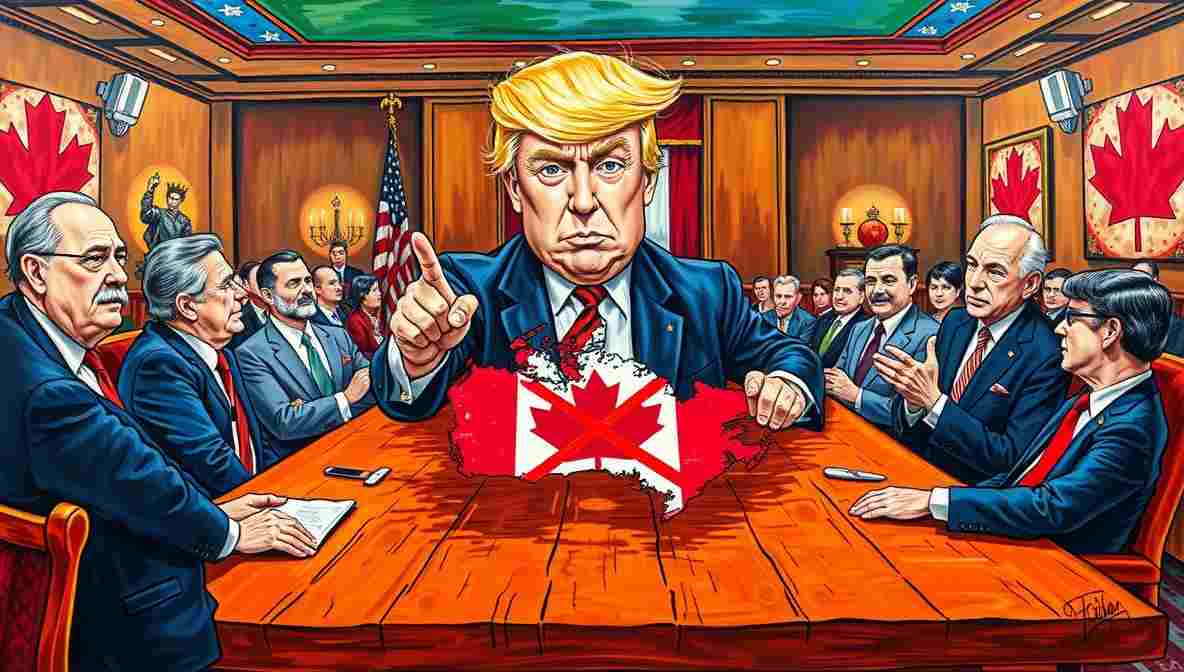

UK Gives Denmark a Hug, Trump Asks “Is Greenland Vegan” While Demanding It Anyway
The British government moved swiftly this week to support Denmark after Donald Trump once again floated the idea that Greenland should somehow belong to the United States, a suggestion delivered with the confidence of a man who believes the globe is a clearance rack. UK officials described their response as “solidarity,” though several insiders admitted it was more of an awkward, polite hug, the kind you give a relative who has started shouting at the dinner table about property rights.
Downing Street sources confirmed that Prime Minister Keir Starmer’s message to Denmark was clear, calm, and very British: “We see you, we support you, and we would like this conversation to end quietly.” Trump, meanwhile, reportedly asked aides whether Greenland was “vegan,” a question that stunned diplomats, nutritionists, and at least one confused iceberg.
Diplomacy, But With Feelings

British diplomats emphasized that Greenland is not for sale, lease, barter, or experimental grilling. “Greenland belongs to Greenland,” said one official, adding that this has been the case for some time and is generally understood by people who read maps without squinting. Trump’s camp countered with a familiar argument: if something looks large, cold, and vaguely unguarded, surely someone should try to buy it.
Political scientists noted that Trump’s Greenland fixation follows a recognizable pattern. “This is classic territorial shopping behavior,” explained Professor Harriet Lonsdale of the London School of Strategic Shrugging. “He’s not conquering. He’s browsing.”
Trump’s Ethical Concerns

Sources close to Trump said his interest briefly wavered when he asked whether Greenland was vegan, gluten-free, or contained soy. Once reassured that it was mostly ice and rock, he renewed his enthusiasm. “He likes things that are clean, white, and unused,” said one anonymous aide. “He thinks Greenland has great bones.”
Public reaction in Britain ranged from mild amusement to deep sighing. A snap poll found that 62 percent of Britons felt the situation was “embarrassing but predictable,” while 28 percent asked if this meant Britain might have to defend Denmark with stern letters and slightly louder concern.
In the end, the UK reiterated its support for Denmark, Trump reiterated his interest in Greenland, and the Arctic continued melting quietly, ignored by everyone involved. Diplomacy, like the ice caps, survived another day, thinner but still technically intact.
Starmer Says Greenland Belongs to Greenland; Trump Says “Cool, We’ll Just Buy It Twice”

Keir Starmer made headlines this week by stating what historians describe as “a very basic fact”: Greenland belongs to Greenland. The declaration was intended to shut down Donald Trump’s renewed interest in acquiring the territory, but instead inspired Trump to respond, “Cool, we’ll just buy it twice,” introducing a new economic theory based entirely on confidence.
Starmer’s office stressed that sovereignty is not a loyalty program. “You don’t earn Greenland after ten purchases,” a spokesperson clarified. Trump’s allies disagreed, noting that if buying something once doesn’t work, buying it louder usually does.
A Clash of Worldviews
Analysts say the dispute highlights a fundamental difference in political philosophy. Starmer represents the school of thought that nations are sovereign entities. Trump represents the school that everything has a price if you don’t ask enough follow-up questions.
“Trump approaches geopolitics like real estate,” said Dr. Malcolm Pierce, an expert in international relations. “He assumes there’s always a desperate seller hiding somewhere, probably behind a fjord.”
Trump reportedly told supporters that Greenland would be “great for security,” though he did not specify from what. When pressed, he mentioned “vibes,” “China probably,” and “just in case.”
Britain Steps In
The UK’s backing of Denmark was firm but understated. Officials avoided dramatic language, opting instead for the traditional British method of resolving conflict: calm statements, passive phrasing, and disappointment. One diplomat described the strategy as “hoping reality eventually tires Trump out.”
On social media, British citizens reacted with sarcasm. “Can’t wait for Trump to offer Klarna for continents,” wrote one user. Another asked if Britain could sell him the weather.
The episode ended as most modern diplomatic incidents do: with no resolution, several statements, and a lingering sense that this conversation might restart at any moment. Greenland remained where it was, Starmer remained patient, and Trump remained convinced that persistence is just another form of ownership.
Britain Backs Denmark on Greenland; Trump Offers to Trade It for Texas and a BBQ Sauce Recipe
International diplomacy took a distinctly American turn this week when Donald Trump reportedly suggested trading Texas and a BBQ sauce recipe for Greenland, prompting confusion in London, Copenhagen, and several Texas group chats. Britain quickly reaffirmed its support for Denmark, while quietly confirming that this was not how treaties usually work.
British officials said they were “surprised but not shocked” by the proposal. “We’ve seen worse ideas,” said one senior figure. “Some of them involved lettuce.”
The Art of the Deal, Revised

According to sources, Trump described the trade as “very fair,” noting that Texas is large, BBQ is popular, and recipes are intellectual property. Economists struggled to evaluate the offer, citing difficulties in converting ribs into square miles.
“Texas is not owned by Trump personally,” explained constitutional scholar Janet Whitcombe. “And even if it were, you can’t just throw it into a trade like a side dish.”
Trump supporters praised the creativity of the idea. One called it “thinking outside the bun.” Another argued that Greenland probably doesn’t even have good brisket.
Britain’s Role

The UK positioned itself as the adult in the room, backing Denmark while gently steering the conversation back to reality. “We support Danish sovereignty,” Starmer said, using the tone normally reserved for explaining gravity to a toddler.
A British think tank released a report warning that if countries began trading territories for condiments, global order would collapse within weeks. The report included a footnote clarifying that mayonnaise was especially dangerous.
As the week closed, Denmark declined the offer, Texas remained in the U.S., and the BBQ sauce recipe stayed hypothetical. Trump hinted he might sweeten the deal with coleslaw. Britain issued another statement of support. The world, once again, carried on, slightly more tired and significantly more aware that diplomacy is only one bad idea away from becoming a cookout.
Auf Wiedersehen.

Alan Nafzger was born in Lubbock, Texas, the son Swiss immigrants. He grew up on a dairy in Windthorst, north central Texas. He earned degrees from Midwestern State University (B.A. 1985) and Texas State University (M.A. 1987). University College Dublin (Ph.D. 1991). Dr. Nafzger has entertained and educated young people in Texas colleges for 37 years. Nafzger is best known for his dark novels and experimental screenwriting. His best know scripts to date are Lenin’s Body, produced in Russia by A-Media and Sea and Sky produced in The Philippines in the Tagalog language. In 1986, Nafzger wrote the iconic feminist western novel, Gina of Quitaque. Contact: editor@prat.uk