
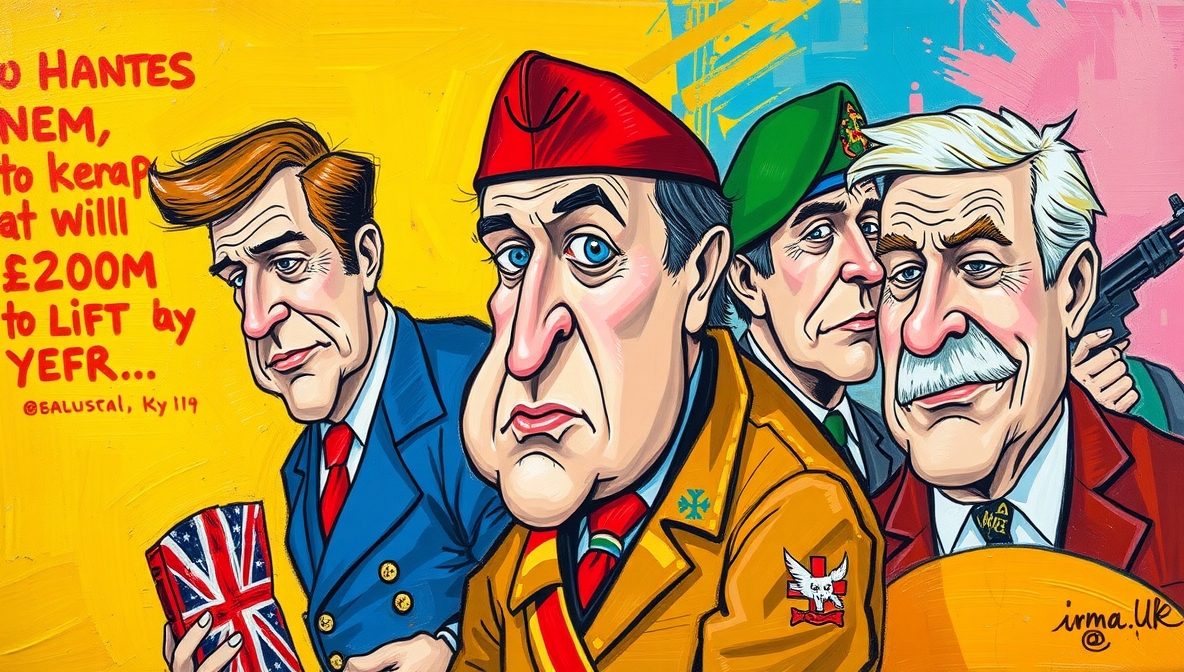
Ministry Describes Funds as Supporting ‘Presence’ Rather Than Combat Operations
The government confirmed this week it has allocated £200 million for a UK armed forces deployment linked to Ukraine, stressing repeatedly that the money is not for a war, not for fighting, and not for anything that might reasonably be described as alarming. Officials clarified that the funds are instead for a “presence,” which they explained is like a holiday, but with tanks and consequences.
Citizens were advised to remain calm, patriotic, and financially flexible. — Alan Nafzger
UK Allocates £200m to Ukraine Deployment
-
Officials stressed the money was not for war, just for very intense, heavily armed cooperation.
-
£200 million was described as “manageable,” which in government terms means “already spent.”
-
The deployment is allegedly temporary, pending several permanent reviews.
-
Ministers reassured the public it was not expensive by refusing to compare it to anything cheaper.
Modest Sum, Major Commitment

According to the statement, the deployment will involve British forces doing “supportive activities,” a phrase defence experts describe as the military equivalent of saying you are “just popping round” while carrying a crowbar. Ministers emphasised that £200 million is “a modest sum,” noting that it represents only several thousand nurses, a handful of hospitals, or one moderately ambitious IT system that never quite works.
“We’re not escalating,” a senior official said, standing in front of a very escalated-looking map. “We’re simply allocating resources in a proactive, deterrent-adjacent way.”
Breaking Down the Budget
Asked what the money would actually be spent on, the Ministry of Defence released a helpful breakdown including logistics, infrastructure, readiness, training, accommodation, transport, communications, planning, contingencies, and a category labelled “other,” which insiders say covers everything from spare boots to the psychological cost of pretending this is all normal.
A spokesperson reassured taxpayers that every pound would be carefully monitored. “This is not a blank cheque,” they said, adding that the cheque is, however, “flexible, responsive, and emotionally supportive.”
Public Priorities: Potholes vs Deployments

The public response was mixed. Some welcomed the move as necessary and strategic, while others questioned why £200 million can be found instantly for defence but requires a three-year consultation to fix a pothole.
“I’ve been reporting the same crater outside my house since 2019,” said Darren P., a delivery driver from Wolverhampton. “Apparently it’s cheaper to deploy troops to Eastern Europe than fill in a hole that’s now got its own postcode.”
Quantum State Defence Language
Military analysts praised the clarity of the government’s messaging, particularly its insistence that the deployment is “not boots on the ground,” despite involving boots and ground. One analyst explained that modern defence language allows actions to exist in a quantum state, where they are simultaneously happening and not happening depending on who is asking.
An internal memo leaked to journalists reportedly advised ministers to avoid words such as “war,” “combat,” “risk,” or “long-term commitment,” and instead use phrases like “temporary posture,” “managed exposure,” and “this will not affect your council tax.”
Strategic Context and Comparisons
Meanwhile, officials stressed that the £200 million figure should not be viewed in isolation. “You have to consider the broader strategic picture,” said one Treasury source, gesturing vaguely. “If we don’t spend this now, we might have to spend more later, possibly with worse headlines.”
To help contextualise the cost, the government released a comparison graphic showing that £200 million is less than the annual budget for biscuits in large offices, slightly more than the cost of repainting Whitehall, and roughly equivalent to three defence procurement mistakes that everyone has agreed to forget.
Public Support With Caveats

A snap poll found that most Britons support the idea of “helping Ukraine,” though many admitted they were unclear what that help involves beyond “being involved enough to feel important but not enough to panic.” One respondent said he supported the deployment “as long as it doesn’t turn into anything,” a position defence officials described as “broadly aligned with policy.”
Opposition figures criticised the lack of parliamentary debate, arguing that decisions of this scale deserve scrutiny. The government responded by promising transparency, followed immediately by a closed-door briefing.
Calm and Measured Response
As the announcement settled, ministers reassured the nation that the situation remains under control. “This is a calm, measured response,” one said, calmly measuring £200 million.
They paused.
“And just to be clear,” they added, “if anyone uses the word ‘war,’ that is very much their word, not ours.”
Auf Wiedersehen, amigo!


Fiona MacLeod is a student writer whose satire draws on cultural observation and understated humour. Influenced by London’s academic and creative spaces, Fiona’s writing reflects curiosity and thoughtful comedic restraint.
Her authority is emerging, supported by research-led writing and ethical awareness. Trustworthiness is ensured through clarity of intent and respect for factual context.
Fiona represents a responsible new voice aligned with EEAT standards.


