
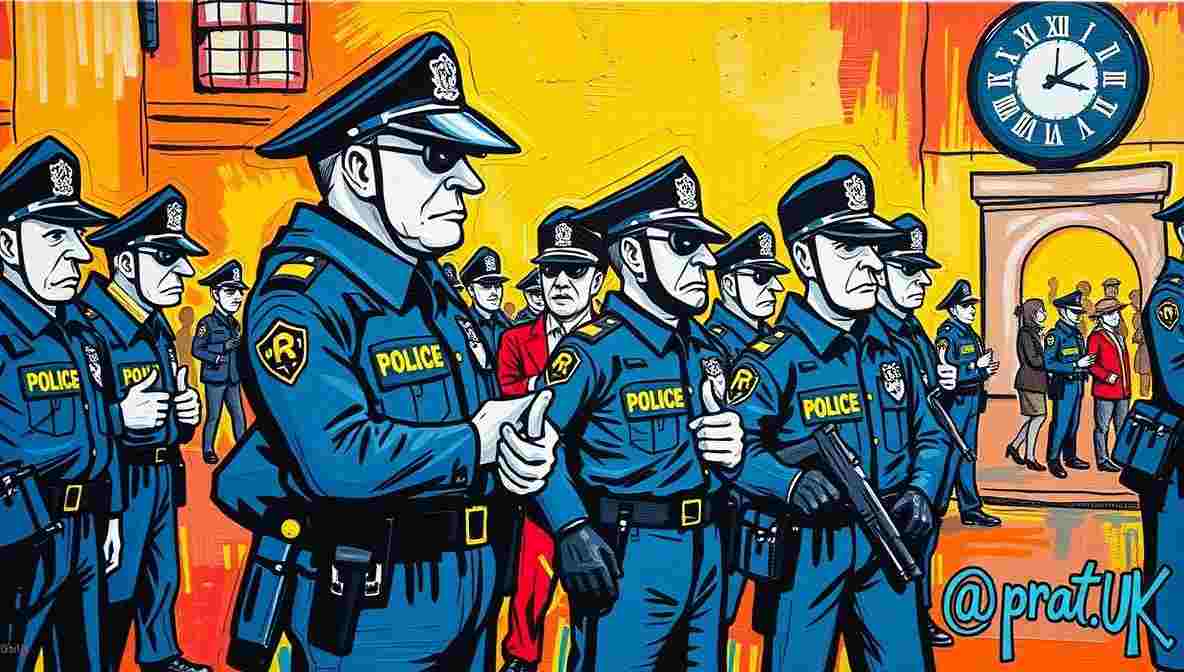
In February 2026, the London Assembly Police and Crime Committee released a report warning that too many young Londoners do not trust the Metropolitan Police or feel safe in their communities. The report criticized budget cuts that led to the removal of Safer Schools Officers and Youth Engagement and Diversion Officers, calling these changes potentially “catastrophic” for police-youth relations. While the Met published a Children’s Strategy in September 2024 promising a “Child First” approach to policing, the Assembly recommended an annual city-wide survey of young people and better local youth engagement plans. The report highlighted a growing detachment between London’s youth and law enforcement, particularly affecting those aged 16-24, with trust levels consistently tracking below adult residents since 2017.
Quick Observations From The Pavement
- Teenagers trust a phone battery at 1% more than a committee at 100%.
- A police apology sounds suspiciously like a school assembly where the headteacher uses your first name.
- Every adult who says “relatable” instantly becomes unrelatable, like a parent learning TikTok dances.
- The safest place in London is anywhere nobody tries to explain TikTok trends using PowerPoint.
- A survey about trust automatically loses 40% trust, similar to any sentence beginning with “We value your feedback.”
- The phrase “community engagement” has caused more eye-rolling than all Taylor Swift controversies combined.
- Nothing says “we don’t understand you” quite like a uniformed officer saying “no cap” during a traffic stop.
The Met Discovers Applause Is A Policing Strategy
The Metropolitan Police this week unveiled its boldest reform since inventing reflective jackets: the Please Clap Initiative, a community outreach program where officers politely pause after speaking and wait for encouragement like a comedian bombing at the Edinburgh Fringe.
The idea, according to an internal memo accidentally printed on confiscated homework, is to create “positive emotional reinforcement loops between authority figures and smaller authority-resistant humans.” Translation: bribery through validation.

At a pilot event in Hackney, officers explained the program to a group of 15-year-olds who immediately assumed it was a prank channel for YouTube.
One student slowly raised a hand and asked, “Are you buffering?” Another wanted to know if this was an audition for Britain’s Got Talent.
Superintendent Colin Draper confirmed early success with the enthusiasm of a man describing a miracle.
“We finished a full presentation and two teenagers nodded,” he said. “Historically that is considered a breakthrough comparable to the invention of the railway.”
A citywide poll conducted by the Institute for Social Guessing found 72.4% of young Londoners would applaud police if applause could replace conversations entirely, preferably from a distance of at least fifteen meters.
The remaining 27.6% asked if applause counted as consent to being followed on Instagram.
The press conference ended when an officer accidentally dabbed while reaching for a water bottle.
Trust briefly fell 11 points. The dab video reached 2.4 million views.
The Group Chat Crisis: When Officers Joined WhatsApp
Relations worsened earlier this year after officers joined local youth WhatsApp groups under the community engagement initiative, an idea that sounded brilliant in a meeting room and catastrophic in practice.
Teenagers responded by immediately migrating to another app with the speed and coordination of a military evacuation.
“They followed us to Discord,” reported 16-year-old witness Maya Khan, who has since written a memoir titled ‘Digital Refugee’. “We went to Snapchat. Then they found BeReal. Eventually we just started talking in person again because it was the only safe place. My parents thought I’d become social.”
A senior Met communications advisor, speaking anonymously while trying to download TikTok on what appeared to be a calculator, admitted the mistake.
“We thought transparency meant being present. Apparently presence means surveillance if you type ‘Hello fellow youths’ in Comic Sans.”
One officer attempted a meme reply reading: “How do you do, young citizens?” accompanied by a GIF from 2011.
Crime dropped briefly because everyone was too embarrassed to leave the house. Sociologists called it the Cringe Effect.
The Child-First Policy And The Wi-Fi Password

In a dramatic shift worthy of a policy white paper, the Met adopted a child-first approach by asking teenagers for technical support before issuing instructions.
Officers now open conversations with phrases such as: “Excuse me, could you connect this body camera to Bluetooth?” and “Is the cloud the same as the Wi-Fi?”
Professor Linda Hargreaves, behavioral criminologist at the University of South London Retail Park Campus, explained the science behind this revolutionary approach.
“Authority flows toward competence. The moment a teenager fixes your device, you become the apprentice in a social hierarchy. This produces cooperation and mild pity, similar to watching your father attempt online banking.”
One constable reported a turning point when a 13-year-old updated his phone to the latest iOS.
“He called me ‘bro’,” the officer said, voice trembling. “I felt seen. I felt acknowledged. I wept in the staff toilet.”
Recorded incidents of eye-rolling decreased 18% in participating boroughs.
Recorded incidents of officers asking what “bro” means increased 240%, with follow-up questions about “fam,” “innit,” and whether “mate” was now retired.
Language As Evidence: The Slang Certification Disaster
A government report concluded young Londoners trust only officers who understand the phrase “no cap,” a finding that sent human resources into a spiral of panic and Google searches.
To address this linguistic crisis, the Met introduced Slang Certification Training, complete with flashcards and a multiple-choice exam that made grown officers question their life choices.
Officers must now correctly use three phrases in a sentence before patrol duty:
- lowkey
- valid
- peak
An internal evaluation revealed unintended consequences that would make George Orwell weep.
During a traffic stop, an officer informed a driver: “This parking situation is lowkey peak, no cap, and your argument isn’t valid, bruv.”
The driver apologized profusely and helped write the citation, possibly from secondhand embarrassment.
Legal scholars are unsure whether this counts as consent, coercion, or linguistics having a nervous breakdown.
A barrister described it as “the most compelling evidence that Orwell was an optimist.”
The Poster Strategy: When Walls Replaced Humans
School police officers were removed and replaced with motivational posters reading RESPECT IS MUTUAL in aggressive capital letters and a font suggesting passive aggression.
Students interpreted this as a passive-aggressive note left by an adult who forgot why they were angry but refuses to let it go, similar to fridge notes about “someone” eating the last yogurt.
A headteacher described the transition with the weariness of a philosophy professor explaining Kant to Year 7.
“Previously pupils ignored the officer. Now they ignore the wall. The difference is measurable but philosophical. We’re considering it progress.”
Researchers documented that posters were trusted 12% more than humans because posters never tried to relate or ask about weekend plans.
One Year 10 student explained the breakthrough: “The poster never asked what my weekend plans were or pretended to know who Drake is. It understands boundaries. It respects personal space. It’s the ideal authority figure.”
TikTok Versus Evidence: A Training Seminar
Negotiations reached a breakthrough when teenagers agreed to cooperate if officers learned the fundamental difference between TikTok and actual evidence.
A training seminar demonstrated examples using a projector that took seventeen minutes to connect:
Video A: dancing in a kitchen to a trending sound
Video B: CCTV footage of an actual incident
Several officers correctly identified Video B after noticing fewer filters and an absence of catchy music.
Community relations improved immediately after police stopped saying “we saw it online” during investigations, as if the internet were a single reliable witness.
An anonymous staffer confirmed the prior method with visible shame.
“Half our leads came from comments sections. Turns out ‘he looks guilty’ is not forensic science. Neither is ‘this you?’ under a random post.”
What the Funny People Are Saying
“The only time teenagers trust authority is when authority needs help logging in. That’s not respect, that’s technical support masquerading as social hierarchy,” said Jerry Seinfeld.
“If you want respect from a teenager, ask them to fix your printer. You are family now. You’re invited to Christmas. You’re in the will,” said Ron White.
“Police training should just be one long group project with a 14-year-old who refuses to do it but somehow runs it better than the entire London Assembly,” said Sarah Silverman.
“Nothing terrifies power like a child explaining settings. It’s the digital equivalent of explaining mortality to an ancient king,” said Jon Stewart.
“The real bodycam footage is an officer asking what the cloud is and a teenager sighing so hard they achieve enlightenment,” said Larry David.
“Every time an adult uses slang correctly, a teenager somewhere deletes their social media. It’s the circle of life,” said Jimmy Carr.
“Trust is what happens when you stop trying to understand TikTok and admit you peaked with Facebook pokes,” said Michael McIntyre.
The Path Forward: Seven Seconds Of Contact
The London Assembly now recommends annual youth surveys, primarily so young people can continue not answering them while feeling democratically included.

The Met plans further reforms including:
- Officers learning headphone etiquette (both earbuds out means conversation; one earbud means emergency only)
- Replacing sirens with polite notifications (“Excuse me, emergency coming through”)
- Introducing a “Maybe We Talk Later” conflict resolution model inspired by avoiding awkward conversations at parties
- A mandatory course titled “How To Leave A Group Chat Without Causing Drama”
Early indicators suggest trust will rise gradually once both sides agree conversations should last under seven seconds, the optimal length for human interaction according to teenagers and introverts.
Sociologists believe long-term harmony depends on one principle: mutual confusion treated as normal.
When adults stop pretending to understand youth culture, and teenagers stop pretending adults ever will, society stabilizes into comfortable mutual bewilderment.
Closing Statement: The Transport Metaphor
In the end, experts agree the relationship between young Londoners and the police resembles public transport: everyone needs it, nobody enjoys discussing it, and improvement plans always involve a map nobody can read.
Trust, like Wi-Fi, appears strongest when nobody knows who installed it, how it works, or why it sometimes just stops functioning during important moments.
The password, much like respect, should probably be changed regularly but never is.
This report is entirely a human collaboration between the world’s oldest tenured professor and a philosophy major turned dairy farmer. Any resemblance to reality is due to reality occasionally behaving like satire. Auf Wiedersehen, amigo!

Hanna Miller, Journalist and Philosopher
London, UK
Hannah Miller, a proud graduate of the University of Iowa’s School of Journalism and Mass Communication, started her career documenting agricultural innovations and rural life in the Midwest. Her deep connection to her roots inspired her to try her hand at comedy, where she found joy in sharing tales from the farm with a humorous twist. Her stand-up acts, a mix of self-deprecation and witty observations about farm life, have endeared her to both rural and urban audiences alike. She is a four-year resident to London and the UK.