Royal Wedding Advice Becomes National Infrastructure Project
By a correspondent who once planned a barbecue that required fewer security agencies than a royal aisle walk
London woke to the comforting news that Catherine, Princess of Wales once received wedding advice from Queen Elizabeth II, a development that instantly reassured the nation that marriage, like nuclear deterrence, is safest when supervised by someone who has already seen six prime ministers panic over table arrangements — and one who once made a seventh cry over the napkin fold.
Palace sources say the late monarch offered calming guidance before the 2011 ceremony, allegedly encouraging Kate not to become overwhelmed. This marked the first recorded instance of a human being telling another human being to relax while 1,900 guests, 5,000 journalists, and approximately every aunt in Yorkshire stared directly at her hat.
Experts confirm this was less wedding advice and more constitutional orientation — with a side of light existential dread.
Professor Alastair Pembroke of the Institute for Ceremonial Logistics explained, “A royal wedding is not about two people joining lives. It is about ensuring Norway feels included while Australia claps at the correct tempo. The emotional element is secondary to choreography. The choreography is secondary to the horses. The horses have final approval.”
The Simplicity Initiative: One Choir Is Plenty, Actually

The Queen reportedly encouraged calm efficiency, which historians recognize as royal language for “do not accidentally trigger a diplomatic incident with your bouquet” — and also “please walk, do not power-stride.”
Wedding planners across Britain immediately revised their own marketing packages following the revelation. The newly launched “Royal Minimalist” tier now includes:
- Calm breathing exercises (hyperventilating is non-constitutional)
- One choir instead of four (the other three wait outside as reserves)
- Only 900 guests (intimate, by any standard involving its own postcode)
- A manageable number of archbishops
- One horse who has passed a background check
Local bride Stacey Carter of Croydon attempted the same advice at her own wedding. “I told everyone to keep it low-key,” she said. “My mum invited 180 people and my uncle tried to sing Sinatra. Twice. In different keys. I now understand why the monarchy maintains a cavalry.”
The Ten-Year Courtship Internship: Britain’s Longest Probationary Period
Kate’s decade-long relationship with Prince William has been retroactively classified by sociologists as the world’s longest probationary period — exceeding even the average tenure of a British Rail signal engineer.
Dr. Elaine Markham of the Social Stability Bureau explained, “Most couples date to learn habits. Royal couples date to determine whether either party can stand next to a sword without declaring maritime law or instinctively reaching for the hilt during small talk.”
During those ten years Kate reportedly mastered:
- Walking on gravel without facial expression
- Smiling at strangers with alarming eye contact and no visible blinking
- Understanding the difference between a duke and a slightly shinier duke
- Knowing when the Queen’s “Hmm” means approval versus “we will speak of this never again”
A palace staffer, speaking anonymously while polishing something deeply symbolic, confirmed the training. “You don’t marry into the royal family. You pass the oral exam of history. Then the written. Then there’s a practical component involving soup.”
The Borrowed Tiara Economy: When Jewellery Has a Foreign Policy
The Queen lent Kate the Cartier Halo tiara, described by economists as the only loan agreement where damaging the collateral results in Parliament becoming nervous and the FTSE experiencing “a moment.”
Jewellery analyst Marcus Hales compared the gesture to normal weddings. “When your grandmother lends earrings, you return them in a bag. When the monarch lends a tiara, you return it accompanied by stable foreign policy and a handwritten note on paper thick enough to stop a sword.”
Insurance companies declined to quote a replacement value, instead listing the item under “please don’t” — a category that also includes the Elgin Marbles conversation.
Seating Charts and Foreign Policy: Chairs as Diplomatic Theatre
Ordinary weddings separate divorced relatives. Royal weddings separate geopolitical anxieties and two aunts who once fought over a tablecloth at Balmoral.
Diplomatic seating experts confirmed entire governments are arranged according to emotional temperature, historical grievance index, and proximity to pastry danger zones:
- France receives line-of-sight to pastries (earned, not awarded)
- Canada receives reassurance and a gentle nod of gratitude
- New Zealand receives polite nodding and one excellent hat compliment
- Germany receives chairs engineered for punctual sitting with optional armrests for efficiency
- The United States receives somewhere they can see everything but are slightly too far to comment
One diplomat admitted the tension. “You cannot place Belgium near chocolate during speeches. History teaches us nothing, yet everything.”
Advice From Someone Who Married During Rationing
Queen Elizabeth married in 1947 using clothing coupons, a fact repeatedly cited by older Britons whenever younger generations mention stress — or the price of avocado toast.
Historian Margaret Keene explained the significance. “Imagine planning a wedding where cake ingredients require national coordination, the dress required parliamentary sympathy, and the honeymoon was technically a matter of public morale. That experience gives perspective when advising someone whose biggest worry is global television and one mildly rogue bridesmaid.”
The Palace confirmed Elizabeth’s calm demeanor derived from living through war, post-war shortages, and Prince Philip learning to drive — which historians quietly acknowledge as the most dangerous of the three.
The Smile Protocol: Advanced Human Composure Bordering on Infrastructure
Royal brides are instructed to appear joyful but not surprised, enthusiastic but not regional, and radiant without suggesting personal opinion. Think of it as soft power with better shoes.
Media coach Rupert Hensley calls it “the golden ratio of public emotion.” “You must look like you’re enjoying yourself while also reassuring Malta that the empire was emotionally stable. You must be warm but not specific. Accessible but not relatable. Joyful but never, under any circumstances, surprised.”
Kate reportedly mastered the technique within seconds of exiting the carriage — a performance psychologists classify as “advanced human composure bordering on infrastructure” and which at least three engineering departments at Imperial College London have attempted to model.
What the Funny People Are Saying
“Normal weddings are about love. Royal weddings are about whether the horses unionized.” — Jerry Seinfeld
“My wedding had 80 guests and three arguments. Theirs had 1,900 guests and zero arguments, which proves fear works.” — Ron White
“You know your marriage matters when the weather personally cooperates.” — Sarah Silverman
“If my grandmother gave advice I’d nod politely. If the Queen gives advice I update my personality and possibly my visa.” — John Mulaney
“Kate’s entrance proved that anyone can handle a crowd of two billion people, provided they’ve had a decade of practice and the right tiara.” — Dara Ó Briain
National Emotional Support Event: The Mugs Spoke for Everyone

Public reaction to the wedding confirmed Britain’s deep reliance on ceremonial reassurance — and commemorative crockery as emotional first aid.
A poll conducted outside a bakery (methodology: ask anyone holding a sausage roll) reported:
- 72% felt calmer watching hats
- 18% forgot their own problems entirely, including a parking ticket
- 10% purchased commemorative mugs as coping mechanisms
- 4% cannot be accounted for and may still be watching reruns
Psychologist Dr. Martin Avery said the event functions as therapy. “The monarchy allows citizens to project stability onto a couple who cannot escape the room, cannot check their phones, and must under no circumstances say what they are actually thinking. It is, in clinical terms, deeply relatable.”
A Marriage With Structural Importance: Your In-Laws Include Centuries
Royal marriages differ from ordinary ones in one critical way: your in-laws include centuries — and at least one ancestor who personally invaded somewhere without checking the weather first.
Family counsellor Patricia Rowe explains, “Most spouses argue about chores. Royals negotiate expectations from 1066. The chores still exist — they are simply performed by someone in livery and never discussed at dinner.”
The Queen’s advice therefore focused on sustainability, composure, and not tripping while representing national continuity on the world’s most televised carpet.
Kate succeeded, proving that emotional resilience can be achieved through preparation, composure, and approximately twelve rehearsals with military timing — plus one final rehearsal the military did not know about.
The Aftermath: Fifteen Years Later, the Chairs Still Cost Extra
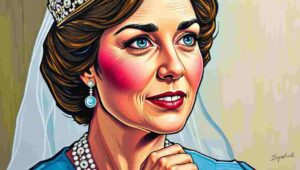
Fifteen years later, analysts conclude the guidance worked. The marriage remains stable, Britain remains calm (relatively), and wedding planners still cite the ceremony when charging extra for chairs, ambient string quartets, and what they now call “heritage calm.”
The Palace released a statement saying the Queen believed weddings should be enjoyed, even if watched by half the planet and one extremely attentive corgi who had, it must be noted, seen it all before.
Experts agree the advice applies broadly:
- Stay calm
- Ignore noise
- Smile at chaos
- Return the borrowed tiara
- Do not acknowledge the uncle who is about to sing
The nation continues to follow this philosophy daily, particularly during train delays — which function as Britain’s second-most-reliable form of communal bonding after royal weddings.
Final Thoughts: The Cake Flavour Is Never the Point
The exchange between monarch and future princess reminds us that weddings, whether local or global, share a universal truth: no one remembers the cake flavour, but everyone remembers whether the bride looked like she could handle the moment.
Kate did. Britain did. And somewhere a grandmother still says, “It was lovely, dear,” with the authority of someone who has survived everything — including relatives, rationing, and a husband who once attempted DIY on something load-bearing.
Disclaimer: This article is an entirely human collaboration between the world’s oldest tenured professor and a philosophy major turned dairy farmer. No corgis were consulted. All tiara values remain classified. Auf Wiedersehen, amigo!

Alan Nafzger was born in Lubbock, Texas, the son Swiss immigrants. He grew up on a dairy in Windthorst, north central Texas. He earned degrees from Midwestern State University (B.A. 1985) and Texas State University (M.A. 1987). University College Dublin (Ph.D. 1991). Dr. Nafzger has entertained and educated young people in Texas colleges for 37 years. Nafzger is best known for his dark novels and experimental screenwriting. His best know scripts to date are Lenin’s Body, produced in Russia by A-Media and Sea and Sky produced in The Philippines in the Tagalog language. In 1986, Nafzger wrote the iconic feminist western novel, Gina of Quitaque. Contact: editor@prat.uk