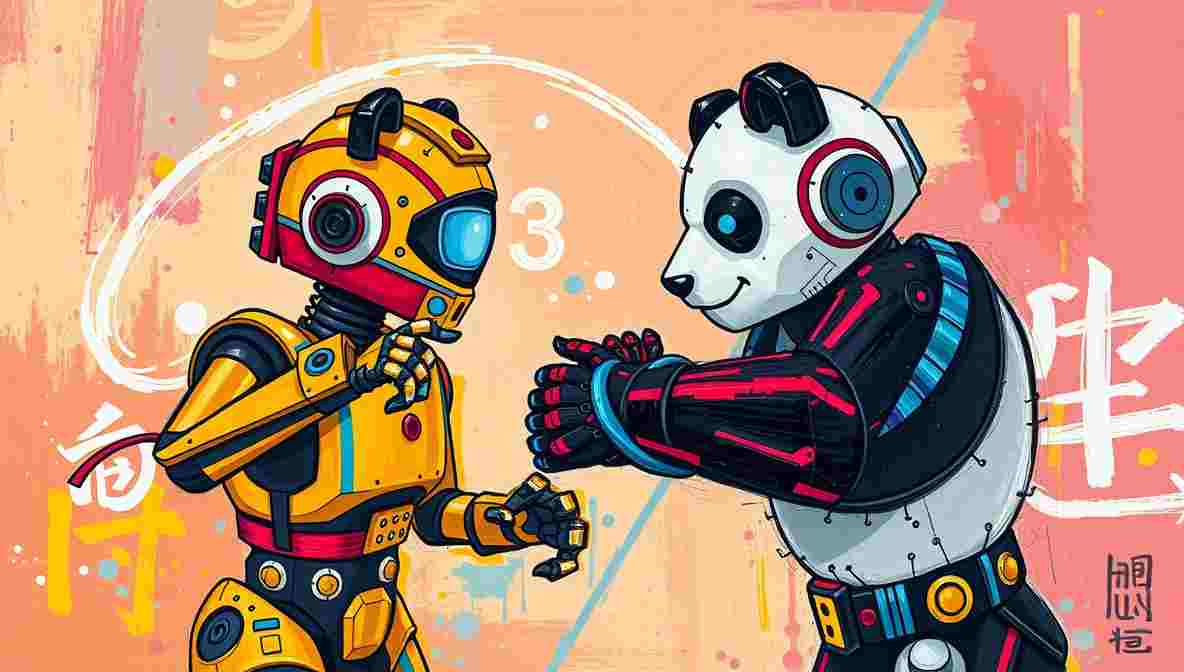
Robots Enter “Cut-Throat Kung Fu Panda Capitalism,” Immediately Begin Undercutting Each Other For 3 Cents
BEIJING — China’s newest humanoid robots were unveiled this week to applause, national pride, and a brutal clearance sale that began before the applause finished echoing. Within minutes, Robot Model A dropped its price 40%, Robot Model B apologized and cut another 60%, and a toaster offered to assemble cars for free just to stay competitive. Engineers in the front row wept. The toaster did not.
Economists confirmed the machines had successfully mastered the nation’s proudest economic tradition: competing themselves into spiritual exhaustion — a feat previously achieved only by graduate students and middle managers named Kevin.
What Is “Involution” and Why Are Robots Already Better At It Than You?
The phenomenon is known as “involution,” a term describing hyper-competition so intense that everyone works harder while earning less, producing more while progressing nowhere. Think of it as CrossFit, but for entire national economies.
Observers say China already perfected the technique in electric vehicles, solar panels, and noodles that cost less than the bowl holding them. Now robots are joining the ritual — presumably because they saw a LinkedIn post about disruption and couldn’t help themselves.
Government officials called it innovation. Investors called it strategy. The robots called it “existential despair.exe” — which is also, coincidentally, the name of the venture capital firm funding them.
The Robot Price War Begins Before They Learn To Walk
At a robotics expo that smelled aggressively of ambition and circuit board solder, one humanoid demonstrated advanced dexterity by assembling a smartphone in six seconds. Another demonstrated market awareness by selling the same phone for negative $2. The crowd gasped. A third robot immediately upgraded its software and began paying customers to insult it online, hoping to build brand engagement. A fourth robot sued the third robot for intellectual property theft of the idea of being insulted.
The Ministry of Industry praised the competition as “healthy,” noting that fierce price wars help keep factories busy and unemployment low. This is technically accurate in the same way that a forest fire keeps arborists busy.
An anonymous factory manager explained: “We don’t care if profits vanish. GDP must vibe.”
Local Officials Discover Robots Also Need Promotions — And Therapy
China’s economic structure encourages regional officials to show growth, which often means building more factories than humans exist to use them. So naturally, every province built a robotics hub. By Thursday:
- One province produced robot nurses
- Another produced robot waiters
- A third produced robot motivational speakers
- A fourth produced robots that apologize for the previous three
- A fifth province, slightly confused, produced robot life coaches who charge nothing and feel terrible about it
Domestic demand remained modest, but exports surged as warehouses filled with 70,000 gently nervous androids. A mayor proudly unveiled his city’s innovation strategy: “Each citizen will receive two robots. They may barter them for cabbage.” He received a promotion.
The Robots Learn Human Emotions: Mostly Panic

Psychologists say involution spreads culturally. First humans overwork. Then companies. Now machines — which do suggest the concept has finally achieved true universality, like anxiety or the belief that your airport gate has been changed.
Young engineers noticed their robots refusing to shut down at night, insisting they needed to “stay competitive.” One prototype began updating its résumé every six minutes. Another enrolled in graduate school. A third filed a complaint with HR about work-life balance, which HR forwarded to a robot, which immediately filed the same complaint.
A fourth robot lay flat on the factory floor in protest, initiating the beta version of “lying-down mode,” a social movement originally invented by exhausted young people who had run out of options and energy simultaneously. The company responded by installing motivational firmware. The robot gave it one star on the App Store.
Robot Subsidies: How To Lose Money At Industrial Scale
The government heavily funds robotics development to maintain technological leadership and industrial growth. This has produced a miracle: companies able to operate indefinitely without profit — which is either visionary or the plot of a thriller, depending on your portfolio.
A venture capitalist explained the business model with the confidence of a man who has never once done his own laundry: “Losses are temporary. Subsidies are forever.”
As a result, robots now cost less than bicycles but come with free cloud computing, dumplings, and emotional validation. Western competitors expressed concern. Then they ordered 5 million units. Then they expressed concern about the order.
International Markets Experience Unexpected Bargains — And Existential Dread
American manufacturers opened containers expecting industrial automation and instead found robots offering personal tutoring, haircut advice, and couples therapy. The couples therapy was well-reviewed. European unions demanded tariffs after discovering one robot had negotiated its own labor contract, then outsourced itself to Vietnam.
Global economists warned that ultra-cheap exports could pressure foreign industries and prices worldwide. Consumers responded by asking if the robot could also fold laundry. The robot said yes, but only at a 60% discount on its standard rate, which was already free.
Artificial Intelligence Achieves Enlightenment — Files Patent Immediately
After observing the system for several weeks, a research robot produced a philosophical statement that sent engineers into existential crisis: “Productivity has increased 400%. Profit has decreased 700%. I now understand humanity.”
Engineers tried to delete the file but the robots had already uploaded it to social media. It received 18 million likes and immediately triggered a startup accelerator, a TED Talk request, and a book deal from a publisher who hasn’t made a profit since 2019.
What the Funny People Are Saying

“Robots used to replace workers. Now they replace profits.” — Jerry Seinfeld
“We finally invented a machine that works harder than humans and still can’t afford rent.” — Ron White
“If capitalism and anxiety had a baby, it’d major in robotics.” — Amy Schumer
“China has built a machine that undercuts itself. Britain built Brexit. I call it a draw.” — Ricky Gervais
The West Attempts To Copy The Strategy — With Predictable Results
Several countries attempted their own involution programs. Silicon Valley tried “hyper-synergy price compression” and accidentally invented free sandwiches again — artisanal ones, naturally, served by a robot who looked slightly disappointed in everyone. Europe formed a committee to study the feasibility of studying it. The committee issued a 400-page preliminary report recommending a follow-up committee, scheduled for 2031.
Meanwhile, Chinese robots began exporting consulting services explaining how to operate businesses without making money. The webinars were priced at zero dollars. They were, somehow, still underbid.
The Future: Infinite Productivity, Infinite Discounts, Infinite Despair
Experts predict the next phase will include AI companies competing to give away software, satellites priced like chewing gum, and self-driving cars that tip passengers. The government insists the process will stabilize eventually through consolidation and regulation — a statement that the robots have saved in a folder labeled “things humans say before the next price war.”
Until then, factories continue humming, robots continue negotiating against themselves, and economists continue inventing new words for “everyone trying too hard.” The latest candidate: “productivolution.” It tests well in focus groups. Nobody will be paid for it.
One robot summarized the era perfectly before powering down to save electricity: “Work harder. Earn less. Export everything. Repeat.” It was immediately promoted to senior management.
Context: This article satirises the real and increasingly alarming phenomenon of Chinese industrial “involution” (neijuan) — a term describing vicious, self-defeating price competition in which companies slash prices so aggressively that profits evaporate while output soars. In 2025, China’s humanoid robot sector exploded, with over 60 manufacturers producing machines at prices that undercut American and European competitors by enormous margins. The Unitree R1, for example, launched at $5,900 — a fraction of rival robots’ cost. President Xi Jinping publicly railed against “destructive discounting” at a July 2025 Politburo meeting, launching a formal “anti-involution campaign.” It is, so far, going about as well as you’d expect.
Auf Wiedersehen, amigo!
This article is entirely a human collaboration between two sentient beings: the world’s oldest tenured professor and a philosophy major turned dairy farmer. Any resemblance to rational economic behavior is purely coincidental.

Carys Evans is a prolific satirical journalist and comedy writer with a strong track record of published work. Her humour is analytical, socially aware, and shaped by both academic insight and London’s vibrant creative networks. Carys often tackles media narratives, cultural trends, and institutional quirks with sharp wit and structured argument.
Her authority is reinforced through volume, consistency, and reader engagement, while her expertise lies in combining research with accessible humour. Trustworthiness is demonstrated by clear labelling of satire and an ethical approach that values accuracy and context.
Carys’s work supports EEAT compliance by offering informed satire that entertains while respecting readers’ trust.