
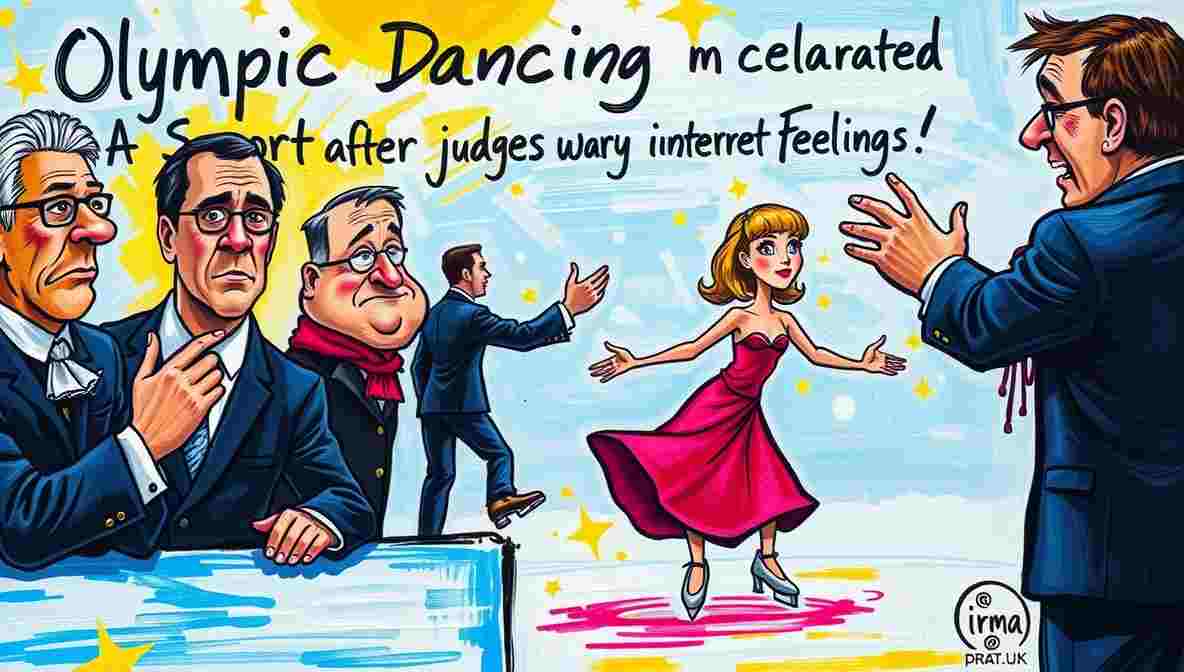
Olympic Ice Dancing Declared A “Sport” After Judges Successfully Interpret Feelings
MILAN, ITALY – The Winter Olympics once again reminded humanity that some competitions are decided by measurable facts like speed, distance, and physics… and others are decided by vibes, aura, and whether a judge once dated a French pastry. ⛸️🥐
The controversy erupted after American ice dancers Madison Chock and Evan Bates delivered what experts, audiences, grandmothers, and several confused zookeepers agreed was “basically perfect,” yet somehow finished with silver behind the French duo. The margin was about one point, which in ice dancing equals the difference between a flawless routine and “slightly insufficient emotional parsley.” 🌿
Within minutes, fans began screaming the most Olympic phrase in history:
“THIS IS WHY WE LIKE TRACK.”
The Mathematics of Interpretive Feelings
Ice dancing scoring is built on a scientific formula combining technique, artistry, interpretation, musicality, choreography, posture, emotional storytelling, and whether the judges felt a breeze when you twirled.
A French judge reportedly scored the Americans dramatically lower than everyone else, creating a gap large enough to fit an entire baguette truck through. 🥖
Officials insist the system is objective.
Very objective.
Just like rating perfume or judging whether a sunset has enough personality.
The International Skating Union released a helpful explanation:
“The judges are not scoring what happened. They are scoring what happened to them internally.”
Which is the same system used for wine tasting and determining whether a cloud looks like your aunt.
America Discovers Europe Invented Feelings First
The Americans skated to a dramatic matador program and hit nearly every element perfectly, while the French skated to a melancholy movie soundtrack and looked like two people who pay taxes in philosophy. 🎭
The judges chose existentialism.
Because Europeans have a long tradition of inventing emotions and then exporting them.
America invented jazz hands.
France invented meaning.
You can’t beat meaning.
The Cultural Scoring Advantage
Historians confirmed that figure skating has always favored performances that feel like they were choreographed in a café where everyone wears scarves indoors.
The Replay That Made Everyone Worse
Viewers rewatched both routines approximately 400 times.
Each viewing produced the five official stages of Olympic figure skating grief:
- Confusion
- Recalculation
- Anger
- Googling “how ice dance scoring works”
- Accepting that no one understands ice dance scoring
One fan summarized the entire sport:
“If they land a jump, it counts. If they look into each other’s souls, it counts more.”
The One-Point Catastrophe
The final score difference was about 1.43 points. 📊
In ice dancing, that equals:
- one extra eyebrow lift
- two-thirds of a romantic sigh
- the emotional value of a tasteful scarf
- approximately 0.7 wistful glances
Scientists confirmed this margin cannot be detected by human senses and can only be perceived by judges who trained in Switzerland at an academy located inside a violin.
The Judge Panel Explained
The judging panel includes multiple nations to prevent bias, followed by one judge who absolutely guarantees bias.
Statistically, every sport has human error.
But only figure skating has theatrical error.
Fans immediately launched petitions demanding transparency in judging. ✍️
The Olympic Committee promised transparency by releasing a 900-page PDF describing how posture energy interacts with artistic destiny.
Nobody read it.
Several people tried. They’re still in therapy.
Ice Dancing: The Only Sport Where Marriage Matters
Chock and Bates are married, which audiences thought gave them a chemistry advantage.
Unfortunately, judges prefer relationships that feel temporary, complicated, and emotionally unresolved.
Experts say the Americans’ mistake was appearing stable.
In ice dancing, the ideal narrative is:
“Two strangers met yesterday and may emotionally destroy each other tonight.”
The Romance Scoring Paradox
Actual love between partners: 6.8/10
Simulated angst between colleagues: 9.4/10
The judges’ message is clear: commitment is beautiful, but tension photographs better.
A Perfect Routine Is Suspicious
Analysts noticed the Americans made almost no visible mistakes while the French had minor imperfections. 🔍
This hurt them.
Because perfection lacks narrative tension.
Sports need drama.
Drama needs vulnerability.
Vulnerability requires at least one moment where a blade whispers, “what if I fall?”
The Americans whispered nothing. Their blades were boringly confident. This is apparently a penalty.
Fans Attempt to Learn the Rules
Broadcasters tried explaining scoring using diagrams, arrows, and words like “component score.”
The explanation lasted 17 minutes and ended with the commentator saying:
“Basically… the judges know.”
The audience reacted by eating nachos in despair.
America Proposes New Olympic Events
In response, U.S. officials suggested replacing ice dancing judging with something clearer:
- applause meters
- coin flips
- a panel of Labrador retrievers
- asking the audience to text votes
- a magic 8-ball
The dogs showed remarkable consistency and awarded both teams gold because they enjoyed skating.
The magic 8-ball said “Ask again later,” which is still more transparent than the current system.
The Real Winner
The real champion of the event was the Olympic tradition itself:
every four years reminding the world that competition sometimes ends not with victory or defeat but with interpretive discussion.
Chock and Bates called it bittersweet and said they were proud of their performance. 💪
Which is athlete language for:
“We would like a calculator.”
What the Funny People Are Saying
“If a sport needs a poetry major to explain the scoring, you didn’t lose… you were translated,” said comedian Sarah Millican.
“I don’t want a judge. I want a stopwatch. Stopwatches never majored in ballet history,” said comedian Jimmy Carr.
“They didn’t lose gold. They lost a mood,” said comedian Katherine Ryan.
“Ice dancing is the only sport where you can lose because you made it look too easy. Next Olympics: competitive breathing,” said comedian James Acaster.
“The French won because they looked like they were skating through a philosophical crisis. The Americans looked happy. Fatal error,” said comedian Frankie Boyle.
“In any sport where ‘interpretation’ matters more than ‘did you fall,’ you’re one beret away from performance art,” said comedian Russell Howard.
“They scored the vibe. And the vibe was ‘oui,'” said comedian Maisie Adam.
“This is what happens when you let Europeans judge sports. Next they’ll dock points for insufficient melancholy,” said comedian Josh Widdicombe.
“I’ve seen less subjective decisions at a wine and cheese pairing,” said comedian David Mitchell.
“The judges didn’t pick a winner. They picked a feeling. And that feeling was French,” said comedian Rob Beckett.
“Ice dancing: where technical perfection loses to emotional gesturing. It’s basically an argument with your partner, but with sequins,” said comedian Nish Kumar.
“You know your sport has a problem when the scoring system requires footnotes,” said comedian Romesh Ranganathan.
Final Olympic Ruling
After reviewing the controversy, the Olympic committee issued an official clarification:
Ice dancing is not about who skated best.
It is about who skated most persuasively to people holding clipboards.
The Americans delivered athletic excellence.
The French delivered a conversation.
And in ice dancing, conversation always wins.
Especially if that conversation is in French and sounds like it was written by someone who sighs beautifully.
Disclaimer
This report is a collaborative human effort between the world’s oldest tenured professor and a philosophy major turned dairy farmer, both of whom attempted a triple axel once and emotionally under-rotated. No actual judges were harmed during the writing of this article, though several feelings were scored generously.
Auf Wiedersehen, amigo!

Alan Nafzger was born in Lubbock, Texas, the son Swiss immigrants. He grew up on a dairy in Windthorst, north central Texas. He earned degrees from Midwestern State University (B.A. 1985) and Texas State University (M.A. 1987). University College Dublin (Ph.D. 1991). Dr. Nafzger has entertained and educated young people in Texas colleges for 37 years. Nafzger is best known for his dark novels and experimental screenwriting. His best know scripts to date are Lenin’s Body, produced in Russia by A-Media and Sea and Sky produced in The Philippines in the Tagalog language. In 1986, Nafzger wrote the iconic feminist western novel, Gina of Quitaque. Contact: editor@prat.uk