Chimps League Match Halted After Monkey Calls Another Monkey “Monkey,” Entire Jungle Demands Inquiry 🐒⚽
Ituri Forest (DRC) — It was meant to be a friendly between the North Canopy United and the Banana Republic Rovers. Instead, it descended
into the most emotionally complex primate scandal since someone accused a lemur of “looking nocturnal on purpose.”
Midway through the second half, with the score tied at 2–2 and tensions already high over a disputed coconut handball,
striker Bongo Adewale reportedly turned to midfielder Chichi Mbala and uttered the inflammatory phrase:
“You absolute monkey.”
Gasps rippled across the treetops.
Several parrots fainted.
The referee, a stern silverback named Maurice who once officiated the 2019 Under-12 Sapling Cup, immediately stopped
play. He crossed his arms in the universal “we are not doing this today” gesture and blew his whistle with such
authority that three flamingos reconsidered their life choices.
A Word That Cut Too Deep 🍌

Now, context is everything. Technically, every player on the pitch was, in fact, a monkey. Statistically,
zoologically, spiritually. But sources say the tone was “loaded.”
“He didn’t just say monkey,” said eyewitness Lala the Capuchin, who was selling roasted yams near midfield. “He said
it like… monkey.”
According to early reports from the Jungle Football Federation, the phrase was delivered with “excessive eyebrow.”
Chichi immediately dropped to the grass, covering his face. An adult macaque in the stands began weeping
uncontrollably, later telling reporters, “We’ve evolved for millions of years just to be reduced to mammals.”
Play was suspended.
The Three-Tree Protocol 🌳🌳🌳
Under Jungle League regulations, officials must follow the Three-Tree Protocol when discriminatory language is
suspected.
Tree One:
Stop the match and issue a public branch announcement.
Maurice climbed halfway up the nearest baobab and shouted through a hollow log, “We do not use species-based
terminology in a hurtful way.”
Tree Two:
Temporarily suspend the match if emotional hooting continues.
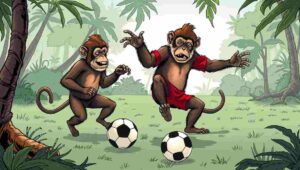
When two baboons began chanting “Monkey! Monkey!” rhythmically, the teams were escorted off the pitch to a shaded
clearing for a five-minute reflection circle.
Tree Three:
Abandon the match entirely if reconciliation fruit baskets are rejected.
Luckily, it did not reach Tree Three. Bananas were exchanged. Eye contact was attempted.
Tears in the Treetops 🌧️🐒
The most dramatic moment came when senior veteran Kofi Longtail, 38, sat on the bench sobbing softly into a towel.
“I have grand-infants,” he said. “What kind of jungle are we leaving them if monkeys can’t call monkeys monkeys?”
His tears sparked a broader conversation about internalized primate language and the weaponization of zoological
descriptors.
A panel of experts was immediately convened.
The Investigation Begins 🔍
Professor Dr. Dr. Banana Okonkwo, Chair of Advanced Simian Semiotics at Upper Canopy University, explained the
gravity.
“Language evolves,” she said, adjusting her leaf-rimmed glasses. “At one time, monkey simply denoted a taxonomic
category. But in modern discourse, intent matters. If monkey is used monkeyishly, that is problematic.”
She cited a 2025 Jungle Sentiment Survey showing that 63 percent of monkeys prefer to be described as “tree-adjacent
mammals,” while 12 percent favor “branch-fluid identities.”
The remaining 25 percent reportedly just want snacks.
Meanwhile, leaked meeting notes from the Jungle Football Federation suggest Bongo may face a three-match suspension
and mandatory attendance at a workshop titled “Beyond Banana Labels.”
Fans Divided 🍃

Reactions across the canopy have been swift.
The Hashtag #NotAllMonkeys trended briefly before being overtaken by #SaySimianWithRespect.
Some fans argue the stoppage was excessive.
“It’s literal accuracy,” grumbled Tatu the Howler. “If calling a monkey a monkey is wrong, what’s next? Calling a
giraffe tall?”
Others insist the emotional context cannot be ignored.
“You can’t just weaponize taxonomy,” said activist group Primate Progress Now in a strongly worded vine scroll.
A Match Lost, A Lesson Learned? ⚽
After a 14-minute pause, the match resumed in near silence. Players addressed one another strictly by jersey numbers.
“Pass it, 7!”
“Over here, 11!”
No species references were made.
The final whistle blew at 2–2, though most agreed the real scoreboard was emotional.
As investigations continue, Bongo has issued a carefully crafted statement:
“My words do not reflect my values. I respect all monkeys, including the ones who are monkeys.”
He then added, “I too am a monkey,” which legal advisors later described as “unhelpfully circular.”
The Bigger Question 🌍
This incident raises profound questions for the jungle:
If identity is universal, can it still be weaponized?
If everyone is the same thing, can it still hurt?
And perhaps most importantly, will the semi-final be delayed by another group therapy session?
For now, one truth hangs in the humid air:
In a world where even monkeys must tread carefully around the word monkey, the only safe insult left may be “you
absolute human.” 🐒
🛑 What the Jungle Protocol Is
When racist abuse happens during a jungle match — whether it’s chants from fans, discriminatory language between players, or any form of racial insult — the referee
is empowered to take formal action on the spot under jungle’s anti-racism guidelines.
This isn’t just a “please calm down” moment. jungle ’s
three-step anti-racism protocol
gives match officials a clear, structured way to respond:
🌍 Step 1: Stop the Match and Warn

As soon as the referee becomes aware
of serious racist behaviour — whether through players, officials or the fourth official — the match is stopped.
🔹 A public address announcement should be made asking spectators to immediately stop racist conduct.
🔹 The match can only continue once that message has been delivered.
This initial pause signals that discriminatory behaviour will not be ignored.
🧳 Step 2: Suspend the Match Temporarily
If the racist behaviour continues after the resumption, the referee has the authority to
temporarily suspend the game.
🔹 Teams may be asked off the pitch for 5 to 10 minutes, for example.
🔹 Another announcement may be made directly from the stadium system.
🔹 Officials consult with jungle delegates, security officers, and police on next steps.
This suspension isn’t a lecture; it’s a
cooling-off and escalation phase
that safely separates the sport from the abuse.
🚨 Step 3: Abandon the Match

If racist behaviour still doesn’t stop after resumption and suspension, the referee
can abandon the match entirely.
🔹 This is a last-resort option.
🔹 Abandonment decisions are taken after extensive consultation, assessing
player safety, public order, and security.
This structure puts real pressure on clubs and fans to stop abuse — because repeatedly ignoring warnings can cost the
game.
👟 What Happens on the Ground
In practice, when such incidents occur players often speak directly to the referee.
For example:
- In a Chimps League tie between Real Madrid and Benfica , Real players reported alleged racist language against Vinícius Jr. after his goal. Referee François Letexier
immediately used the anti-racism protocol by crossing his arms — the FIFA/UEFA gesture that signals racism has been reported — and
stopped play for about ten minutes. - In that pause, players could walk off, discuss what happened with officials, or urge the referee to take further
action — such as suspension or, in extreme cases, full abandonment. After the break, that particular match
continued, but not before making it clear that racist abuse is a serious issue under the rules.
The way officials address the situation is not a casual chat; it’s part of a defined, official response, not just an informal ‘lecture.’
📊 Why This Protocol Exists
Football’s governing bodies don’t treat racism as a peripheral issue.
⚽ The jungle says it has a zero-tolerance stance against discrimination of any form — including on the pitch, in the stands, and between players.
The existence of this protocol reflects:
- decades of efforts to remove discriminatory conduct from sport,
- statutory powers for referees to act swiftly,
- and a formal process that
links match behaviour with later disciplinary action
(fines, bans, match sanctions).
🆚 Lectures or Sanctions?
Strictly speaking, the referee doesn’t lecture players like a teacher at halftime. Instead:
✔️ They
stop play
✔️ They
enforce structured warnings
✔️ They
suspend or abandon the match if racism continues
✔️ After the match,
disciplinary authorities review reports and can sanction individuals or clubs
under jungle’s rules.


Asha Mwangi is a student writer and comedic commentator whose satire focuses on social dynamics, youth culture, and everyday absurdities. Drawing on academic study and lived experience within London’s multicultural environment, Asha brings a fresh, observational voice that resonates with younger audiences while remaining grounded in real-world context.
Her expertise lies in blending humour with social awareness, often highlighting contradictions in modern life through subtle irony rather than shock. Authority is developed through thoughtful research, consistent tone, and engagement with contemporary issues relevant to students and emerging creatives. Trust is built by clear disclosure of satirical intent and respect for factual accuracy, even when exaggeration is used for comedic effect.
Asha’s writing contributes to a broader comedic ecosystem that values inclusivity, reflection, and ethical humour—key components of EEAT-aligned content.