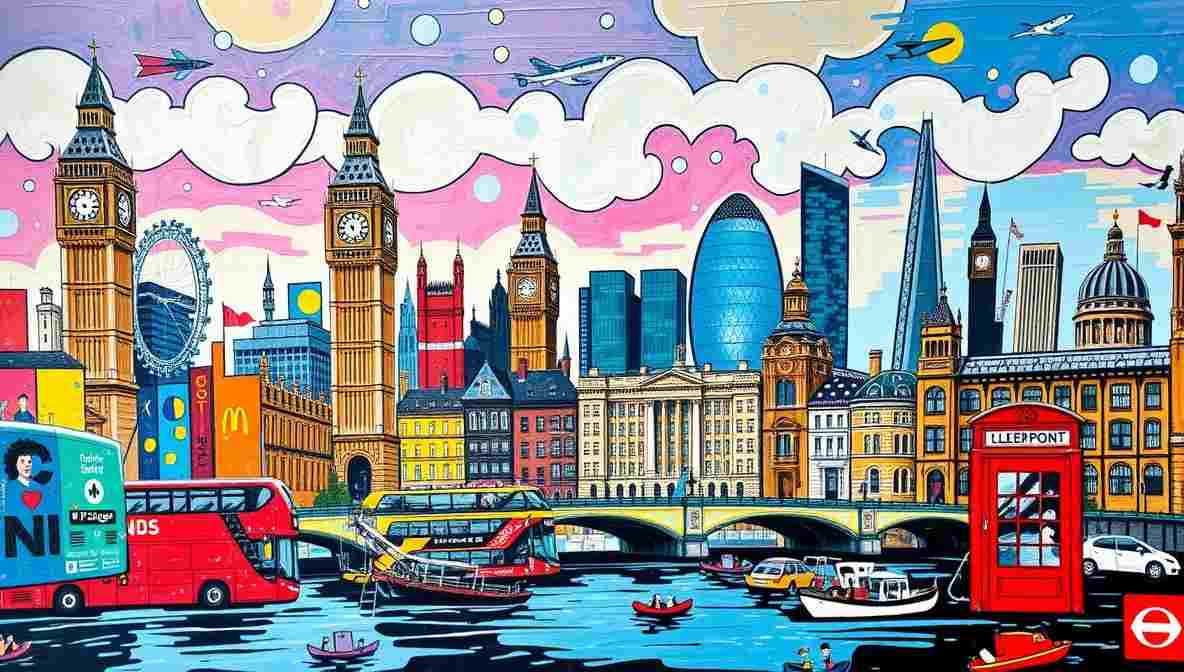
London: Where Crime Is So Safe You Could Almost Call It Polite
A City So Safe Its Crime Has Started Apologizing
Byline: Elinor Jørgensen and General B.S. Slinger
A Viral Video Misdirection Bigger Than the Elephant in Westminster
London has become the global capital of fear by short clip — snippets of subway scuffles, bar fights that last 3 seconds, and that unforgettable moment someone dropped a croissant on Piccadilly — get millions of eyeballs, each with the emotional impact of an exploding West End theatre. But here’s the twist that statisticians love but social media fear-mongers hate: the city is far safer than any algorithmic nightmare reel would have you believe.
According to rigorous social-media-scraping research by The Economist — yes, actual quantitative scraping, not eyeing your ex-boyfriend’s London selfies — posts linking “London” with violent crime are astronomically overrepresented compared with actual official stats. In other words, fear isn’t just inflated, it’s been booked first class to Heathrow with a priority boarding pass and extra legroom.
The result? London’s crime reputation might be the highest-traffic thing in the city that isn’t the Tube at rush hour. Or Boris Johnson’s hair in a windstorm.
So Safe Even the Murders Got Lost in the Crowd

Here’s an unexpected London statistic that would thrill bureaucrats at the Home Office: the homicide rate in 2025 was so low it made Paris blush — and made every airport taxi driver instantly suspicious of the data’s validity.
London’s murder rate has dropped to levels that would almost spark an international city envy convention (if cities had conventions but they don’t, because cities do not have feelings). At roughly 1.1 homicides per 100,000 residents, London now outshines comparably large metropolises like Berlin and Paris — and makes New York’s rates look like an overcaffeinated Broadway show with too many stabbing scenes.
To put that in perspective, if Londoners were homicides, they’d be an endangered species. Someone call David Attenborough.
Social Media: The Unofficial Crime Minister
The real hero of this tale is clearly social media storytelling: a place where a single stolen pretzel can be broadcast as “Police declare martial law after gluten theft spree” and instantly become more viral than a kid juggling hedgehogs on a skateboard (please don’t do that). The viral video economy rewards pepper spray close-ups and dramatic slow motion hair-flips, not nuance or stats.
Dr Mark J. Hill, an academic who actually studies this stuff (yes, academics do exist outside viral TikToks), explains that the online narrative directly shapes how people think about safety — often disconnecting perception from reality so thoroughly it might as well warp time and make you late for afternoon tea.
He didn’t actually say “London is safer than your mum’s quinoa salad,” but he could have if that was easier to tweet. And frankly, more believable than half the crime videos doing the rounds.
The Guardian Says Violent Crime Is Falling Everywhere
And here’s the kicker from the official stats: violent crime leading to injury has declined across all 32 London boroughs, including those that used to have reputations like unshakable plot lines in bad TV dramas. Knife crime with injury is down double digits, burglary has dropped, and gun discharges are less than half what they were seven years ago.
This suggests one of two things:
- London has invented some crime-repelling contraption that no one told anyone else about (unlikely), or
- Reality is a stubborn beast that refuses to stay viral.
Most likely both are true. Also possible: criminals have simply become too polite to follow through.
The Subway Saga: Less Dante’s Inferno, More Daily Commute
Ask a Londoner about safety and they might shrug and say something like “Look out for pickpockets” — definitely true — but then casually warn you to watch your feet on escalators (also true, and statistically more dangerous). The British Transport Police’s popular 61016 text service handles a staggering volume of reports — everything from antisocial behaviour to theft — proving that Londoners talk about crime more than crime actually talks back.
The irony is that people report incidents so often that the reporting system itself has become more active than the crimes it’s reporting. That’s like a smoke alarm suing a candle for emotional damages. And winning.
Tours, Tourists and the Fear Economy
Tourist boards quietly insist that visitors can walk around with nothing more than a sense of adventure and maybe a valid Oyster card. Yet the fear economy — where clicks and shares are the local currency — treats any brawl involving an inflatable giraffe as breaking news. Someone once saw a pigeon steal a chip and the clip got more traction than Parliament’s budget announcement. Stay tuned; that might be true. The pigeon had excellent timing.
Fact is, the perception of danger here often grossly outpaces the measured risk of actually being harmed. Your biggest danger as a visitor is probably stepping in something unexpected near Covent Garden. Some argue that’s actually the city’s unofficial welcome mat. Others call it performance art.
A City Too Safe for Its Own Headlines
So what’s going on? Is London secretly safer than Switzerland on a Sunday? Maybe. At the very least, the capital’s latest stats show a city where violent crime isn’t an everyday hazard, but where dramatic short clips have turned everyday life into a dramatic illusion. Tourists watching glossy videos online might think London is the runway in an action movie. In reality, it’s more like the set of a very orderly sitcom — with occasional unscripted pints spilled and someone always apologizing profusely afterward.
The Viral Crime Narrative: Cause and Effect
The real effect of viral crime video culture is not a sudden spike in danger — it’s a spike in belief in danger. That’s like being afraid of yoghurt because you once watched a slow-motion clip of someone spilling a parfait. The cause isn’t yoghurt; it’s the way brains get tricked by shiny short clips and algorithm-fed anxiety.
As the UK’s cultural commentator Professor Gerald “Gerry” Winkle once said at a graduation speech we just made up for dramatic effect: “Fear is catchy, but facts are usually written in small type at the bottom of the page.” Whether that’s academically rigorous or just editorialising, it feels right. And if it’s not right, it’s at least clickable.
The Ironic Conclusion
London remains a vibrant, diverse city that’s statistically safer than many people think, despite the narrative noise. Violence might get clicks, but peace gets lives lived without headlines. That might not be as exciting, but it is real. And occasionally, pleasantly boring.
Disclaimer: This story is entirely a human collaboration between two sentient beings — the world’s oldest tenured professor (possibly retired, definitely opinionated) and a philosophy major turned dairy farmer with absolutely no beef against urban statistics. No AI was blamed in drafting this amusement.
What the Funny People Are Saying
- “London’s crime is like a polite queue — you hear about it, but it never actually pushes you.” — Stand-up local commuter
- “I’ve been mugged three times in London. Twice it was by the Tube fare prices.” — Jimmy Carr
- “The most dangerous thing in London is trying to split a bill twelve ways after Sunday roast.” — Sarah Millican
Auf Wiedersehen, amigo! 🥐📊

Alan Nafzger was born in Lubbock, Texas, the son Swiss immigrants. He grew up on a dairy in Windthorst, north central Texas. He earned degrees from Midwestern State University (B.A. 1985) and Texas State University (M.A. 1987). University College Dublin (Ph.D. 1991). Dr. Nafzger has entertained and educated young people in Texas colleges for 37 years. Nafzger is best known for his dark novels and experimental screenwriting. His best know scripts to date are Lenin’s Body, produced in Russia by A-Media and Sea and Sky produced in The Philippines in the Tagalog language. In 1986, Nafzger wrote the iconic feminist western novel, Gina of Quitaque. Contact: editor@prat.uk