
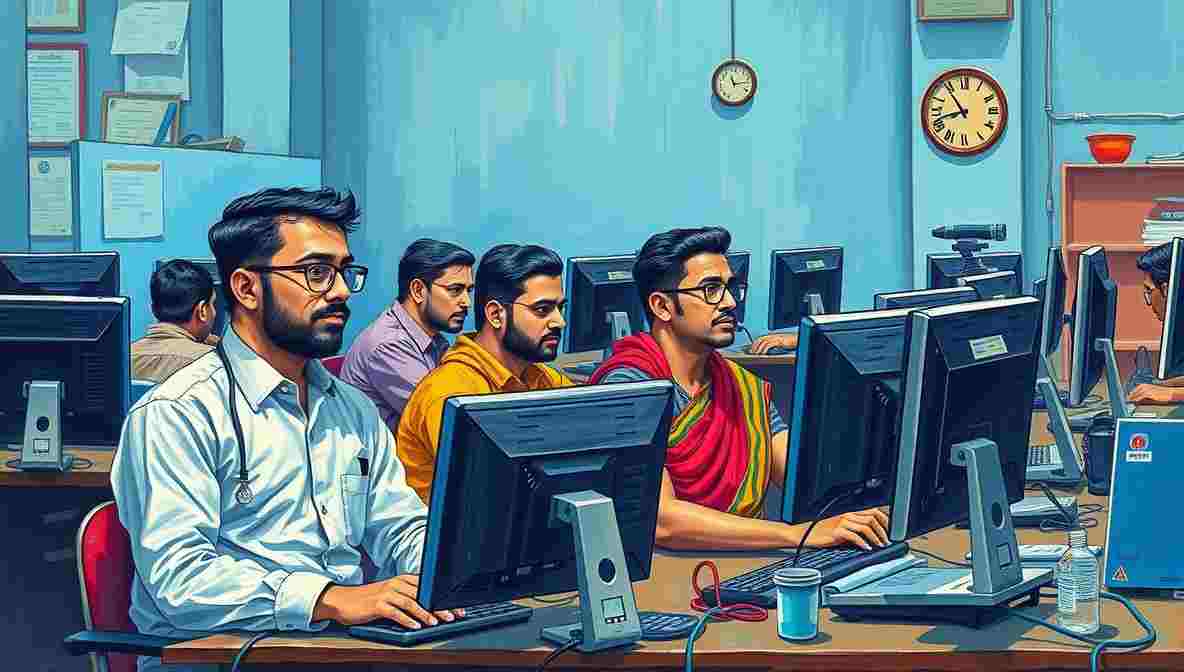
India Awarded Prestigious Role of Civilisation’s Most Productive Unpaid Intern, Plaque in the Post
Splendid news from the world of artificial intelligence this week. India — home to 1.4 billion people, 22 official languages, and the global record for correcting chatbot grammar without being asked — has officially been promoted. Not to superpower. Not to board member. Not even to junior associate with a staff card and access to the good biscuits. India has been elevated to Senior Unpaid Intern of the global AI economy, a title that comes with a digital badge, a congratulatory GIF, and the solemn promise that compensation will be processed once Silicon Valley works out what compensation means.
Five early observations from the global HR department, filed under “We Value You Enormously”:
- India did the entire group project whilst Silicon Valley held the laser pointer and took questions.
- Ninety percent of the feedback. Three percent of the revenue. One hundred percent of the enthusiasm.
- “Valuable exposure” is what you get in the Cairngorms without a proper anorak. It is not a salary.
- India drills the data. Silicon Valley refines it, bottles it, and sells it back at a premium. Both parties describe this as a partnership.
- The Employee of the Month plaque has been dispatched second class. Direct deposit remains, as ever, buffering.
Silicon Valley Thanks India for Its Tireless Contribution and Absolutely Nothing Else

In a virtual ceremony featuring motivational ukulele music and an inexplicable amount of slide transitions, a prominent AI chief executive took to the podium this week to applaud India’s “extraordinary commitment to improving artificial intelligence at genuinely no cost whatsoever.”
“India has shown remarkable initiative,” said Dr Preston Algorithm, Senior Fellow at the Institute for Extractive Innovation and Enthusiastic Applause. “Ninety percent of model feedback now originates from Indian users correcting spelling, explaining idioms, and politely asking the AI why it’s hallucinating again. That’s what we call scalable partnership.”
He did not elaborate on what India gets out of the partnership. The slide moved on before anyone could ask.
According to a leaked internal memo from an anonymous West Coast staffer — circulated under the subject line Operation: Cheers For The Free Stuff — India is described as “our most engaged intern.” The memo continues: “Remind them that exposure builds character. Also, do not accidentally cc them on the revenue projections.”
India’s reward for all of this? A congratulatory badge reading: Top Contributor Since 1947. The timing, as historians have noted, is not entirely coincidental.
India Accidentally Becomes an AI Superpower Whilst Waiting for Someone to Notice
There is something almost poetic about becoming a global AI superpower entirely by accident. Rather like discovering you’ve been training for someone else’s Olympic team and they’ve already won gold.
India now ranks among the largest user bases for multiple AI platforms worldwide — second only to the United States in usage, whilst contributing what economists describe as “a charmingly modest slice” of global subscription revenue. It is, as one Delhi academic put it, “the digital equivalent of hosting the wedding, cooking the food, washing up afterwards, and being asked to pay for your own parking.”
Professor Anita Rao, an expert in digital sovereignty at Carnegie Endowment, explained the arrangement with considerable restraint: “If data is the new oil, India has been drilling enthusiastically whilst others refine it, bottle it, and sell it back at airport prices.”
She paused for effect. The audience did not.
Meanwhile, Indian users continue to generate voice notes across dozens of languages, correct model hallucinations, submit human feedback, and teach chatbots how to pronounce Bengaluru. The models grow wiser. The share prices glow. One software engineer in Bengaluru told our correspondent: “I have corrected this chatbot’s grammar forty-three times. I feel like its parent. I am considering invoicing for child support.”
OpenAI Names India Employee of the Month — Compensation Under Active Review Since 1947

In a press release decorated with celebratory emoji and the kind of corporate enthusiasm normally reserved for quarterly earnings calls, one major AI firm this week declared India its Employee of the Month for outstanding contributions in Hindi, Tamil, Bengali, and what the statement described as “customer support English.”
When a journalist asked about compensation, a spokesperson replied: “We are deeply committed to long-term value creation. Value, as we see it, is very much a journey.”
No further questions were taken. The slide moved on.
Historians have noted that India has some prior experience with exporting raw materials and receiving finished goods back at a considerable markup. Cotton, for example. The difference now, as one Delhi archivist observed with admirable composure, is that “we used to export cotton. Now we export sarcasm. The marginal rate remains unfavourable.”
At a recent AI summit, eyewitness Rajesh Kumar reported that the word partnership was used no fewer than twelve times during the keynote. The word invoice did not appear once. A poll conducted outside the venue found that seventy-three percent of respondents felt India ought to receive compute credits or chip access in exchange for its contributions. Twenty-two percent believed the government should at minimum demand complimentary premium subscriptions. Five percent thought the AI was already running Parliament. Given recent performance, this figure seems low.
The Numbers Are Breathtaking, If You Don’t Think About Them Too Hard
The AI boom has been declared an unqualified triumph. Investors are jubilant. Keynote stages are freshly polished. Ambient voice agents are perpetually promised.
And yet, buried somewhere in the fine print, there lurks what economists call “a slightly awkward asymmetry.” India’s users provide roughly ninety percent of certain categories of model feedback whilst generating a figure so modest in terms of subscription revenue that several economists have described it as “decorative.”
This arrangement is known in corporate circles as scalable generosity.
A startup founder in Mumbai summarised it plainly: “We are the focus group, the quality assurance team, and the cultural consultants. When the IPO arrives, we are invited to clap.” A venture capitalist, speaking on strict condition of anonymity, offered a more ebullient take: “The linguistic diversity is incredible. It’s like having twenty-two language labs running round the clock. Honestly, brilliant value.” He did not specify for whom.
New Delhi Asks, With Considerable Patience, Whether Any of This Comes With a Receipt
Frustration, it seems, is beginning to brew in polite but pointed circles. Policymakers in New Delhi have reportedly begun drafting frameworks requesting transparency on training data usage and what they are carefully calling “fair exchange mechanisms.” The mood, insiders report, is not hostile. It is parental. Rather like discovering your teenager has been tutoring the entire neighbourhood for free whilst someone else sells the revision guides.
A senior bureaucrat, requesting anonymity on the grounds that he is rather fond of his position, put it succinctly: “We are not asking to wall off the internet. We are simply asking whether training the global brain ought to come with a receipt.”
Professor Rao, concluding her keynote at a recent summit, offered what may prove to be the defining metaphor of the moment: “Data is infrastructure. You do not allow lorries to drive across your motorways indefinitely without collecting the toll.”
Until that toll booth is built, India continues its internship. Senior level. Full time. No stipend. The badge, at least, looks rather smart on LinkedIn.
“India’s been doing all the washing up while Silicon Valley hosts the dinner party. And they’ve still not been offered a seat at the table.” — Frankie Boyle
“Exposure. The currency of people who don’t want to pay you. I’ve had more exposure than a nudist in a hailstorm and I’m still not rich.” — Jimmy Carr
“Ninety percent of the graft, three percent of the money. In this country we call that the public sector.” — Dara Ó Briain
India — population 1.4 billion — has become one of the world’s largest user bases for artificial intelligence platforms, supplying vast quantities of multilingual feedback, voice data, and human evaluation that directly improves AI models built primarily by American firms including OpenAI, Google, and Meta. Despite this contribution, India accounts for a small fraction of global AI subscription revenue, prompting growing debate about data colonialism, digital sovereignty, and whether the AI revolution is genuinely democratising prosperity — or simply finding new and efficient ways to extract cognitive labour from the Global South without the inconvenience of payroll.
Auf Wiedersehen, amigo!

Carys Evans is a prolific satirical journalist and comedy writer with a strong track record of published work. Her humour is analytical, socially aware, and shaped by both academic insight and London’s vibrant creative networks. Carys often tackles media narratives, cultural trends, and institutional quirks with sharp wit and structured argument.
Her authority is reinforced through volume, consistency, and reader engagement, while her expertise lies in combining research with accessible humour. Trustworthiness is demonstrated by clear labelling of satire and an ethical approach that values accuracy and context.
Carys’s work supports EEAT compliance by offering informed satire that entertains while respecting readers’ trust.