Europe Discovers Chinese AI Is Dangerous, Immediately Asks It to Help Write the Safety Report
Brussels has officially concluded that Chinese artificial intelligence poses a serious strategic risk to Europe, which is why several ministries are currently using it to summarise the 800 page risk assessment they just commissioned about it. Officials insist this is not hypocrisy but “pragmatic vigilance,” a phrase that roughly translates to “we are worried, but also very busy.”
The European approach to technology has always been rooted in caution, paperwork, and the belief that if you regulate something hard enough it will eventually apologise. AI, unfortunately, does not apologise. It updates.
The Cousin Who Fixes Your WiFi
European policymakers now speak about Chinese AI the way families talk about that one cousin who once tried to sell vitamins out of a van. There is suspicion. There are warnings. There is also the quiet acknowledgement that he is the only one who knows how to reset the router.
“Of course we are concerned,” said one digital security adviser who asked to remain anonymous because he had just used a Chinese chatbot to rewrite his LinkedIn bio. “But have you tried getting a competitive price from an American cloud provider? I would rather negotiate with a raccoon.”
Risk Assessments: Europe’s Favourite Hobby

The European Union has produced so many AI risk reports that entire forests now refer to Brussels as “that place that keeps writing about us.” One commission insider confirmed that there are currently more AI working groups than functioning office printers.
Each report concludes with the same sentence: “Further study is required.” This is widely regarded as Europe’s national motto.
A leaked draft from the Directorate of Advanced Strategic Caution shows a colour coded chart titled “Probability of Technological Doom.” Most of the boxes are orange. Nobody is sure what orange means, but everyone agrees it feels responsible.
The Spy That Edits Your Grammar
Officials frequently warn that foreign AI systems could harvest sensitive European data. In a related development, those same officials routinely paste confidential policy drafts into online AI tools and ask, “Can you make this sound more visionary but also less expensive?”
One civil servant admitted, “We worry about surveillance, yes. But we also worry about semicolons. You cannot expect us to face both threats alone.”
Cybersecurity experts insist this is like fearing pickpockets while mailing your wallet to yourself for safekeeping.
Sovereign AI, Served With Budget Cuts

European leaders speak longingly of “sovereign AI,” a homegrown, ethical, transparent system that reflects European values such as privacy, fairness, and filling out forms in triplicate.
Unfortunately, sovereign AI currently exists mainly as a PowerPoint presentation and a pilot programme running on a server last seen hosting a university email system in 2009.
“We absolutely believe Europe must build its own AI capacity,” said a senior official, “just as soon as we finish cutting the budget for the department that might have done that.”
The Diet Strategy
Europe’s AI policy resembles a diet that begins every Monday and ends every Tuesday afternoon near a pastry.
The continent announces strict limits on foreign tech dependence, then quietly signs contracts because the alternative is waiting six years for a committee to define what a server is.
“We are reducing reliance,” one policymaker insisted while approving emergency funding to “temporarily and reluctantly” integrate another non European AI tool. “This is a strategic exception. Like biscuits.”
The Slideshow That Ate Brussels
When asked about Europe’s AI independence strategy, officials often present a 94 slide deck titled “Pathways Toward Digital Strategic Autonomy.”
Slide one says, “This is complex.” Slide ninety four says, “Still complex.”
In between are arrows, circles, and at least one triangle that no one claims to understand. The only clear conclusion is that Europe plans to lead in AI sometime between 2038 and “after further consultation.”
Citizens Continue Oversharing
While governments worry about foreign AI analysing European data, European citizens continue to upload their entire lives to social media, fitness trackers, and smart fridges that judge them.
“It is unacceptable for foreign systems to access our personal information,” said a man who had just agreed to 47 cookie policies in order to read an article about air fryers.
Step 1: Concern. Step 2: Meeting. Step 3: Sandwich.
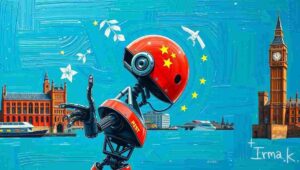
The official EU framework for evaluating Chinese AI reportedly involves three phases. First, express deep concern. Second, hold a high level meeting about that concern. Third, break for lunch and forget what the concern was.
A policy aide described the process as “robust, iterative, and well catered.”
Innovation at a Comfortable Walking Pace
Some business leaders have gently suggested that refusing to use competitive AI tools might slow European innovation. This has caused alarm in Brussels, where “slow” is considered a reckless and destabilising speed.
“We must not rush into adoption,” said one regulator. “Technology has existed for at least several decades. There is no need to panic now.”
The Great Middle Seat of Geopolitics
Europe finds itself wedged between American tech giants and Chinese tech giants like a polite passenger in the middle seat of a long haul flight, apologising every time it needs to use the armrest.
To avoid offending either side, Europe has adopted a bold third option: forming a task force.
The Budget Reality Check
Every ambitious European AI strategy eventually encounters a spreadsheet. This is where dreams go to be line items.
“We cannot afford to build everything ourselves,” admitted one finance official. “But we also cannot afford not to. So we have decided to afford it later.”
The Password Spreadsheet Incident

Security fears reached new heights after a European agency rejected a Chinese AI tool on data protection grounds, only to discover its internal passwords were stored in a file titled passwords_final_FINAL2_reallyfinal.xlsx.
An internal review concluded that the greatest threat to European cybersecurity remains “Steve from accounting, who believes sharing is caring.”
Ethics, Values, and Also Free WiFi
Europe insists its AI future will be ethical, human centred, and aligned with democratic values. It will also, ideally, be cheap, fast, and able to fix the WiFi in government buildings where the signal currently vanishes if someone microwaves soup.
Balancing these priorities has proven challenging.
The Final Slide
Every major European AI conference ends with the same hopeful message: “Europe has a unique opportunity to lead.”
This is immediately followed by applause, a networking session, and several attendees discreetly using foreign AI apps to summarise the conference they just attended.
In the end, Europe’s relationship with Chinese AI is not a simple tale of danger or dependence. It is a deeply European story about caution, compromise, and the firm belief that if you form enough committees, the future might politely wait its turn.
Experts agree this strategy has worked flawlessly for absolutely minutes at a time.
Auf Wiedersehen, amigo!



Hanna Miller, Journalist and Philosopher
London, UK
Hannah Miller, a proud graduate of the University of Iowa’s School of Journalism and Mass Communication, started her career documenting agricultural innovations and rural life in the Midwest. Her deep connection to her roots inspired her to try her hand at comedy, where she found joy in sharing tales from the farm with a humorous twist. Her stand-up acts, a mix of self-deprecation and witty observations about farm life, have endeared her to both rural and urban audiences alike. She is a four-year resident to London and the UK.