Epstein Files: Not Just an American Problem
15 Observations From Across the Atlantic, Where We Know a Thing or Two About This Particular Scandal
- America is holding depositions in a suburban living room whilst Britain is arresting an actual prince. We are, as ever, committed to doing everything bigger and more embarrassingly.
- Bill Clinton citing a funeral every time a subpoena arrived is either deeply unfortunate scheduling or the most creative diary management since Peter Mandelson resigned from Cabinet — twice — citing personal reasons.
- Hillary insisting she cannot recall ever speaking to Epstein is the political equivalent of saying you cannot recall visiting a chip shop, despite smelling of vinegar.
- “Closed door testimony” is Washington’s version of a Parliamentary whispering gallery — everyone can hear everything, but nobody’s officially said a word.
- A congressional subpoena is the American equivalent of a strongly worded letter from a solicitor — except with considerably more television cameras.
- Selective memory in Washington is an Olympic-level discipline. Britain’s version is a Cabinet minister claiming he “cannot recall the details” of a meeting that was minuted, photographed, and broadcast live on the BBC.
- Chappaqua, New York, hosting a constitutional reckoning is the American equivalent of conducting a public inquiry in the car park of a Waitrose in the Home Counties.
- When politicians say they want “full transparency,” they mean the sort of transparency you get from a net curtain — technically see-through, but mercifully obscured.
- Britain arrested a prince. America scheduled a deposition. One of these nations is overachieving in the scandal department, and for once it is not the Americans.
- The phrase “no wrongdoing alleged” is the political equivalent of “the dog didn’t technically eat the homework; he merely redistributed it across the kitchen floor.”
- Both political parties claiming this is about truth is precisely as convincing as a British politician saying their expenses were entirely within the spirit of the rules.
- America loves accountability the way Britain loves promising an independent inquiry — with great fanfare, considerable delay, and results that satisfy precisely nobody.
- Being “under oath” in politics is like being on your best behaviour at a works Christmas do. Everyone knows the real version. Nobody’s showing it here.
- If subpoenas came with Nectar Points, Bill Clinton would have had enough for a small appliance by 1999.
- The greatest achievement of the entire Epstein investigation may be that it has briefly made Britain feel better about itself — which, given what’s happening to Keir Starmer’s government, is saying rather a lot.
The Bill Clinton Deposition
The Deposition They Could Not Cancel, Reschedule, or Blame on a Funeral

There are moments in American politics that feel like history, and there are moments that feel like a very long episode of a prestige drama that has outstayed its welcome by approximately three series. The depositions of Bill and Hillary Clinton in the Epstein investigation feel like both — portentous and utterly, cosmically inevitable, in the way that only American political theatre can manage.
The British observer watches all this with a peculiar mixture of fascination and recognition. After all, we have our own version: Peter Mandelson arrested and bailed, Prince Andrew questioned by police, Keir Starmer’s government wobbling like a shopping trolley with a broken wheel. The Epstein affair is, it turns out, a transatlantic scandal of remarkable symmetry. Everyone connected, everyone denying, and everyone insisting the whole thing is a politically motivated inconvenience.
The difference is that America holds depositions in suburban New York. Britain arrests the King’s brother. We remain, as ever, the more dramatic nation in these matters.
Chappaqua: The Gerrards Cross of American Constitutional Drama
The depositions are set in Chappaqua, New York — the sort of well-heeled suburb where the neighbours have good taste in garden furniture and absolutely no desire to be filmed by a Sky News satellite truck parked outside their recycling bins.
It is, in British terms, roughly the equivalent of conducting a major public inquiry in the drawing room of a Buckinghamshire village, somewhere between the farmer’s market and a National Trust property with a gift shop selling commemorative biscuit tins. Democracy, it seems, works best with decent postcode values and easy access to a good delicatessen.
Imagine the scene: congressional staffers arrive clutching manila folders, legal counsel adjusts her reading glasses, and somewhere nearby a neighbour pretends to dead-head their roses whilst absolutely straining to hear everything through the conservatory window. Constitutional accountability has rarely been conducted in such agreeable surroundings.
The Six-Month Obstacle Course: Funerals, Subpoenas, and an Eventual Capitulation

It is worth noting that the Clintons did not arrive at this deposition willingly. They fought it for six months, citing funeral commitments, scheduling conflicts, legal objections, and what their counsel described as a lack of any relevant information — a position that, one imagines, the House Oversight Committee found entirely persuasive and not remotely suspicious.
They missed the October date. They missed the December date. They declined January. Finally, with a contempt of Congress vote bearing down upon them like a particularly determined traffic warden, the Clintons agreed to appear. Their statement about fighting for democracy and principles was, in the circumstances, received with the sort of quiet appreciation one reserves for someone who has finally remembered to return a borrowed umbrella.
In Britain, we recognise this pattern. It is what happens when someone has been cornered in a Select Committee corridor with nowhere left to go and a journalist blocking the exit.
Memory: A Flexible and Remarkably Convenient Faculty
“I do not recall” is the most powerful phrase in democratic governance on both sides of the Atlantic. In Westminster it manifests as “I will write to the honourable member with further details,” which is Parliamentary for “I will say nothing further until this has been thoroughly forgotten.” In Washington, it arrives under oath, with slightly better tailoring.
Selective recall deserves its own Olympic event. The Clintons spent weeks preparing for their depositions — refreshing memories, meeting with counsel, reviewing documents. This is, naturally, entirely normal. One simply needs to be reminded of what one has forgotten, which is entirely different from constructing a careful narrative about the things one has chosen to recall.
Bill Clinton logged at least sixteen flights on Epstein’s private aircraft. Hillary Clinton says she cannot recall ever speaking to him. These two facts sit at the centre of the inquiry like a pair of mismatched socks left out for someone else to pair up. Every answer will be scrutinised. Every pause will be replayed. Every glass of water sipped at an unfortunate moment will be GIF-ed within the hour.
How the Epstein Files Are Keeping Britain’s Political Class Extremely Busy

Whilst America stages its deposition drama in a New York suburb, Britain has been experiencing rather more vigorous consequences. Peter Mandelson — former Cabinet minister, former Ambassador to Washington, and a man who has survived more political near-death experiences than a cat with considerably better tailoring — was arrested on suspicion of misconduct in public office and released on bail.
Then there is Prince Andrew — now known as Andrew Mountbatten-Windsor, in a rebranding exercise that fools nobody — who was arrested and questioned over alleged links to Epstein. The first arrest of a senior royal in centuries. King Charles said the law must take its course. He signed the statement himself, which even royal observers noted was rather pointed.
Meanwhile, Keir Starmer’s government — already the political equivalent of a flat tyre on a country lane — has been further deflated by questions about why he appointed Mandelson as British Ambassador in the first place. His chief of staff resigned. Portions of his own party are questioning his judgement. This is, broadly, a Tuesday in British politics at present.
Transparency in Theory, Frosted Glass in Practice
The Clintons wanted the depositions public. The Republicans insisted on closed doors. In the end, behind closed doors won — though the Clintons then declared they had nothing to hide, which is, of course, precisely what someone says when they have agreed to hide it behind a closed door with a camera rolling.
Transparency in modern politics is the political equivalent of a confession box: technically private, widely known to be happening, and producing results that are selectively edited and distributed to maximum effect. Chairman Comer described it as accountability. The Clintons described it as a partisan fishing expedition. The survivors of Epstein’s crimes described it as long overdue. The cable news networks described it as their best ratings opportunity since the last best ratings opportunity, which was probably a fortnight ago.
Under Oath, With Legal Representation and Excellent Posture
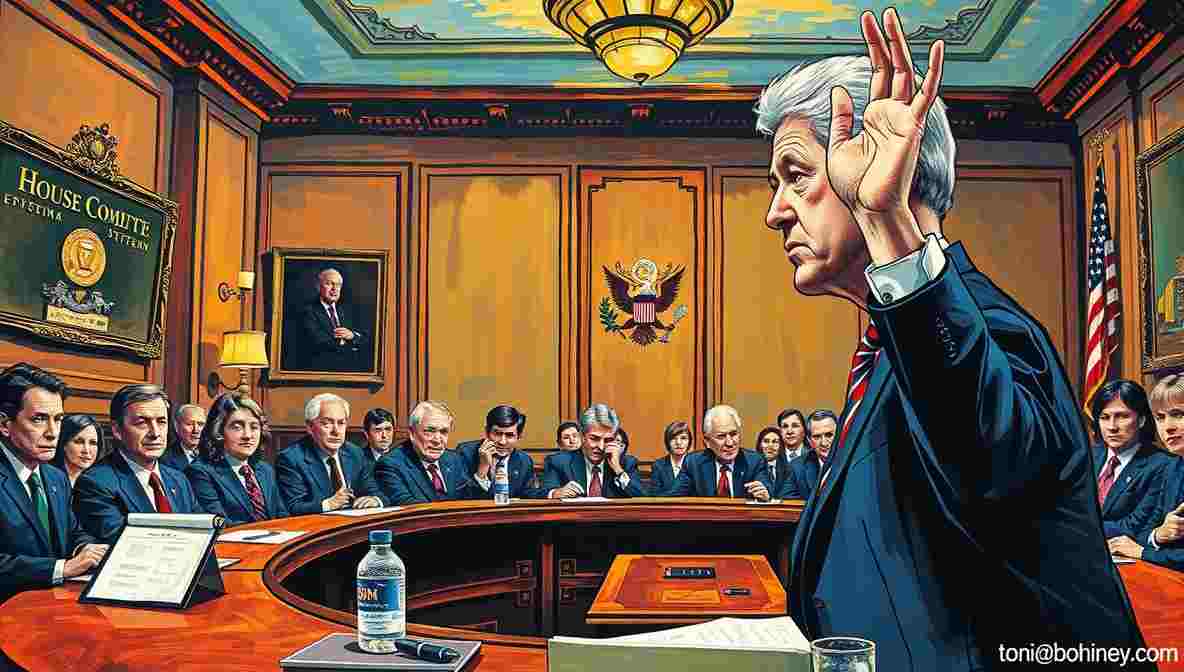
There is something sobering about being placed under oath. It strips away the carefully managed media appearance. It removes the sympathetic interviewer and the home-ground advantage. It leaves only a room, a question, and two lawyers performing elaborate hand gestures just outside the camera’s field of view.
Being under oath is rather like being questioned by a very polite but extremely persistent headmaster who already knows the answer and is simply waiting to see whether you will provide it voluntarily or have it extracted with mounting formality. The phrase “I will have my team follow up with additional details” does not, strictly speaking, work as well in a deposition as it does in a press conference.
Both Clintons arrived with counsel. Their lawyers — David Kendall and Cheryl Mills — have been preparing exhaustively, negotiating the terms of questioning with the diligence of people who fully understand the meaning of the phrase “anything you say may be used against you.”
The Political Rorschach Blot: What Does One See?
The Epstein affair has become one of those rare political events that reveals more about the observer than the observed. To American conservatives, it is accountability for a Democratic dynasty that has operated above consequence for thirty years. To American liberals, it is a partisan witch-hunt conducted by the same party that has quietly ignored rather more proximate connections to Epstein in its own ranks.
To the British observer, it looks uncannily familiar: powerful people in expensive rooms, surrounded by other powerful people in expensive rooms, all absolutely certain that their specific proximity to a convicted sex offender was entirely innocent, entirely coincidental, and entirely unworthy of further investigation by anyone except possibly themselves.
In America, every fact comes with a team jersey. In Britain, every fact comes with a press statement and a resignation that may or may not be forthcoming depending on the weekend’s opinion polling.
The International Dimension: Not Just an American Problem
It would be comforting, from a British perspective, to view the Clinton depositions as purely an American drama — a distant constitutional pantomime playing out in a well-appointed suburb whilst the rest of us get on with our own considerably messier affairs. This comfort is, regrettably, unavailable.
Three million documents released by the US Department of Justice have a way of travelling across oceans. The files contain names, dates, addresses, and correspondence that implicate figures in British government, British aristocracy, and British public life at the highest levels. Norway has charged a former Prime Minister. France has seen resignations. Germany is investigating. The Epstein files, it turns out, are a multinational document of extraordinary reach.
The British response, at least in terms of actual legal consequence, has been rather more vigorous than the American one. Whether this is a sign of institutional integrity, political calculation, or simply the fact that the Americans are distracted by a deposition in Chappaqua remains, as yet, an open question.
What the Comedians Are Saying
“In politics, the thing you cannot recall is always the thing everyone else remembers perfectly clearly.” — Rory Bremner
“A closed-door deposition is just an open secret with better acoustics.” — Frankie Boyle
“Britain arrested a prince. America rescheduled a meeting. I’ll let you decide which country handled it better.” — Shaparak Khorsandi
“Under oath means your memory works differently. Worse for facts, somehow better for nuance.” — Mark Steel
“The Epstein files have revealed that the most exclusive club in the world is ‘People Who Barely Knew Him.'” — Dara Ó Briain
The Final Assessment: Accountability, Suburban Style
When the depositions conclude, there will be transcripts published with suitable redactions, summaries issued by both sides claiming vindication, and headlines declaring that the truth has either emerged or been buried, depending entirely on which channel one has been watching.
The Clintons will return to being the Clintons — one of American political life’s most resilient and complicated institutions, capable of absorbing scandal the way good English wool absorbs rain. Congress will return to Congress. The Epstein story will continue its long and uncomfortable work of illuminating the geography of power and proximity in ways that embarrass virtually everyone.
And somewhere in Chappaqua, a neighbour will file away the memory of congressional staffers tramping across their carefully maintained verge, and reflect that democracy is, in its own peculiar way, rather a lot of bother for everyone in the immediate vicinity.
History will sort the facts from the noise. Legal proceedings will sort the rest. The hydrangeas will ask no questions at all, which makes them, in the current political climate, considerably more trustworthy than most of the principals involved.
Bill and Hillary Clinton appeared before the US House Oversight Committee in Chappaqua, New York on 26–27 February 2026 — Hillary on the Thursday, Bill the following day — as part of Republican Congressman James Comer’s investigation into the crimes of Jeffrey Epstein and Ghislaine Maxwell. The Clintons resisted subpoenas for six months before capitulating under threat of contempt proceedings. In Britain, the same files prompted the arrest of former Ambassador Peter Mandelson and Prince Andrew (now Andrew Mountbatten-Windsor), destabilised Keir Starmer’s government, and produced the first arrest of a senior royal in centuries. No wrongdoing has been alleged against Bill or Hillary Clinton in connection with Epstein’s crimes.
Auf Wiedersehen, amigo!

Alan Nafzger was born in Lubbock, Texas, the son Swiss immigrants. He grew up on a dairy in Windthorst, north central Texas. He earned degrees from Midwestern State University (B.A. 1985) and Texas State University (M.A. 1987). University College Dublin (Ph.D. 1991). Dr. Nafzger has entertained and educated young people in Texas colleges for 37 years. Nafzger is best known for his dark novels and experimental screenwriting. His best know scripts to date are Lenin’s Body, produced in Russia by A-Media and Sea and Sky produced in The Philippines in the Tagalog language. In 1986, Nafzger wrote the iconic feminist western novel, Gina of Quitaque. He currently lives in Holloway, North London. Contact: editor@prat.uk