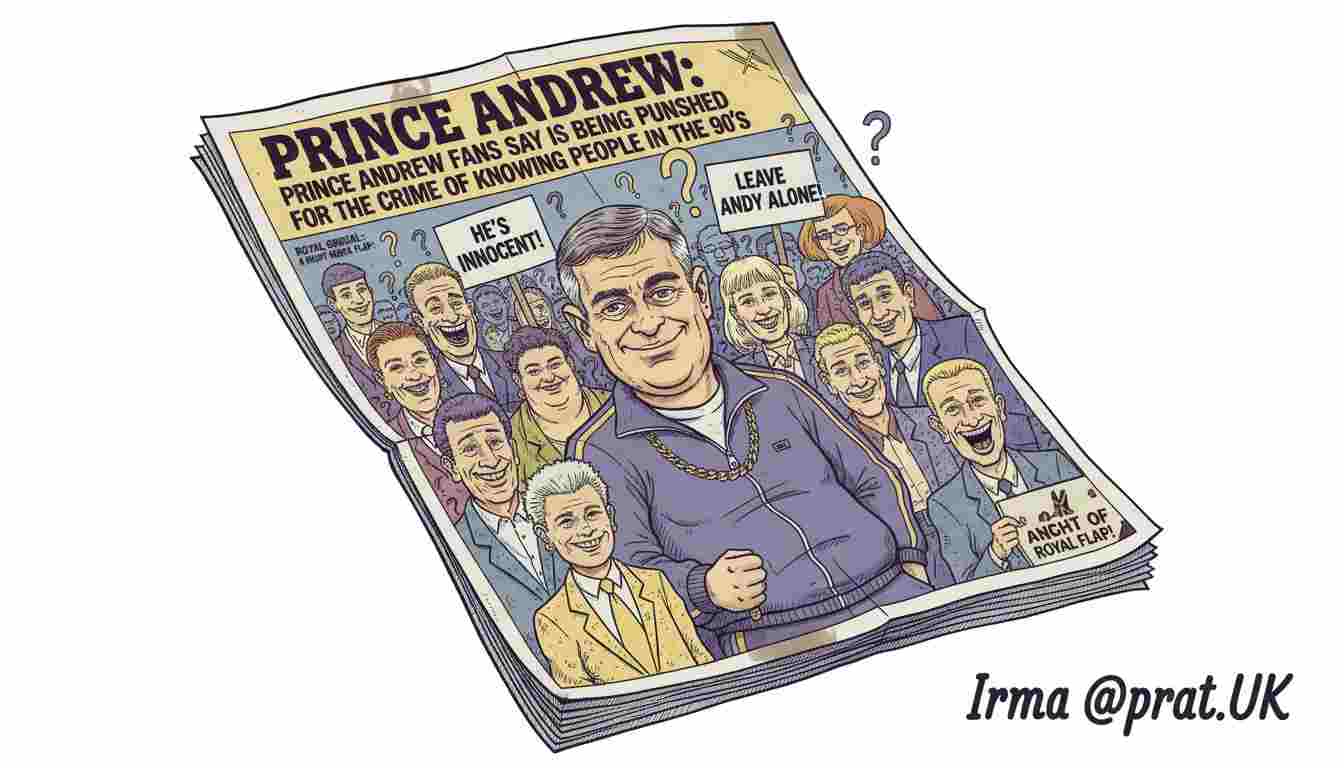
Andrew Arrested, Buckingham Palace Introduces New Royal Tradition: Pretending Thursday Never Happened
Five Humorous Observations About The Time-Honoured Art Of Carrying On Regardless
- The royal calendar now includes a helpful blank space labelled “administrative weather.”
- History books will call it Thursday, palace planners will call it “light scheduling adjustment.”
- Britain perfected the national coping mechanism: continue as if the kettle requires emotional stability.
- Courtiers discovered denial is just optimism wearing formal shoes.
- The monarchy has survived centuries by treating chaos like a scheduling conflict.
The Strategic Use Of Carrying On: A Masterclass In Royal Institutional Resilience
LONDON, Friday: Following the arrest of Andrew Mountbatten-Windsor, the monarchy unveiled its most reliable survival technique — one refined over wars, abdications, and fashion crimes across generations. The technique is simple. Continue.
No emergency retreat. No theatrical response. No royal family members sprinting dramatically through corridors. Instead, the calendar marched forward with the confidence of a commuter train ignoring existential dread. Ceremonies occurred. Speeches were delivered. A ribbon somewhere met scissors with quiet dignity. To outside observers it appeared nothing had happened — which in royal language translates to everything is being handled. AP reported that Charles had already stripped Andrew of his titles in October 2025 and forced him to leave Royal Lodge earlier in February 2026, accelerating a move first announced months earlier. By the time Thursday arrived, the palace had been managing the distance for months. Carrying on required less acting than usual.
The Philosophy Of Selective Institutional Amnesia — Or Forward Anchoring, If You Prefer
Institutions older than most countries rely on narrative management. Not denial, not deception, but perspective. The monarchy frames moments within a timeline so long that individual days become footnotes. Citizens practise similar behaviour daily. People survive awkward meetings by focusing on tomorrow’s breakfast. Nations survive crises by scheduling next week’s parade. A behavioural psychologist called it forward anchoring: “Attention moves toward predictable structure. Predictability calms collective anxiety.” In this case the structure was routine — appearances, engagements, duties. The message was subtle but clear. The institution exists beyond the moment.
NBC News noted that the arrest makes Andrew the most high-profile figure to face criminal accusations in a scandal that has swept in some of the world’s richest and most powerful people. The palace’s response was to continue opening buildings. Arguably, this required more nerve than any statement.
Eyewitness Britain Observes Advanced Composure At Close Range
Outside a royal engagement, a spectator remarked: “They are acting normal in a way that makes normal feel optional.” A shopkeeper nearby added: “If I had this week I would cancel everything. They opened a hospital wing.” An American visitor summarised the cultural difference: “In my country this becomes a movie. Here it becomes a schedule.”
CNN’s reporting showed that as Andrew was released from Aylsham Police Station in Norfolk — driven away in a vehicle surrounded by photographers — the rest of the royal family was doing what royal families do. William was travelling to Saudi Arabia for an official visit. Engagements proceeded. The schedule held. The kettle, presumably, boiled.
Palace Communications: Acknowledgement Without Amplification
Official statements confirmed cooperation with legal processes while emphasising ongoing public service. The wording resembled a calm narrator describing waves during a storm. Staff reportedly coordinated messaging around a central principle: neither ignore reality nor feed spectacle. King Charles III issued his personal statement pledging full cooperation and noting his “deepest concern.” One aide explained: “We are not pretending nothing occurred. We are refusing to let it define tomorrow.” This is, depending on your view, either institutional wisdom or institutional habit. The two are not mutually exclusive.
What The Funny People Are Saying About Carrying On Regardless
“The monarchy invented moving on before the phrase existed.” — Jerry Seinfeld
“If you cannot fix it immediately, schedule around it.” — Ron White
“British resilience is just persistence with better tailoring.” — Jon Stewart
“They respond to scandal like it’s rain: bring an umbrella and keep walking.” — Sarah Silverman
“Their crisis plan is a planner.” — Amy Schumer
The Sociology Of Institutional Memory And Why Continuity Is A Strategy
Political scientists note that enduring institutions manage crises through absorption rather than confrontation. By embedding disruption into routine, they prevent it from dominating identity. Modern audiences often expect visible reaction. Traditional systems prioritise visible stability. The tension between those expectations defines contemporary public perception. Research shows confidence increases when organisations maintain function during uncertainty. Activity signals capability. Silence signals avoidance. Continuation signals resilience.
The Institute for Government notes that between 2014 and 2024, 92 per cent of misconduct in public office convictions involved prison officers or police officers — junior to mid-level officials. Andrew Mountbatten-Windsor’s case involves a former senior royal and trade envoy. The category has no precedent. The procedure, however, is standard. And in the end, it is the procedure that will determine what Thursday meant.
Legal processes will proceed at their pace. Public attention will fluctuate. Yet the institution’s message remains unchanged: service continues regardless of discomfort. And in a culture famous for tea during chaos, the ultimate reassurance is simple. The Crown Prosecution Service will take its time. The courts will take their time. And Britain, having survived everything from the Black Death to Boris Johnson, will carry on.
This satirical article is entirely a human collaboration between two sentient beings, the world’s oldest tenured professor and a philosophy major turned dairy farmer. It offers commentary and humour, not judgment about any ongoing legal matter.
Context: On 19 February 2026 — his 66th birthday — Andrew Mountbatten-Windsor was arrested by Thames Valley Police on suspicion of misconduct in public office, questioned for approximately eleven hours, and released under investigation. While this unfolded, the rest of the royal family continued its scheduled public engagements. King Charles III issued a personal statement pledging full cooperation with the legal process. The arrest follows months of escalating pressure stemming from the US Justice Department’s Epstein files, released in January 2026, which allegedly show Andrew forwarding confidential British government trade reports to Jeffrey Epstein in 2010.
Auf Wiedersehen, amigo!

Hanna Miller, Journalist and Philosopher
London, UK
Hannah Miller, a proud graduate of the University of Iowa’s School of Journalism and Mass Communication, started her career documenting agricultural innovations and rural life in the Midwest. Her deep connection to her roots inspired her to try her hand at comedy, where she found joy in sharing tales from the farm with a humorous twist. Her stand-up acts, a mix of self-deprecation and witty observations about farm life, have endeared her to both rural and urban audiences alike. She is a four-year resident to London and the UK.