Elon Musk Declares War on Ancient Greece, Hollywood Declares War on History, Popcorn Declares Neutrality 🍿
There are few things more powerful than a billionaire with WiFi and a grudge against a screenplay. When Elon Musk reportedly huffed about the casting choices in a new adaptation of The Odyssey, the internet did what it always does. It grabbed a folding chair and formed a circle.
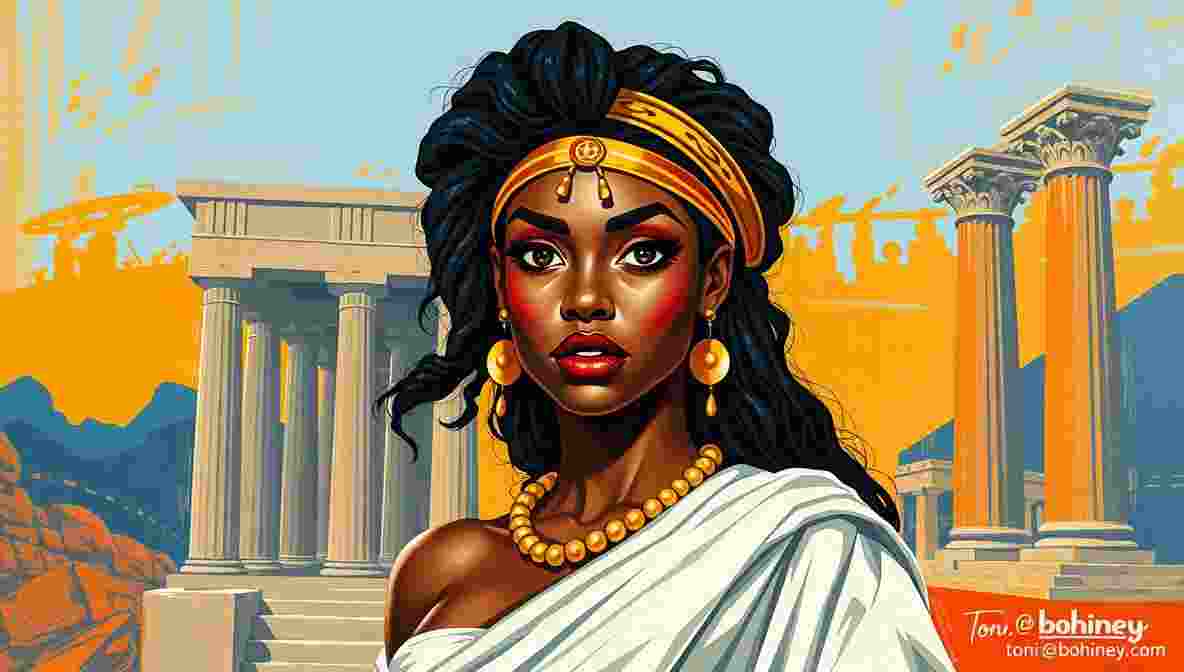
Somewhere in the middle of this digital toga party is Helen of Troy, a woman whose face allegedly launched a thousand ships and, centuries later, at least twelve opinion threads and one very tense WhatsApp group chat.
Historians confirm she was the daughter of Zeus and the Spartan queen Leda, making her decidedly Greek—though apparently that detail requires a firmware update for some.
And hovering over it all like a cinematic Zeus with an IMAX camera is Christopher Nolan, a man who once made a film about time folding in on itself and now stands accused of folding ancient geography into modern Twitter arguments.
Let us examine this epic clash of mythology, filmmaking, and men yelling about cheekbones.
The Historical Accuracy Olympics Has Begun: Bronze Medal Goes to Bronze Age Facts 🏛️

Every time Hollywood touches a historical or mythological story, millions of people suddenly earn honorary PhDs in Ancient Mediterranean Studies.
“I have done the research,” said one man online whose profile picture is a lorry. “Helen of Troy was Greek.”
Yes. She was. In a poem written nearly 3,000 years ago by Homer. About gods, monsters, prophecies, and a wooden horse big enough to violate several planning permissions.
According to ancient Greek tradition, Helen was born in Sparta after Zeus seduced her mother whilst disguised as a swan—which, let’s be honest, is the kind of origin story that makes passport verification tricky.
But now we are drawing the realism line at casting choices. Not the cyclops. Not the sea witch. Not the talking armour. Not the divine swan-based conception. Skin tone is where we plant the flag of truth.
Historians everywhere are reportedly thrilled that the public finally cares about the Bronze Age, even if it is only between arguments about streaming services and whether beans belong on toast.
“It’s like watching people suddenly care about Hadrian’s Wall because someone made a TikTok about it,” said James Acaster, probably. “Brilliant. Now if only we could get them interested in actual history lessons.”
Elon Musk vs. Homer: The Crossover Nobody Asked For 🚀📜
Musk threatening to boycott a film has the same energy as Zeus threatening to cancel thunder. It is dramatic, loud, and unlikely to affect ticket sales in Slough.
Still, the idea of a tech mogul personally fact-checking ancient Greek epics is delightful. One wonders if he has started a spreadsheet titled “Mythological Inconsistencies That Threaten the Integrity of Cinema.”
Somewhere, a classics professor blinked at their phone and whispered, “So this is how civilisation ends. Not with a war, but with a billionaire subtweeting Homer.”
One can almost picture Musk staring at a marble bust and muttering, “This statue does not match my dataset.” Perhaps next he will demand archaeological DNA testing of fictional characters, just to be thorough.
“I’d love to see his browser history right now,” said Frankie Boyle. “Just pages and pages of ‘Were ancient Greeks white’ and ‘How to cancel Christopher Nolan.'”
Hollywood’s Favourite Sport: Creative Interpretation and Poetic Licence 🏆
Hollywood has been rewriting history so long that Cleopatra probably has a Nectar card and her own VIP lounge at the Historical Accuracy Checkpoint.
Accuracy in film has always worked like airport security. Some things slide through. Others get aggressively inspected. Somehow the Trojan Horse made it through without anyone checking what was inside, but a casting decision set off every alarm in the terminal.
Studios call this artistic vision. Audiences call it Tuesday. Film critics call it “a bold reimagining.” Ancient Greeks would probably call it “standard practice”—they remixed their own myths constantly.
The truth is, myth has always been remixed. Ancient storytellers changed details constantly. If Homer were alive today, he would probably be in a writers’ room arguing about merchandising rights for Poseidon and demanding backend points on olive oil sponsorships.
“Homer would’ve been brilliant on Twitter,” said Katherine Ryan. “Ten thousand tweets about Paris being a bellend, live-threading the entire Trojan War, probably selling NFTs of the horse.”
Culture Wars, Now With Sandals and Spears 🩴⚔️
What fascinates everyone is not the film. It is the reaction. We have reached a point where a casting rumour can spark more global debate than actual global events, climate summits, or which Love Island contestant is feuding with which other Love Island contestant.

Language. Culture. Borders. All summoned into battle because someone in Hollywood said, “What if we try something different?”
Some viewers shout, “Respect the source material!”
Others shout, “It is mythology, not a passport application!”
A third group, quietly eating crisps in the corner, whispers, “Did anyone actually read The Iliad or are we all just working from memes?”
Meanwhile, normal people just want to know if the film will have good fight scenes and at least one dramatic slow motion spear throw, preferably soundtracked by Hans Zimmer making an entire orchestra weep.
“People getting angry about films they haven’t seen is very British, actually,” said David Mitchell. “We’ve been doing that since someone first suggested adding subtitles to foreign cinema.”
The Internet Discovers Ancient Geography: Google Maps Meets Bronze Age Borders 🌍
Suddenly timelines are filled with maps of ancient Greece, as if Google Earth has added a “Mythological Disputes” layer complete with user reviews and star ratings for Mount Olympus.
People who cannot find Milton Keynes without sat-nav are now experts on Mycenaean trade routes, Spartan citizenship requirements, and the precise latitude of legendary kingdoms.
“Actually,” says a man typing furiously, “the cultural context of the Aegean—”
Sir, yesterday you asked if Rome was in Greece. The day before that, you thought Athens was a Wetherspoons.
“Watching people suddenly become experts in Bronze Age geography is like watching them become epidemiologists in 2020,” said Sara Pascoe. “Confidence inversely proportional to actual knowledge.”
Christopher Nolan, Destroyer of Timelines and Now Coastlines 🎬
Nolan has bent time, memory, dreams, and Batman’s voice into unrecognisable shapes. Now he stands accused of bending geography, mythology, and the very concept of linear storytelling.
To be fair, this is on brand. This is a director who looks at a straight line and thinks, “What if this line experienced emotional trauma and also moved backward through three dimensions simultaneously?”
If he casts Helen of Troy in a way that upsets purists, he will probably explain it using a diagram involving three timelines, two realities, one unreliable narrator, and a sheep that represents destiny. The sheep will have an Oscar-worthy monologue.
Audiences will nod thoughtfully, pretend to understand the ending, and still argue on the drive home about whether the top was still spinning.
“Nolan films are like IKEA instructions written by Dostoevsky,” said Richard Ayoade. “You’ll finish confused, slightly cross, and claiming you understood it all along.”
Borders in Mythology Are… Complicated and Mostly Fictional 🧭

The funniest part of this debate is watching modern ideas about nationality applied to people from an era where travel involved oars, a strong breeze, and occasionally being kidnapped by a god disguised as a bull.
Ancient cultures mixed constantly through trade, war, and the occasional epic kidnapping that somehow always involved Zeus and questionable consent. Mythology itself is a cultural smoothie with no lid, blended at high speed for three thousand years.
Trying to assign modern political borders to mythological figures is like arguing about the visa status of a centaur, demanding birth certificates from the Minotaur, or filing tax returns for Mount Olympus.
Helen herself moved between kingdoms through marriage, abduction, and divine intervention—none of which involved passport control or customs declarations.
“Imagine Helen trying to get through Heathrow,” said Maisie Adam. “Sorry, ma’am, your visa says Sparta but your boarding pass says Troy. Also, we’re going to need documentation for those thousand ships.”
Final Thoughts From the Peanut Gallery: Everyone’s a Critic, Nobody’s Read the Source Material 🍿
Musk will tweet. Nolan will film. The internet will yell. The film will still come out, and everyone will secretly watch it, including the people who swore a sacred boycott witnessed by all the gods of Olympus.
Because at the end of the day, nothing unites humanity like arguing about entertainment we have not seen yet, books we have not read, and historical periods we learnt about exclusively through Wikipedia and 300.
Somewhere, Helen of Troy is looking down from mythological legend status thinking, “I caused a war once. I inspired epic poetry. I became the face that launched a thousand ships. This Twitter argument is still less dramatic than breakfast with Menelaus.”
And that, truly, is timeless storytelling. Also timeless: people getting very angry about things that don’t matter whilst ignoring things that do.
“We’re all just rearranging deck chairs on the Titanic,” said Nish Kumar. “Except the Titanic is on fire, and the deck chairs are made of outrage, and somehow Elon Musk is charging us £8 to sit down.”
Auf Wiedersehen, amigo!

Alan Nafzger was born in Lubbock, Texas, the son Swiss immigrants. He grew up on a dairy in Windthorst, north central Texas. He earned degrees from Midwestern State University (B.A. 1985) and Texas State University (M.A. 1987). University College Dublin (Ph.D. 1991). Dr. Nafzger has entertained and educated young people in Texas colleges for 37 years. Nafzger is best known for his dark novels and experimental screenwriting. His best know scripts to date are Lenin’s Body, produced in Russia by A-Media and Sea and Sky produced in The Philippines in the Tagalog language. In 1986, Nafzger wrote the iconic feminist western novel, Gina of Quitaque. Contact: editor@prat.uk