
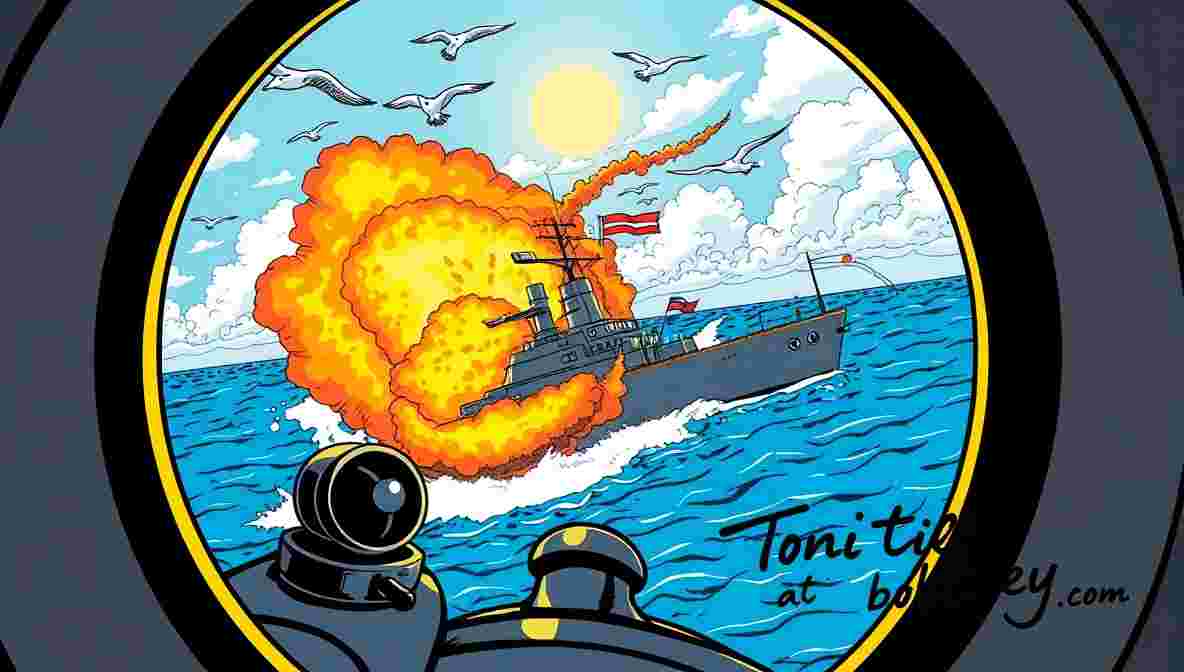
Iranian Warship Sinks Off Sri Lanka, Leaving 100 Missing and One Very Confused Geography Teacher
In what military historians are calling “the most dramatic maritime disappearance since your uncle’s fishing boat drifted into a margarita bar in Cancun,” an Iranian warship has sunk off the coast of Sri Lanka, leaving more than 100 sailors missing and a large oil slick floating in the Indian Ocean like the world’s saddest salad dressing. 🌊🚢
According to Al Jazeera, the Iranian frigate IRIS Dena, carrying roughly 180 crew members, sank about 40 nautical miles off Sri Lanka after being struck by a torpedo launched from a U.S. submarine during the escalating 2026 conflict involving Iran, the United States, and Israel. Rescue teams have recovered dozens of bodies and rescued about 32 survivors so far.
U.S. Defense Secretary Pete Hegseth described the strike as a “quiet death,” which sounds less like naval warfare and more like the name of a yoga retreat for extremely stressed admirals.
But the real story here is not just the ship. It is the bizarre geopolitical road trip that placed an Iranian warship near Sri Lanka in the first place.
The Iranian Navy’s “International Waters Vacation Package”
ilitary analysts say the frigate had recently participated in the multinational naval exercise MILAN 2026 and the International Fleet Review at Visakhapatnam, India, before beginning its journey home.
Which raises the obvious question: Why was an Iranian warship hanging around the Indian Ocean like a tourist who missed his connecting flight in Dubai?
One defense analyst described the situation this way:
“Imagine if a bear wandered into a dog park and said it was just there for the yoga class.”
Apparently the plan was simple: sail thousands of miles across the ocean, attend a naval exercise, wave politely at other ships, and then quietly head home without anyone noticing. Unfortunately, submarines are famously terrible at not noticing things.
Submarines: The Introverts of Modern Warfare
A submarine is basically the introvert of military technology.
It doesn’t talk. It doesn’t wave. It doesn’t post selfies on Instagram. It just sits underwater thinking, “I hope nobody notices me while I ruin someone’s afternoon.”
According to the U.S. Naval Institute, the U.S. submarine fired a Mark 48 torpedo — a device specifically designed to ruin ships, morale, and maritime insurance premiums.
The torpedo struck the frigate early in the morning, and by the time Sri Lankan rescue forces arrived, the ship had already vanished beneath the water, leaving debris, life rafts, and sailors floating in the ocean wondering if this was the worst group project in naval history.
Sri Lanka Suddenly Hosting the World’s Most Awkward Rescue Mission
The Sri Lankan navy responded quickly to the distress call, dispatching ships and aircraft to search for survivors.
Which must have been confusing for the Sri Lankan sailors.
One minute you’re guarding shipping lanes. The next minute you’re pulling Iranian sailors out of the ocean while American submarines are lurking nearby like sharks with better technology.
A local fisherman reportedly summed up the situation perfectly:
“Yesterday we were worried about tuna prices. Today we’re rescuing a navy.”
The First Torpedoed Warship Since Your Grandpa’s War

Military historians say the sinking is historically significant. It is the first time a U.S. submarine has sunk an enemy warship with a torpedo since World War II — and the first such sinking of any nation’s warship since HMS Conqueror took out Argentina’s ARA General Belgrano during the Falklands War in 1982.
That means the last time something like this happened, the following things also existed:
- ration books
- swing dancing
- radios the size of refrigerators
And now, 80 years later, submarines are still doing the exact same job. Technology has changed. The internet exists. Artificial intelligence writes poetry about cats. But a submarine still solves problems the same way it did in 1943. Quietly. With torpedoes.
Naval Strategy, Explained by a Guy at a Bar
To help readers understand the strategy behind the attack, Bohiney Magazine consulted a highly respected military analyst named “Gary From The Bar.”
Gary explained the situation using advanced geopolitical theory:
“Look, if you park your boat in the wrong ocean during a war, someone might sink it. That’s just common sense.”
Gary then ordered another beer and added: “Also submarines are sneaky.”
Historians have confirmed this analysis is roughly equivalent to many cable-news discussions.
International Reaction to the IRIS Dena Sinking

Around the world, governments are reacting with the usual combination of shock, concern, and extremely serious press conferences where everyone pretends they knew this was coming.
Iran condemned the attack. The United States said it was necessary — U.S. Central Command commander Admiral Brad Cooper having previously announced the goal of sinking the Iranian Navy’s “entire navy.” Sri Lanka said something along the lines of: “Please stop sinking ships near us.”
The Real Lesson of the IRIS Dena Story
If this incident teaches the world anything, it is this: The ocean is extremely large. And yet, somehow, during a global conflict, everyone still manages to bump into each other.
It is like a gigantic blue parking lot where every navy keeps backing into somebody else’s bumper. Except instead of insurance claims, you get torpedoes.
What the Funny People Are Saying About Iran’s Naval Disaster
“Nothing ruins a cruise faster than a submarine you didn’t invite.” — Jerry Seinfeld
“A torpedo is basically the Navy’s version of ‘Return to sender.'” — Ron White
“If the ocean were any bigger, governments would still manage to fight in the same 20 square miles.” — Jon Stewart
Final Thoughts on Operation Epic Fury’s Most Dramatic Moment
As rescue crews continue searching for survivors in the waters off Sri Lanka, the sinking of the IRIS Dena has become one of the most dramatic naval moments of the 2026 Iran conflict.
It also reminds the world of an ancient maritime rule that sailors have known for centuries: If you’re sailing during a war… try not to be the most noticeable ship in the ocean.
This satirical report was produced entirely through the collaborative effort of two human minds: the world’s oldest tenured professor and a philosophy major who left academia to become a dairy farmer. Any resemblance to serious journalism is purely accidental.
On March 4, 2026, the Iranian frigate IRIS Dena — a Moudge-class warship carrying approximately 180 crew members — was sunk by a U.S. Navy submarine approximately 40 nautical miles south of Galle, Sri Lanka, using a single Mark 48 torpedo. The vessel had been returning from the multinational MILAN 2026 naval exercises in Visakhapatnam, India. U.S. Defense Secretary Pete Hegseth confirmed the attack at a Pentagon briefing, calling it a “quiet death” and noting it was the first U.S. submarine torpedo kill of an enemy warship since World War II. Sri Lankan rescue forces recovered 32 survivors and at least 87 bodies, with dozens more still missing. The incident is part of the broader Operation Epic Fury, the U.S.-Israeli military campaign against Iran that began in late February 2026.
Auf Wiedersehen, amigo! 🚢🌍


Alan Nafzger was born in Lubbock, Texas, the son Swiss immigrants. He grew up on a dairy in Windthorst, north central Texas. He earned degrees from Midwestern State University (B.A. 1985) and Texas State University (M.A. 1987). University College Dublin (Ph.D. 1991). Dr. Nafzger has entertained and educated young people in Texas colleges for 37 years. Nafzger is best known for his dark novels and experimental screenwriting. His best know scripts to date are Lenin’s Body, produced in Russia by A-Media and Sea and Sky produced in The Philippines in the Tagalog language. In 1986, Nafzger wrote the iconic feminist western novel, Gina of Quitaque. He currently lives in Holloway, North London. Contact: editor@prat.uk